Advise And Advice Are Often Wrongly Used Interchangeably; Here Is The Difference
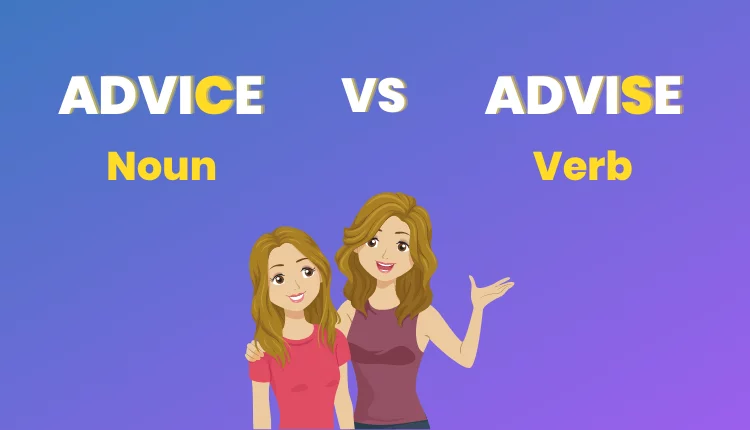
The main difference between advice and advise is that “advise” (with an S) is a verb, which means to recommend, or to give information to someone. On the other hand, “advice” (with a C) is a noun: an opinion or recommendation offered as a guide to action.
Read below how you can use them in a sentence.
Because “advice” and “advise” are words that sound alike or similar, they are often used interchangeably. Now, some tips on telling them apart.
READ ALSO: Where are the textbooks for basic schools? Stop destroying our children

Advice vs. Advise: the difference
Advice
Is a noun: to give counsel to; offer an opinion or suggestion as worth following. When spoken, it rhymes with ‘ice’ [s].

Advise
Is a verb: an opinion or recommendation offered as a guide to action, conduct, etc. When spoken, it rhymes with ‘realise’ [z].
Advice vs. Advise: the definitions
Advice

An opinion that someone offers you about what you should do or how you should act in a particular situation. It is an uncountable noun so we often use ‘piece’ to say ‘a piece of advice’.
Advise
The act of giving someone advice (recommending, advising, counselling).
Advice vs. Advise: the synonyms
Advice
Information, consultation, guidance, instruction, encouragement, suggestion, tip.
Advise
Counsel, recommend, caution, direct, encourage, instruct, preach, urge.
READ ALSO: Nigel Gaisie Describes The Way He First Saw God For The Very First Time
Advice vs. Advise: in a sentence
Advice
- It is best to get legal advice from your lawyer before you take any legal action.
- The blog gives good advice for first home buyers.
- My guidance counsellor gave me great advice when I was trying to decide if I should further my education after high school.
- We bought the house on our real estate manager’s advice.
Advise
- Mary advised me to stop taking the medicine, as it does more harm than good.
- Please advise her to stop smoking, as she refuses to listen to me.
- My teacher advised us to revise our subjects regularly.
- I advise my customers to sample the cookies before they buy them.
📊 Stakeholder Guidance & Contextual Analysis
As developments continue to unfold regarding Advise And Advice Are Often Wrongly Used Interchangeably; Here Is The Difference, educational administrators, teachers, and candidates across Ghana are advised to follow established guidelines. Aligning school operations with official Ghana Education Service (GES) circulars and Ministry directives remains essential for institutional coherence and academic planning.
Key Directives for Schools and Educators:
- Administrative Alignment: School management and district directorates should cross-check official announcements before adjusting operational schedules.
- Stakeholder Transparency: Maintain active communication channels across Parent-Teacher Associations (PTAs), teaching staff, and student bodies.
- Continuous Oversight: Stay updated on supplementary directives issued by authorized public education authorities.
Frequently Asked Questions (FAQ)
Q: How does this update impact academic calendars and school operations?
A: School administrators are advised to incorporate official directives into current term plans while awaiting further formal clarifications. Refer to official channels for exact timelines.
Q: Where can educators verify authentic announcements?
A: Notices can be verified through official Ministry of Education releases, GES headquarters circulars, or accredited national education portals like GhanaEducation.org.