
An external keyboard with Excel keyboard shortcuts is something that many users find to be useful for increasing productivity.
Keyboard shortcuts are an indispensable replacement for mice for people with eyesight or movement impairments. They can also be simpler to use than touchscreens.
This article describes the keyboard shortcuts, function keys, and some other common shortcut keys in Excel for Windows.
EXCEL IN YOUR EXAMS
Get instant access to the most reliable Mocks and Marking Schemes.
BUY TOP 2026 BECE MOCKS AND ANSWERSNotes:
- To quickly find a shortcut in this article, you can use the Search. Press Ctrl+F, and then type your search words.
- If an action that you use often does not have a shortcut key, you can record a macro to create one. For instructions, go to Automate tasks with the Macro Recorder.
For those who do computer work.
Ctrl + E – Select All
Ctrl + N – Black
Ctrl + C – Copy
Ctrl + D – Refill
Ctrl + B – Search
Ctrl + G – Save
Ctrl + L – Replace
Ctrl + K – Italian
Ctrl+U – new workbook
Ctrl + A – Open
Ctrl + P – Print
Ctrl + R – Nothing Right
Ctrl + S – Underlined
Ctrl + V – Hit
Ctrl W – Close
Ctrl + X – Cut
Ctrl + Y – repeat
Ctrl + Z – Undresser
F1 – Help
F2 – Edition
F3 – Stick the name
F4 – Repeat the last action.
F4 – When entering a formula, switch between absolute / relative references
F5 – Go to
F6 – Next panel
F7 – Spelling Checker
F8 – widen the mode.
F9 – Recalculate all books
F10 – Activate the menu bar
F11 – New Graphics
F12 – Save as
Ctrl +:- Insert the current time
Ctrl +; – Insert the current date.
Ctrl + “- Copy the value of the upper cell
Ctrl + ‘- Copy the formula from above cell
Change – Compensation adjustment for additional functions in Excel Menu
Shift + F1 – What is it?
Shift + F2 – Edit cell comment
Shift + F3 – Stick the function in the formula
Shift + F4 – Seek Next
May + F5 – Seek
Mayus + F6 – Front Panel
Mayus + F8 – Add to selection
Shift + F9 – Calculate the active spreadsheet
Shift + F10 – Pop-Up Menu Display
Shift + F11 – New Spreadsheet
May + F12 – Save
Ctrl + F3 – Set name
Ctrl + F4 – Close
Ctrl + F5 – XL, size of restoration window
Ctrl + F6 – Next Workbook Window
Shift + Ctrl + F6 – Previous Workbook Window
Ctrl + F7 – Move window
Ctrl + F8 – Resize a window
Ctrl + F9 – Minimize the Workbook
Ctrl + F10 – Maximize or Restore Window
Ctrl + F11 – Insert 4.0 macro sheet
Ctrl + F1 – Open archive
Alt + F1 – Insert Graph
Alt + F2 – Save As
Alt + F4 – Exit
Alt + F8 – Macro Dialogue Box
Alt + F11 – Basic Visual Editor
Old + 64 – @
CTRL + Esc. You can quickly go back to the home screen. And here nothing happened.
Ctrl + Shift + F3 – Create a name using the names of row and column labels
Ctrl + Shift + F6 – Front Window
Ctrl + Shift + F12 – Printing
Alt + Shift + F1 – New Spreadsheet
Alt + Shift + F2 – Save
Old + = – AutoSum
Ctrl + ` – Change value / formula display
Ctrl+Shift+A – Insert names of arguments in the formula
Alt + down arrow – auto view list
Alt +’ – Style Dialogue Format
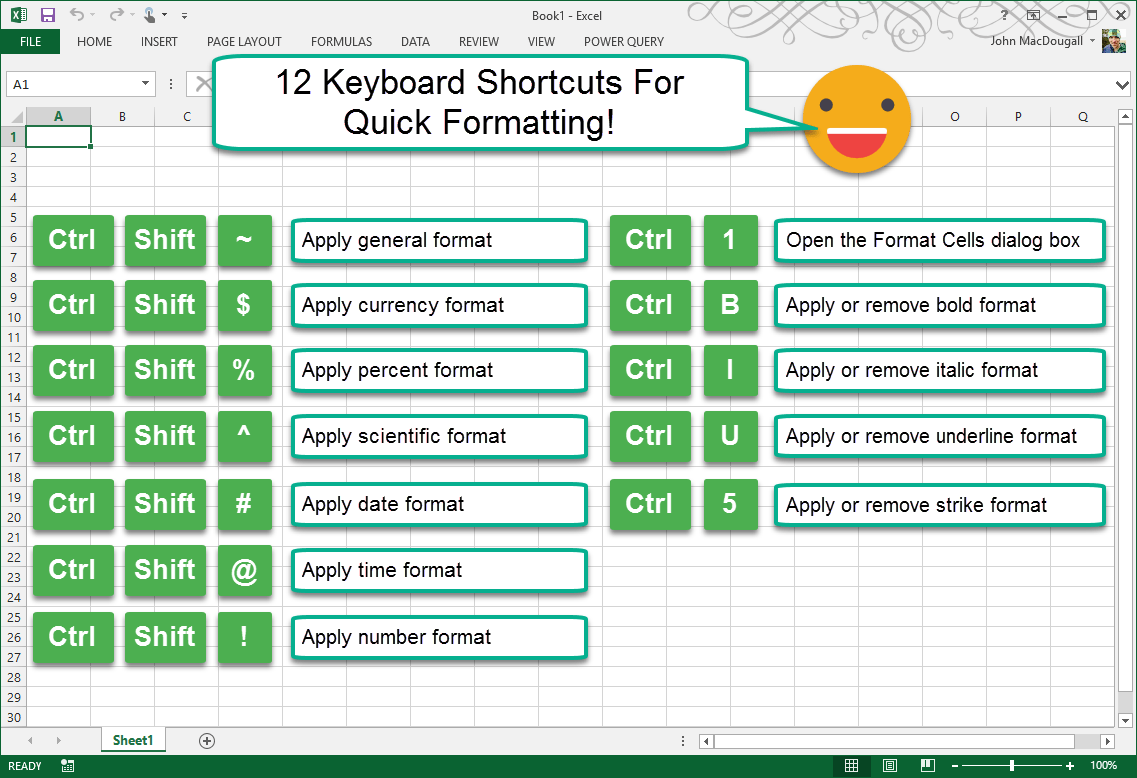
Ctrl + Shift + ~ – General Format
Ctrl + Shift +! – Coma Format
Ctrl + Shift +@ – Hour Format
Ctrl + Shift + # – Date Format
Ctrl + Shift + $ – Coin Format
Ctrl + Shift +% – Percentage Format
Ctrl + Shift +^ – Exponential Format
Ctrl + Shift + & – Place the outline edge around the selected cells
Ctrl+Shift+_ – Remove Edge Outline
Ctrl + Shift +* – Select current region
Ctrl ++ – Insert
Ctrl + – – Remove
Ctrl+1 Cell Dialog Format
Ctrl + 2 – Black
Ctrl + 3 – cursive
Ctrl + 4 – Underlined
Ctrl + 5 – Tinted
Ctrl+6 – Show/Hide objects
Ctrl+7 – Show/Hide Standard Toolbar
Ctrl+8 – Swap Symbols
Ctrl+9 – Hide lines
Ctrl + 0 – Hide columns
Ctrl + Shift + (- Show Lines)
Ctrl + Shift +) – Show columns
Alt or F10 – Activate menu
Ctrl + Tab – In the toolbar: Next toolbar
Shift + Ctrl + Tab – Over the Toolbar: Previous Toolbar
Ctrl + Tab – In a book: activate the next book
Top + Ctrl + Tab – In a c arpeta: activate the previous folder
Token – Next tool
Mayus + Tabulator – Previous tool
Walk in – Place order
Major + Ctrl + F – Source Drop List
Mayus+Ctrl+F+F – Cell Dialog Frame Format Lash Source
Major + Ctrl + P – Knit Size Dropdown List.
Ribbon keyboard shortcuts
The ribbon groups related options on tabs. For example, on the Home tab, the Number group includes the Number Format option. Press the Alt key to display the ribbon shortcuts, called Key Tips, as letters in small images next to the tabs and options as shown in the image below.
CHEAP NON-EXPIRING DATA
Buy affordable data bundles that never expire. Reliable and Instant Delivery!
BUY CHEAP DATA NOW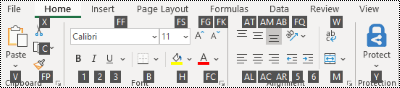
You can combine the Key Tips letters with the Alt key to make shortcuts called Access Keys for the ribbon options. For example, press Alt+H to open the Home tab, and Alt+Q to move to the Tell me or Search field. Press Alt again to see KeyTips for the options for the selected tab.
Depending on the version of Microsoft 365 you are using, the Search text field at the top of the app window might be called Tell Me instead. Both offer a largely similar experience, but some options and search results can vary.
In Office 2013 and Office 2010, most of the old Alt key menu shortcuts still work, too. However, you need to know the full shortcut. For example, press Alt, and then press one of the old menu keys, for example, E (Edit), V (View), I (Insert), and so on.
A notification pops up saying you’re using an access key from an earlier version of Microsoft 365. If you know the entire key sequence, go ahead, and use it. If you don’t know the sequence, press Esc and use Key Tips instead.
ALSO READ : January 2024 BECE Home Mock for JHS Students Starts 26th
Keyboard shortcuts for formatting cells
| To do this | Press |
|---|---|
| Open the Format Cells dialog box. | Ctrl+1 |
| Format fonts in the Format Cells dialog box. | Ctrl+Shift+F or Ctrl+Shift+P |
| Edit the active cell and put the insertion point at the end of its contents. Or, if editing is turned off for the cell, move the insertion point into the formula bar. If editing a formula, toggle Point mode off or on so you can use the arrow keys to create a reference. | F2 |
| Insert a note. Open and edit a cell note. | Shift+F2 Shift+F2 |
| Insert a threaded comment. Open and reply to a threaded comment. | Ctrl+Shift+F2 Ctrl+Shift+F2 |
| Open the Insert dialog box to insert blank cells. | Ctrl+Shift+Plus sign (+) |
| Open the Delete dialog box to delete selected cells. | Ctrl+Minus sign (-) |
| Enter the current time. | Ctrl+Shift+Colon (:) |
| Enter the current date. | Ctrl+Semicolon (;) |
| Switch between displaying cell values or formulas in the worksheet. | Ctrl+Grave accent (`) |
| Copy a formula from the cell above the active cell into the cell or the formula bar. | Ctrl+Apostrophe (‘) |
| Move the selected cells. | Ctrl+X |
| Copy the selected cells. | Ctrl+C |
| Paste content at the insertion point, replacing any selection. | Ctrl+V |
| Open the Paste Special dialog box. | Ctrl+Alt+V |
| Italicize text or remove italic formatting. | Ctrl+I or Ctrl+3 |
| Bold text or remove bold formatting. | Ctrl+B or Ctrl+2 |
| Underline text or remove underline. | Ctrl+U or Ctrl+4 |
| Apply or remove strikethrough formatting. | Ctrl+5 |
| Switch between hiding objects, displaying objects, and displaying placeholders for objects. | Ctrl+6 |
| Apply an outline border to the selected cells. | Ctrl+Shift+Ampersand sign (&) |
| Remove the outline border from the selected cells. | Ctrl+Shift+Underscore (_) |
| Display or hide the outline symbols. | Ctrl+8 |
| Use the Fill Down command to copy the contents and format of the topmost cell of a selected range into the cells below. | Ctrl+D |
| Apply the General number format. | Ctrl+Shift+Tilde sign (~) |
| Apply the Currency format with two decimal places (negative numbers in parentheses). | Ctrl+Shift+Dollar sign ($) |
| Apply the Percentage format with no decimal places. | Ctrl+Shift+Percent sign (%) |
| Apply the Scientific number format with two decimal places. | Ctrl+Shift+Caret sign (^) |
| Apply the Date format with the day, month, and year. | Ctrl+Shift+Number sign (#) |
| Apply the Time format with the hour and minute, and AM or PM. | Ctrl+Shift+At sign (@) |
| Apply the Number format with two decimal places, thousands separator, and minus sign (-) for negative values. | Ctrl+Shift+Exclamation point (!) |
| Open the Insert hyperlink dialog box. | Ctrl+K |
| Check spelling in the active worksheet or selected range. | F7 |
| Display the Quick Analysis options for selected cells that contain data. | Ctrl+Q |
| Display the Create Table dialog box. | Ctrl+L or Ctrl+T |
| Open the Workbook Statistics dialog box. | Ctrl+Shift+G |
Keyboard shortcuts in the Paste Special dialog box in Excel 2013
In Excel 2013, you can paste a specific aspect of the copied data like its formatting or value using the Paste Special options. After you’ve copied the data, press Ctrl+Alt+V, or Alt+E+S to open the Paste Special dialog box.

Tip: You can also select Home > Paste > Paste Special.
To pick an option in the dialog box, press the underlined letter for that option. For example, press the letter C to pick the Comments option.
| To do this | Press |
|---|---|
| Paste all cell contents and formatting. | A |
| Paste only the formulas as entered in the formula bar. | F |
| Paste only the values (not the formulas). | V |
| Paste only the copied formatting. | T |
| Paste only comments and notes attached to the cell. | C |
| Paste only the data validation settings from copied cells. | N |
| Paste all cell contents and formatting from copied cells. | H |
| Paste all cell contents without borders. | X |
| Paste only column widths from copied cells. | W |
| Paste only formulas and number formats from copied cells. | R |
| Paste only the values (not formulas) and number formats from copied cells. | U |
Keyboard shortcuts for making selections and performing actions
| To do this | Press |
|---|---|
| Select the entire worksheet. | Ctrl+A or Ctrl+Shift+Spacebar |
| Select the current and next sheet in a workbook. | Ctrl+Shift+Page down |
| Select the current and previous sheet in a workbook. | Ctrl+Shift+Page up |
| Extend the selection of cells by one cell. | Shift+Arrow key |
| Extend the selection of cells to the last nonblank cell in the same column or row as the active cell, or if the next cell is blank, to the next nonblank cell. | Ctrl+Shift+Arrow key |
| Turn extend mode on and use the arrow keys to extend a selection. Press again to turn off. | F8 |
| Add a non-adjacent cell or range to a selection of cells by using the arrow keys. | Shift+F8 |
| Start a new line in the same cell. | Alt+Enter |
| Fill the selected cell range with the current entry. | Ctrl+Enter |
| Complete a cell entry and select the cell above. | Shift+Enter |
| Select an entire column in a worksheet. | Ctrl+Spacebar |
| Select an entire row in a worksheet. | Shift+Spacebar |
| Select all objects on a worksheet when an object is selected. | Ctrl+Shift+Spacebar |
| Extend the selection of cells to the beginning of the worksheet. | Ctrl+Shift+Home |
| Select the current region if the worksheet contains data. Press a second time to select the current region and its summary rows. Press a third time to select the entire worksheet. | Ctrl+A or Ctrl+Shift+Spacebar |
| Select the current region around the active cell. | Ctrl+Shift+Asterisk sign (*) |
| Select the first command on the menu when a menu or submenu is visible. | Home |
| Repeat the last command or action, if possible. | Ctrl+Y |
| Undo the last action. | Ctrl+Z |
| Expand grouped rows or columns. | While hovering over the collapsed items, press and hold the Shift key and scroll down. |
| Collapse grouped rows or columns. | While hovering over the expanded items, press and hold the Shift key and scroll up. |
Keyboard shortcuts for working with data, functions, and the formula bar
| To do this | Press |
|---|---|
| Turn on or off tooltips for checking formulas directly in the formula bar or in the cell you’re editing. | Ctrl+Alt+P |
| Edit the active cell and put the insertion point at the end of its contents. Or, if editing is turned off for the cell, move the insertion point into the formula bar. If editing a formula, toggle Point mode off or on so you can use the arrow keys to create a reference. | F2 |
| Expand or collapse the formula bar. | Ctrl+Shift+U |
| Cancel an entry in the cell or formula bar. | Esc |
| Complete an entry in the formula bar and select the cell below. | Enter |
| Move the cursor to the end of the text when in the formula bar. | Ctrl+End |
| Select all text in the formula bar from the cursor position to the end. | Ctrl+Shift+End |
| Calculate all worksheets in all open workbooks. | F9 |
| Calculate the active worksheet. | Shift+F9 |
| Calculate all worksheets in all open workbooks, regardless of whether they have changed since the last calculation. | Ctrl+Alt+F9 |
| Check dependent formulas, and then calculate all cells in all open workbooks, including cells not marked as needing to be calculated. | Ctrl+Alt+Shift+F9 |
| Display the menu or message for an Error Checking button. | Alt+Shift+F10 |
| Display the Function Arguments dialog box when the insertion point is to the right of a function name in a formula. | Ctrl+A |
| Insert argument names and parentheses when the insertion point is to the right of a function name in a formula. | Ctrl+Shift+A |
| Insert the AutoSum formula | Alt+Equal sign ( = ) |
| Invoke Flash Fill to automatically recognize patterns in adjacent columns and fill the current column | Ctrl+E |
| Cycle through all combinations of absolute and relative references in a formula if a cell reference or range is selected. | F4 |
| Insert a function. | Shift+F3 |
| Copy the value from the cell above the active cell into the cell or the formula bar. | Ctrl+Shift+Straight quotation mark (“) |
| Create an embedded chart of the data in the current range. | Alt+F1 |
| Create a chart of the data in the current range in a separate Chart sheet. | F11 |
| Define a name to use in references. | Alt+M, M, D |
| Paste a name from the Paste Name dialog box (if names have been defined in the workbook). | F3 |
| Move to the first field in the next record of a data form. | Enter |
| Create, run, edit, or delete a macro. | Alt+F8 |
| Open the Microsoft Visual Basic For Applications Editor. | Alt+F11 |
| Open the Power Query Editor | Alt+F12 |
Keyboard shortcuts for refreshing external data
Use the following keys to refresh data from external data sources.
| To do this | Press |
|---|---|
| Stop a refresh operation. | Esc |
| Refresh data in the current worksheet. | Ctrl+F5 |
| Refresh all data in the workbook. | Ctrl+Alt+F5 |
ALSO READ: Take the GTLE Online Test 3: Ghana Teacher Licensure Examination (Essential skills)
Power Pivot keyboard shortcuts
Use the following keyboard shortcuts with Power Pivot in Microsoft 365, Excel 2019, Excel 2016, and Excel 2013.
| To do this | Press |
|---|---|
| Open the context menu for the selected cell, column, or row. | Shift+F10 |
| Select the entire table. | Ctrl+A |
| Copy selected data. | Ctrl+C |
| Delete the table. | Ctrl+D |
| Move the table. | Ctrl+M |
| Rename the table. | Ctrl+R |
| Save the file. | Ctrl+S |
| Redo the last action. | Ctrl+Y |
| Undo the last action. | Ctrl+Z |
| Select the current column. | Ctrl+Spacebar |
| Select the current row. | Shift+Spacebar |
| Select all cells from the current location to the last cell of the column. | Shift+Page down |
| Select all cells from the current location to the first cell of the column. | Shift+Page up |
| Select all cells from the current location to the last cell of the row. | Shift+End |
| Select all cells from the current location to the first cell of the row. | Shift+Home |
| Move to the previous table. | Ctrl+Page up |
| Move to the next table. | Ctrl+Page down |
| Move to the first cell in the upper-left corner of selected table. | Ctrl+Home |
| Move to the last cell in the lower-right corner of selected table. | Ctrl+End |
| Move to the first cell of the selected row. | Ctrl+Left arrow key |
| Move to the last cell of the selected row. | Ctrl+Right arrow key |
| Move to the first cell of the selected column. | Ctrl+Up arrow key |
| Move to the last cell of selected column. | Ctrl+Down arrow key |
| Close a dialog box or cancel a process, such as a paste operation. | Ctrl+Esc |
| Open the AutoFilter Menu dialog box. | Alt+Down arrow key |
| Open the Go To dialog box. | F5 |
| Recalculate all formulas in the Power Pivot window. For more information, see Recalculate Formulas in Power Pivot. | F9 |
MORE STORIES: NTC Registration For 2024 Ghana Teacher Licensure Examination
Function keys
| Key | Description |
|---|---|
| F1 |
|
| F2 |
|
| F3 |
|
| F4 |
|
| F5 |
|
| F6 |
|
| F7 |
|
| F8 |
|
| F9 |
|
| F10 |
|
| F11 |
|
| F12 |
|