Registration Opens: Join the 2026 BECE Home Mock to Secure Grade 1s JOIN NOW ×

What To Do After Checking 2025 School Placement

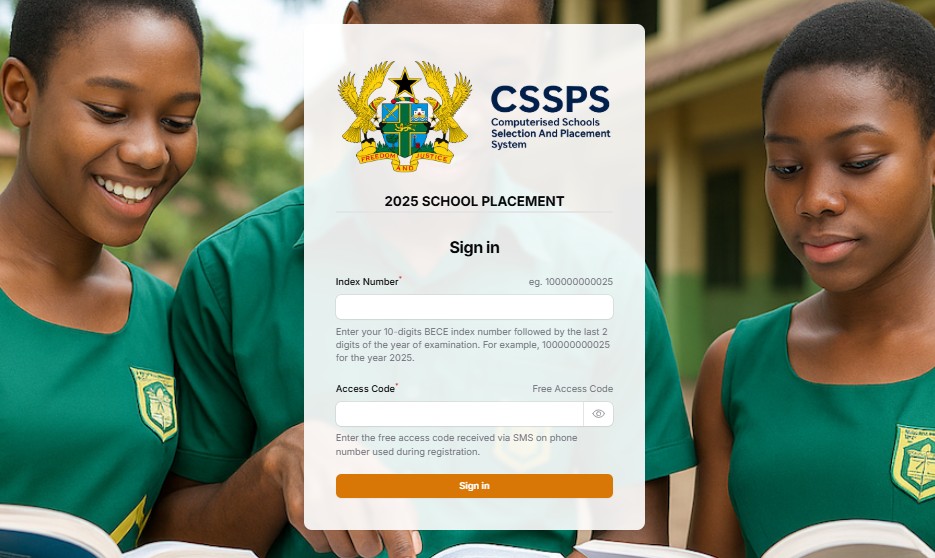
2025 school placement portal

After checking your 2025 school placement, there are steps to take to ensure the student gets enrolled for the SHS1. In this short information-based write-up, we provide parents and candidates some valuable suggestions for action. What to do after Checking 2025 School Placement from the CSSSP portal Many parents are asking themselves what to do … Read more

What is Self Placement Option of School Placement: All you need to know

Steps To SHS Self Placement Self Placement Option of School Placement : Free SHS Self Placement

What is Self Placement Option of School Placement? When the School placement status of BECE graduates is released, it comes with an option that requires candidates and parents to do a manual placement into a school of their choice. This often arises due to the failure of a candidate to be placed in one of the schools … Read more

Steps to verify GTLE Index Number, Teacher Licence, and GES Staff ID online

Steps to verify GTLE Index Number, Teacher Licence, and GES Staff ID online

As a teacher in Ghana today, you can now follow all the steps they need to verify their GTLE index number, teacher licence, and GES staff ID online without any difficulty if you follow the steps shared here.

Steps to verify the GTLE index number

For you to be able to verify the GTLE number., you must be a successful candidate for the GTLE.

To verify the GTLE index number, follow the steps below.

1. Go to the Teacher Portal Ghana.

2. On the homepage, scroll down to find GTLE.

3. Click on INDEX NUMBER VERIFICATION.

4. Key in your valid index number for the exam, which looks like GTLE/VR0011/410.

5. Click on the Search button.

Wait for the system to load the details, and check to be sure you have all your details accurately captured in the system.


READ: New GES Teachers’ Posting Requirements for 2024 And How To Verify Posting Eligibility

The details to look out for are as follows:

  • Your Name
  • The GTLE index number
  • Your GTLE Year Group
  • The college name (the one you completed)
  • College Index Number
  • The programme you studied while in college.

If all these are accurate, you are safe; however, if some of the details are not accurate, contact the NTC for support.


How to Search for Your GES Staff ID Online

To search for and confirm the GES staff ID, kindly follow these steps:

  1. Visit the TPG NTC Portal.
  2. Go to Regulatory Services on the portal.
  3. Click on Licenced Teacher Registration.
  4. Select your region and district.
  5. On this page, download the Licenced Teacher Register.

Steps for verifying any teacher licence in Ghana

Just follow the basic steps below to verify your teacher licence in Ghana:

  1. Visit the Teacher Portal Ghana
  2. Go to Regulatory Services.
  3. Click on Licenced Teacher Verification.
  4. On the new page that pops up, key in your teacher licence number (e.g., PT/00000/2023).
  5. Click on the search button and wait patiently for the details to load.

Once it has loaded the details per your search, check the following:

  • If the name is correct,
  • If the licence number is correct,
  • The date on which the licence will expire
  • Licence category

Just in case you cannot verify this, follow the steps below.

If you are unable to verify a staff ID or SSNIT data,

  1. Get your payslip, SSNIT ID, and scanned copy of your very first appointment letter to the official email: it@ntc.gov.gh
  2. In your email, you request a statement of professional standing.
  3. Note that this can take up to ten business days.
“GES teachers who cannot verify their Staff ID or SSNIT should send their payslip, SSNIT ID and scanned first appointment letter to it@ntc.gov.gh . Please note, requests for statement of professional standing are usually processed within ten business days”
Teacher Portal Ghana

How to get your missing WASSCE or BECE certificate back from WAEC

missing WASSCE or BECE certificate

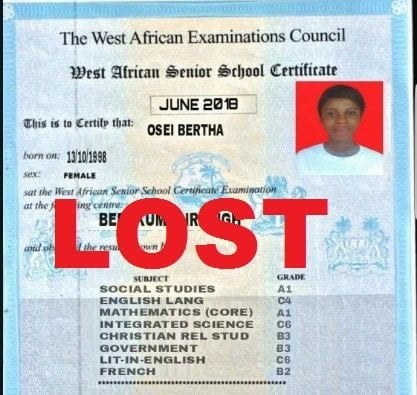
Do you know how to get your missing WASSCE or BECE certificate back from WAEC?  Many JHS and WASSCE graduates are unable to find their missing WASSCE or BECE results or certificates issued by WAEC. This is a sad situation to find yourself in when you need these official documents to further your education, travel, gain employment, enlist in the Ghana Army, Police, or any of the security services, or apply for important documents or services.

READ: Pass BECE Consultancy Services: Help your candidates prepare and pass BECE with Education-News Consult

Unfortunately, once you cannot find the missing WASSCE or BECE certificate, you cannot proceed with what you intend to do. Another sad reality is that the West African Examination Council does not issue a candidate the same certificate or result more than once. After the certificate or results have been sent to your school or examination centre, WAEC will not print that certificate again.

READ: 2024 BECE Social Studies Questions and Answers from Mock 2 (Question 1 & 2 – Case study questions)

However, there is a second window of opportunity that will help you get a valid replacement for the missing WASSCE or BECE certificate.

How to get your missing WASSCE or BECE certificate back from WAEC

To ensure students who sat for the BECE and WASSCE get a document of proof that they sat for the BECE, those who have misplaced their certificates can apply for WAEC’s Attestation of Results. 

WAEC has made it clear that “the West African Examinations Council does not issue duplicate certificates.”

The Council, however, now issues an Attestation of Results, which is as valid as the certificate. Users who wish could confirm the details on the document with the Council.

Attestations of results are issued to individual candidates or persons for their possession. The attestation must be collected personally by applicants from the offices of the Council in Accra or the regions. Currently, WAEC charges GH¢ 400.00 for the attestation of results. 

READ: Guide for Mastering Mathematics for BECE and WASSCE Students

READ: How To Retrieve Lost BECE And WASSCE Certificates

Getting your missing WASSCE or BECE certificate back demands that you provide the information below.

For the issuance of the attestation by WAEC, applicants will be required to provide the following details:

  1. Provide your name (in full, as used in the examination).
  2. The Name, Month, and Year of Examination
  3. Your index number
  4. Passport photograph.
  5. A valid identification document.

The information to be provided above will be entered on a form at the WAEC office. Ensure that you have all the requirements before going to the WAEC main office in Accra or its regional office near you for this service. Do not also forget to go along with the GH¢ 400.00 you need to register for the service.

Once you process the WAEC’s Attestation of Results form and make the payment, you will be told how long it will take for you to come for the attestation.

Make a photocopy of the proof of payment and any other document issued by WAEC. You are also advised to take a picture of the form you fill out, whether it is an online or offline form. These will serve as evidence if, for some reason, WAEC fails to provide you with the certificate.

I hope this post on how to get back your Missing WASSCE or BECE Certificate has been helpful.

How To Study Smart for Excellent WASSCE 2025 Results

Study Smart for Excellent Results Top 10 Study Hacks for Better Grades

Do You Know How To Study Smart for Excellent WASSCE 2025 Results? The West African Senior School Certificate Examination (WASSCE) is a major milestone in your academic life. Many students think that success depends on studying long hours. They believe more time equals better results. This is a mistake. The key to excellent WASSCE results is not studying harder. It is about studying smarter. Your performance in the WASSCE 2025 depends on your strategy.

Study Smart for Excellent Results

This guide will show you how to prepare for your examinations. It provides practical steps you can take starting today. Forget last-minute cramming. Let us focus on a clear plan that builds knowledge, confidence, and readiness. This approach will help you achieve the WASSCE results you want.

Know Your Syllabus and Past Questions

Your first step is to understand exactly what you need to study. The West African Examinations Council (WAEC) provides a syllabus for every subject. This document is your most important tool. It lists every topic that can appear on the exam. Do not rely only on your class notes. Get the official syllabus.

  • Break down the syllabus: For each subject, list all the topics and sub-topics.
  • Create a checklist: Use this list to track your progress. Tick off topics as you master them.
  • Analyse past questions: Gather WASSCE past questions from the last five to ten years. Look for topics that appear frequently. WAEC often repeats concepts.

A student we can call David prepared for his exam using only his textbook. He did not check the syllabus. On exam day, he saw questions on topics his textbook did not cover in detail. His friend, Sarah, had studied the syllabus and practiced with past questions. She knew these topics were important. Who do you think got better WASSCE results? Use the syllabus as your map and past questions as your compass.

Build a Realistic Study Timetable

Saying you will study is not a plan. A plan is a timetable. A good timetable brings discipline and ensures you cover all your subjects. It also prevents burnout. Studying for eight hours straight is less effective than studying in focused blocks.

Your brain needs breaks to process information. Use a method like the Pomodoro Technique. Study for a focused 25-minute period, then take a 5-minute break. After four sessions, take a longer break of 20-30 minutes.

Your timetable should include:

  • Specific study blocks: Assign subjects to definite times. For example, Mathematics from 4:00 PM to 5:00 PM on Monday.
  • A mix of subjects: Alternate between subjects you find difficult and those you find easier. This keeps your mind engaged.
  • Scheduled breaks: Time for rest is not wasted time. It is essential for learning.
  • Enough sleep: Plan for 7-8 hours of sleep each night.

Do you have a study timetable? Or do you just open a book when you feel guilty? A structured plan is the foundation for success.

Use Active Recall, Not Passive Review

How do you study? Do you read your notes over and over? This is passive review. It feels productive, but it is not. It creates a false sense of familiarity with the material. True learning comes from active recall. This means pulling information out of your brain.

Here are ways to practice active recall:

  • Solve problems: After studying a topic in Physics, find related questions and solve them without looking at your notes.
  • Explain it to someone: Try to teach a concept to a friend or family member. If you can explain it simply, you understand it deeply.
  • Use flashcards: Write a key term or question on one side of a card and the definition or answer on the other. Test yourself regularly.

Active recall is hard work. It forces your brain to build strong connections. This is how you move information from short-term to long-term memory. This is what you need on exam day.

Form an Effective Study Group

Studying with others can be very helpful if you do it right. A good study group keeps you motivated and exposes you to different ways of thinking. A bad study group is just a social club.

For your group to be effective, follow these rules:

  • Keep it small: A group of 3 to 5 members is ideal.
  • Set a clear agenda: Decide what topic you will cover before you meet.
  • Everyone must prepare: Each member should study the topic before the meeting.
  • Stay focused: The goal is to learn, not to gossip.

Consider assigning topics. For a meeting on Elective Maths, one person can teach the group about integration by parts. Another can explain partial fractions. This forces each member to achieve mastery.

Take Care of Your Health

You cannot achieve peak academic performance if you are not healthy. Your brain is part of your body. Sacrificing health for study time will lower your WASSCE results.

  • Sleep: When you sleep, your brain consolidates memory. A tired brain cannot learn or recall information well. Do not trade sleep for extra hours with your books.
  • Diet: Eat balanced meals. Avoid too much sugar and processed food, which can cause energy crashes. Drink plenty of water.
  • Exercise: A short walk, a run, or playing a sport can reduce stress and improve blood flow to your brain. This helps with concentration.

Are you fueling your body and brain for success? Or are you running on empty? Your physical health directly supports your mental sharpness.

Simulate Exam Conditions

You must practice how you will perform on the actual day. This means practicing under exam conditions to build stamina and manage your time.

Get a full past paper for a subject. Find a quiet room. Set a timer for the exact duration of the exam. Put your phone and notes away. Write the exam as if it were the real WASSCE. When the time is up, stop.

Next, get the official marking scheme and grade your paper honestly. Where did you lose marks? Was it from lack of knowledge or from careless mistakes? Did you run out of time? This exercise reveals your weaknesses. It gives you a chance to fix them before the main event.

READ: Why the BECE Cut-Off Point Must Return in 2025

Excellent WASSCE results are not a matter of luck. They are the product of smart, consistent, and strategic preparation. Use the syllabus. Create and follow a timetable. Practice active recall. Work with a focused group. Protect your health. Practice under real conditions. Take control of your WASSCE 2025 journey today. Master How To Study Smart for Excellent WASSCE 2025 Results

How to Apply for “No Free Stress” Reimbursement for First-Year University Students

Apply for No Free Stress

First-year university students in Ghana who gained admission into public tertiary institutions can now apply for the John Mahama “No Free Stress” Refund. The refund will be done directly into the bank accounts of the students who gained admission and enrolled onto programmes.

The refund aligns with the 2024 election campaign promise made by the then NDC presidential candidate, stating that if elected president, he would provide free semester one fees to all university students, ensuring that no student loses their chance to enrol in and access tertiary education.

Information reaching the Ghana Education News portal indicates that the government, through the Students Loan Trust Fund (SLTF), has initiated processes to reimburse the fees of all first-year students in public tertiary institutions. The government has therefore outlined the application procedure for all qualified students.

This is confirmed by a letter released via the SLTF portal on May 12, 2025, which states that the Students Loan Trust Fund is ready to reimburse students for their semester 1 academic user fees under the “No Free Stress” initiative. All qualified students in public tertiary institutions who apply for the refund and meet the basic requirements will receive their reimbursed funds from June 2025 under this policy.

Who Qualifies to Apply for the “No Free Stress” Benefits?

“NO FREE STRESS” APPLICATION PORTAL TERMS AND CONDITIONS

These terms and conditions govern the use of the “No Free Stress” Application Portal, which provides eligible students with access to financial support from the Government of Ghana through the Students Loan Trust Fund.

By using this portal, you acknowledge and certify that:

  • You are a first-year student pursuing an accredited program in a public tertiary institution in Ghana.
  • You will provide accurate and complete information during registration, including personal and academic details.
  • Your information will be shared with the National Identification Authority (NIA) for data verification purposes.
  • For disbursement purposes, you consent to the creation of a bank account with Ghana Commercial Bank (GCB) if you do not already have one.
  • You may be required to provide documentary evidence of the information provided in this application.

Data Protection

  • SLTF and its affiliates will handle your data with confidentiality and in accordance with applicable data protection laws.
  • We will implement robust security measures to protect your data from unauthorized access or breaches.
  • Your data will only be used for the purpose of processing your application and providing financial support through the intermediary bank.

General Provisions

  • These terms and conditions will be governed by and construed in accordance with the laws of Ghana.
  • SLTF reserves the right to amend these terms and conditions at any time, with or without notice.
  • Your access to the portal may be terminated if you provide false or misleading information, or if you fail to comply with these terms and conditions.

How to Contact the Students Loan Trust Fund If You Have Any Challenges

If you have any questions or concerns about these terms and conditions, please contact us at:

  • Tel: 0302 231 886/7, 0264 043 072
  • WhatsApp: 0504 021 579
  • Call Centre: 0302 751 020
  • Fax: 233 302 231 873
  • Email: info@sltf.gov.gh

How to Capture and Provide the Correct Ghana Card Details

All applicants are required to provide their valid Ghana Card Number and capture a selfie for NIA Verification.

  1. Ensure that your device camera is enabled to take a selfie for verification.
  2. Capture the selfie in a well-lit area.
  3. The selfie should show your full face in the space provided.
  4. Avoid shadows on your face or blurry pictures.
  5. Do not wear hats or dark glasses.

How to Apply for Your John Mahama “No Free Stress” Refund

Follow the steps below to apply for the refund.

All students should note that the approved web browser for the application is Google Chrome.

  1. Visit the website https://nofeesstress.sltf.gov.gh/ or https://sltf.gov.gh.
  2. On this portal, click on “Apply for NoFeesStress.”
  3. Enter your valid Ghana Card number.
  4. Verify your identity by clicking on “open camera” to take a selfie of your Ghana Card’s pages.
  5. Fill in your personal details, such as name, age, date of birth, phone number, email, etc.
  6. You will receive an OTP code, which you must confirm by entering it on the application portal.
  7. Enter your public institution details, such as the name of the institution, program of study, etc.
  8. Choose your bank name from the drop-down menu.
  9. Enter your correct bank account number. If you do not have an account, you must create one before proceeding with the application.
  10. Once the account number is submitted, check through the details and confirm they are accurate.
  11. Click “submit” to send your application for processing. This will send your information to the SLTF and the Ministry of Education for the processing of your “No Free Stress” refund.
  12. You can also download a copy of your application for your records.

READ: Empowering National Growth: Tertiary Institutions’ crucial role in TVET development

Parents, students, and persons in academi,a and the general public have welcomed the news about the No Free Stress Reimbursement announced, which will help refund fees paid by students and parents for level 100 students.

Transforming Customer Engagement Strategies

Transforming Customer Engagement Strategies

Customer engagement has evolved from traditional methods to a more dynamic, data-driven approach. Organizations now recognize that understanding customer needs, preferences, and behaviors is paramount to fostering strong relationships and ensuring long-term loyalty. This shift has prompted companies to explore innovative tools and techniques that can leverage customer interactions. Among these, conversation intelligence emerges as a game-changing solution.

Understanding Conversation Intelligence

Conversation intelligence refers to the technology that analyzes customer interactions, primarily through voice or text, to extract valuable insights. It uses artificial intelligence (AI) and natural language processing (NLP) to assess conversations, generating data that organizations can use to improve their engagement strategies. By tapping into these insights, companies can understand customer sentiments, identify trends, and refine their messaging.

The Role of AI in Customer Engagement

AI technologies have become integral to modern customer engagement strategies. By implementing machine learning algorithms, organizations can analyze vast amounts of conversational data more effectively than ever before. This not only enhances the quality of customer interactions but also provides a deeper understanding of customer pain points, preferences, and expectations.

For instance, AI-driven conversation intelligence can help businesses identify recurring issues in customer complaints, enabling proactive measures to be taken. Additionally, machine learning enables systems to learn from past interactions, allowing for tailored responses that resonate more with customers.

Enhancing the Customer Experience

At the heart of successful customer engagement lies an enhanced customer experience. By utilizing conversation intelligence, organizations can eliminate friction points in the customer journey. For example, sentiment analysis can help companies determine how customers feel about their products or services in real time.

This data can then be used to personalize interactions, leading to a more tailored approach for every customer. A customer who expresses frustration during a call can be quickly routed to a specialized representative trained to resolve such issues, improving their overall experience. Moreover, understanding the tone and emotional cues in conversations allows businesses to respond with empathy, a crucial element in building trust and rapport.

Driving Sales and Revenue

Customer engagement is not just about building relationships; it also directly impacts sales and revenue. By leveraging conversation intelligence, organizations can uncover insights that lead to upselling and cross-selling opportunities. For instance, if a customer mentions a specific need or interest during a conversation, sales representatives can capitalize on this information to recommend relevant products or services.

Additionally, analyzing conversations can provide valuable data on customer behavior and preferences, allowing businesses to refine their sales tactics. Understanding which messaging resonates best with customers can lead to more effective sales pitches and ultimately, increased conversion rates.

Empowering Customer Service Teams

Empowering customer service teams is essential for any organization focused on enhancing customer engagement. Conversation intelligence can provide these teams with the tools needed to improve their performance. By analyzing previous interactions, customer service representatives can better understand common customer issues and develop effective solutions.

Furthermore, training can be tailored based on real conversation data. By identifying where representatives may struggle, organizations can implement targeted coaching sessions that focus on improvement areas. This support not only enhances the skills of customer service teams but also leads to more efficient problem resolution, ultimately benefiting the customer.

Measuring Success with Data Analytics

One of the most significant advantages of conversation intelligence is its ability to measure success through data analytics. Organizations can track key performance indicators (KPIs) related to customer engagement, such as customer satisfaction scores, Net Promoter Scores (NPS), or average response times. This data becomes invaluable in assessing the effectiveness of engagement strategies and identifying areas for improvement.

Additionally, businesses can perform A/B testing on different engagement tactics to determine which approaches yield the highest customer satisfaction and conversion rates. By continuously analyzing and optimizing these strategies, organizations can stay ahead of market trends and customer expectations.

Integrating Conversation Intelligence with Existing Systems

To fully unlock the potential of conversation intelligence, organizations should consider integrating this technology with their existing systems. By doing so, they can create a seamless flow of information that enhances overall operational efficiency. For instance, integrating conversation intelligence with customer relationship management (CRM) software allows for a more comprehensive view of customer interactions.

READ: MTN Free Data & Talk Time for Customers Linking Ghana Card & SIM

This unified approach can lead to improved collaboration among departments, ensuring that marketing, sales, and customer service teams are aligned in their strategies. When all teams have access to the same insights, they can work together more effectively to create a cohesive customer journey.

Future Trends in Conversation Intelligence

As technology continues to advance, the future of conversation intelligence holds exciting possibilities. The integration of machine learning and AI will likely lead to even more sophisticated analytical capabilities, enabling organizations to gain deeper insights faster than ever before. Additionally, advancements in voice recognition technology may allow for more natural interactions, further enhancing the customer experience.

Moreover, as businesses increasingly recognize the importance of personalization, conversation intelligence will become a crucial component in delivering tailored experiences. Companies that invest in this technology will be well-positioned to understand their customers on a deeper level and respond to their needs effectively.

In conclusion, conversation intelligence is transforming customer engagement strategies by providing organizations with the insights needed to enhance the customer experience, drive sales, empower teams, and measure success effectively. By embracing this technology, companies can create a more dynamic and responsive approach to customer engagement, ultimately leading to stronger relationships and increased loyalty. As the landscape continues to evolve, those who harness the power of conversation intelligence will find themselves ahead of the curve in delivering exceptional customer experiences.

How to buy 2025 nursing training admission vouchers at GHS150

How to buy 2025 nursing training admission vouchers at GHS150 How to buy Nursing Training Form/Pin With Momo (HOT & SIMPLE)
The Ghana Health Service (GHS) has opened the portal for the sale and purchase of the 2025 Nursing Training admission voucher. The sale of the forms per the new directive will take place online via the admission portal. The form or voucher cost only GHS150.00, having been reduced from GHS250.00.
The general public is hereby informed that all qualified individuals who meet the admission requirements of health training institutions in Ghana can apply.  Since there are different nursing programmes and institutions, any applicant interested in applying to multiple nursing training colleges. However a separate application and payment of GHS150.00 must be made for each. Thus, if you want to apply to three different colleges and programmes, you must buy three different vouchers, which will add up to GHS150.00 x 3 = GHS450.00.

The admission process is designed to be simple, transparent, and efficient to help you focus on what matters – your healthcare education.

The application process is simple and can be completed in the shortest time possible. Applicants can also track in real time updates on their application status through the personalised admission application dashboard.

Let us take a look at the guide to buying 2025 Nursing Training admission vouchers at Ghs150 on admission portal.
How to pay & access 2025 Nursing Training admission application forms


All applicants must also know that payments for the form can be made via mobile money, Visa/MasterCard, and other integrated digital payment options.

1. Navigate to https://register.healthtraining.gov.gh

2. Click on make payment & Register

3.⁠ Read the instructions in RED LABEL and complete the form

4.⁠ ⁠Click on Pay GHS150

5.⁠ ⁠Select the payment method and input required details, Click Pay Now.

6.⁠ ⁠PIN & Serial number is sent to the registered email address & phone number

7.⁠ ⁠Click on continue and input pin and serial to access the form.


Now that you know the “How to buy 2025 nursing training admission vouchers at GHS150” let us look at the requirements, programmes and qualifications

ADMISSION REQUIREMENTS

NURSING PROGRAMMES

Entry Requirements

Post-Basic Programs:

    • A strict 2-year top-up program for diploma holders in general nursing in specialized fields such as:
      • Critical Care Nursing
      • Ophthalmic Nursing
      • ENT
      • Public Health Nursing
      • Peri-Operative Nursing etc.


BASIC PROGRAMMES (Diploma):

  1. Registered General Nursing (RGN)
  2. Registered Midwifery (RM)
  3. Public Health Nursing (PHN)
  4. Registered Mental Nursing (RMN)
  5. Registered Community Psychiatry Nursing (RCPN)

Entry Requirements for Ghanaian Nationals:

An Aggregate Score of thirty-six (36) or better comprising (A1 – C6) in three (3) Core Subjects i.e. ENGLISH, MATHEMATICS and INTEGRATED SCIENCE/ADDITIONAL MATHEMATICS/BIOLOGY and in three elective Subjects (A1 – C6) in any of the following programmes itemized below.

NB:

  • Applicants must be 16 – 35 years old
  • Applicants should have their certificate and transcript interpreted by GTEC and WAEC.
  • Applicant have professional verification done if applying for Post Basic programme

ELECTIVE SUBJECTS (For BSc. and Diploma entry)

NO.Elective ProgrammesElective Subjects
AScience Option
  1. Biology
  2. Chemistry
  3. Physics
  4. Mathematics (Elective)
  5. French
  6. ICT
  7. Geography
BGeneral Arts Option
  1. West African Traditional Religion/Christian Religious Studies/Islamic Religious Studies
  2. Literature – In –English
  3. French/ Arabic
  4. Geography
  5. Government
  6. History
  7. Economics
  8. Mathematics (Elective)
  9. ICT
  10. One Ghanaian Language
  11. General Knowledge –In – Art
CAgriculture Option
  1. Agriculture Science/General Agriculture
  2. Biology
  3. Chemistry
  4. Physics
  5. Mathematics (Electives)
  6. ICT
  7. French
DHome Economics Option
  1. Management in living
  2. General Knowledge –In – Art
  3. Food and Nutrition
  4. French
  5. Economics
  6. Chemistry
  7. Biology
  8. Physics
  9. Mathematics (Electives)

AUXILLIARY PROGRAMMES:

  1. Nurse Assistant Clinical (NAC)
  2. Nurse Assistant Preventive (NAP)

Entry Requirements

An Aggregate Score of forty – eight (48) or better comprising (A1 – E8) in three (3) Core Subjects i.e. ENGLISH, MATHEMATICS and INTEGRATED SCIENCE and in three elective Subjects (A1 – E8) in any of the following programmes itemized below.

NB:

  • Applicants must be 16- 35 years’ old
  • Applicants who are above 35 years Must Be Serving officers with letters from employers
  • A COMBINATION of SSSCE and WASSCE results are not acceptable

ELECTIVE SUBJECTS

NO.Elective ProgrammesElective Subjects
AScience Option
  1. Biology
  2. Chemistry
  3. physics
  4. Mathematics (Elective)
  5. French
  6. ICT
  7. Geography
BGeneral Arts Option
  1. West African Traditional Religion/Christian Religious Studies/Islamic Religious Studies
  2. Literature – In –English
  3. French/ Arabic
  4. Geography
  5. Government
  6. History
  7. Economics
  8. Mathematics (Elective)
  9. ICT
  10. General Knowledge –In – Art
CAgriculture Option
  1. General Agriculture
  2. Biology
  3. Chemistry
  4. Physics
  5. Mathematics (Electives)
  6. ICT
  7. French
DHome Economics Option

(Technical & Visual) will be accepted as above programme

  1. Management in living
  2. General Knowledge –In – Art
  3. Food and Nutrition
  4. French
  5. Economics
  6. Chemistry
  7. Biology
  8. Physics
  9. Mathematics (Electives)
  10. Graphic design
EBusiness Option
  1. Financial Accounting
  2. Business Management
  3. Principle of Cost Accounting
  4. Economics
  5. French
  6. Mathematics (Electives)
  7. ICT

Post Basic Programmes (Diploma / BSc)

Requirements for Post Basic Nursing and Midwifery Programmes vary according to the programme of study. Programme specific requirements are given in below.


Age: Not more than 50 years, Subject to medical fitness.


Programme Specific Requirements for Post Basic programmes

PROGRAMMESERVICE REQUIREMENTQUALIFICATION REQUIRED
BSc. Peri-Operative Nursing
  1. Mandatory one year

Rotation/Internship/National

Service

  1. Three years’ experience in a relevant Basic area OR two (2) years’ work experience upon a request from a

facility after internship.

  1. Valid License
Registered General Nurse

SRN

RMN

RM

PHN

RCPN

BSc. Critical Care Nursing

BSc. Ophthalmic

BSc. Public Health Nursing

BSc. Blood Services Nursing

BSc. ENT Nursing
  1. Mandatory one year

Rotation/Internship/National

Service

  1. Three years’ experience in a relevant Basic area OR two (2) years’ work experience upon a request from a facility after internship.

c. Valid License

REGISTERED GENERAL NURSING
 

Post NAC/NAP Midwifery (Diploma)


a At least three (3) years’ experience in a relevant Auxiliary area.

B. Valid License


Nurse Assistant Preventive

(NAP)

Nurse Assistant Clinical (NAC)

BSc. Anesthesia
  1. At least one (1) year

Rotation/Internship/National Service

  1. Two (2) years’ experience in a relevant Basic area OR one (1) year work experience upon a request from a facility after internship.
General Nurse

Physician Assistant (Medical)

BSc Environmental Health
  1. Products from Accra School of Hygiene.
  2. WASSCE students with Pure Science (Physics, Chemistry, Biology)


Possess Diploma in Environmental

Health from accredited Institution

Possess WAHEB/GHAHEB

Pure Science WASSCE

ENTRY REQUIREMENTS FOR ALLIED HEALTH PROGRAMMES

S/NPROGRAMMEENTRY REQUIREMENTS
1Diploma in Environmental HealthMinimum of six (6) credit passes (A1 – C6 WASSCE) or (A – D SSSCE) in three core subjects (English Language, Mathematics and Integrated Science) and ANY three elective subjects obtained from the West Africa Secondary School Certificate Examination (WASSCE) or Senior Secondary School Certificate Examination (SSSCE) or its equivalent.
2Diploma in Occupational Health and SafetyMinimum of six (6) credit passes (A1 – C6 WASSCE) or (A – D SSSCE) in three core subjects (English Language, Mathematics and Integrated Science) and ANY three elective subjects obtained from the West Africa Secondary School Certificate Examination (WASSCE) or Senior Secondary School Certificate Examination (SSSCE) or its equivalent.
3Diploma in Occupational TherapyMinimum of six (6) credit passes (A1 – C6 WASSCE) or (A – D SSSCE) in three core subjects (English Language, Mathematics and Integrated Science) and three elective subjects in General Science (Chemistry, Physics, Biology and/or Elective Mathematics) obtained from the West Africa Secondary School Certificate Examination (WASSCE) or Senior Secondary School Certificate Examination (SSSCE) or its equivalent.
4Bachelor of Science in Environmental Health and SanitationWest Africa Senior School Certificate Examination (WASSCE)/ Senior Secondary School Certificate Examination (SSSCE)

Applicants with (A1-C6)/(A-D) respectively in three (3) core subjects i.e. English Language, Mathematics, Integrated Science and (A1-C6)/ (A-D) respectively in any three (3) elective subjects shall be admitted into the programme at Level 100.

Certificate holders (Top up)

Applicants with Certificate in Environmental Health, Environmental Studies, Environmental Science, Water and Civil Engineering, Occupational Health and Safety, Community Health Nursing, Health Promotion, Nutrition, Disease Control, Laboratory Techniques and other related programmes upon serving a minimum of three (3) years in their field of work and having passed an Access Course conducted by the Affiliating University shall be admitted into the programme at Level 200.

Diploma/Higher National Diploma holders (Top up)

Applicants with Diploma or Higher National Diploma in Environmental Health, Environmental Studies, Environmental Science, Water and Civil Engineering, Occupational Health and Safety, Registered Community Health/General Nursing, Health Promotion, Nutrition, Disease Control, Laboratory Techniques and other related programmes with First and Second Class (Upper and Lower) upon serving a minimum of three (3) years in their field of work shall be admitted into the programme at Level 300. However, applicants with Third Class and Pass with the above work experience shall be admitted into the programme at Level 200.

Mature Students

Applicants must be at least twenty-five (25) years old at the time of application and show proof of age with birth certificate or any legitimate documentary proof of date of birth. Applicants shall be required to take and pass the Mature Students’ Entrance Examination conducted by the Affiliating University, and be admitted into the programme at Level 100.

Certificate Programmes

1. Environmental Health (HO AND TAMALE SCHOOLS OF HYGIENE)


Requirements for Auxiliary Programmes

 ENTRY REQUIREMENTS
 WASSCESSSCE
Age16 – 35 years
Overall AggregateA cut off aggregate score of Forty-Eight (48) or better in six (6) subjects, comprising three

(3) core and three (3) elective

A cutoff aggregate score of

Thirty-Six (36) or better in six (6) subjects, comprising three (3) core and three (3)

Core Subjects and Minimum

Grades

AT LEAST credits (A1-E8) in three (3) core subjects

i.e. English, Mathematics and

Integrated Science.

AT LEAST Passes (A-E) in three (3) core subjects

i.e English, Mathematics and Integrated Science.

Elective Subjects and Minimum

Grades

AT LEAST passes (A1-E8) in three (3) Elective subjectsAT LEAST passes (A-E) in three (3) Elective subjects


Diploma Programmes

  1. Environmental Health (Diploma)
  2. Technical Officer (Dental Technology)
  3. Occupational Therapy
  4. Physiotherapy
  5. Community Nutrition
  6. Health Informatics
  7. Prosthesis and Orthotic Technology
  8. Dispensing Optics


Requirements for Diploma Programmes

 ENTRY REQUIREMENTS
 WASSCESSCE
Age16 – 35 years
Overall AggregateAn aggregate score of thirty Six (36) or better in six (6) subjects, comprising thee (3) core and three (3) elective subjects.An aggregate score of Twenty Four (24) or better in six (6) subjects, comprising three (3) core and three (3) elective subjects.
Core Subjects and Minimum GradesCredits (A1 – C6) in three (3) Core Subjects i.e. English, Mathematics and Integrated Science.Credits (A- D) in three (3) Core Subjects i.e. English, Mathematics and Integrated Science.
Elective Subjects and Minimum GradesCredits (A1 – C6) in three (3) Elective Subjects.Credits (A – D) in three (3) Electives Subjects.

COLLEGE OF HEALTH, KINTAMPO (CoHK)

The College of Health and Wellbeing, Kintampo, formerly known as the Rural Health Training School runs about fourteen (14) different programmes. These programmes range from Certificate (Auxiliary) through to the Bachelors level and cover both preventive and curative health care. Some of the programmes are direct entry programmes (for SSSCE graduates) whilst others are Post basic Entry Programmes (for serving officers).


ENTRY REQUIREMENTS

Certificate (Auxiliary) Programmes

  1. Field Technician (Community Health)
  2. Health Records Management


Requirements for Certificate Programmes

 ENTRY REQUIREMENTS
 WASSCESSSCE
Age16 – 35 years
Overall AggregateA cutoff aggregate score of Forty Eight (48) or better in six (6) subjects, comprising three (3) core and three (3) elective subjects.A cutoff aggregate score of

Thirty Six (36) or better in six

(6) subjects, comprising three (3) core and three (3) elective subjects.

Core Subjects and Minimum

Grades

AT LEAST credits (A1-E8) in three (3) core subjects

i.e. English, Mathematics and

Integrated Science.

AT LEAST Passes (A-E) in three (3) core subjects

i.e English, Mathematics and Integrated Science.

Elective Subjects and Minimum

Grades

AT LEAST passes (A1-E8) in three (3) Elective subjectsAT LEAST passes (A-E) in three (3) Elective subjects


Diploma Programmes

Requirements for entry into these programmes vary according to the programme offered.

  • Direct Entry (using SSSCE or WASSCE) Programmes requiring General Science as an elective
  • Direct Entry (using SSSCE or WASSCE) Programmes which do not require General Science as an elective
  • Post Basic Entry (for serving officers)

Direct Entry Diploma Programmes

a. Programmes Requiring General Science as an Elective

  • 1. Technical Officer (Medical Laboratory Technology)


Requirements for Programmes which require General Science as an Elective

 ENTRY REQUIREMENTS
 WASSCESSSCE
Age16 – 35 years
Overall AggregateAn aggregate score of thirty Six (30) or better in six (6) subjects, comprising three (3) core and three (3) elective subjects.An aggregate score of Twenty Four (24) or better in six (6) subjects, comprising three (3) core and three (3) elective subjects.
Core Subjects and Minimum

Grades

Credits (A1 – C6) in three (3) Core Subjects i.e. English, Mathematics and Integrated Science.Credits (A- D) in three (3) Core

Subjects i.e.

English, Mathematics and Integrated Science.

Elective Subjects and Minimum

Grades

Credits (A1 – C6) in three (3)

Science

Elective Subjects. i.e. Biology,

Physics, Chemistry, Elective

Mathematic

Credits (A- D) in three (3) Science

Elective

Subjects. i.e. Biology, Physics,

ChemistryElective Mathematics


Programmes which do NOT Require General Science as an Elective

  1. Technical Officer (Health Information Option)
  2. Technical Officer (Community Health – Disease Control& Surveillance Option)
  3. Technical Officer (Community Health- Nutrition Option)
  4. Technical Officer (Health Promotion and Social Marketing Option) – Direct Entry
  5. Technical Officer (Registered Dental Surgery Assistant)


Requirements for Programmes which do NOT require General Science as an Elective

 ENTRY REQUIREMENTS
 WASSCESSCE
Age16 – 35 years
Overall AggregateAn aggregate score of thirty six (36) or better in six (6) subjects, comprising three (3) core and three (3) elective subjects.An aggregate score of Twenty Four (24) or better in six (6) subjects, comprising three (3) core and three (3) elective subjects.
Core Subjects and Minimum

Grades

Credits (A1 – C6) in three (3) Core Subjects i.e. English, Mathematics and Integrated Science.Credits (A- D) in three (3) Core Subjects i.e.

English, Mathematics and Integrated Science.

Elective Subjects and

Minimum Grades

Credits (A1 – C6) in three (3) Elective Subjects.Credits (A – D) in three (3) Electives Subjects.


2. Post Basic Entry Programmes

  1. Technical Officer (Health Information Option)
  2. Technical Officer (Community Health – Disease Control & Surveillance Option)
  3. Technical Officer (Community Health- Nutrition Option)
  4. Technical Officer (Health Promotion and Social Marketing Option)
  5. Community Mental Health


Age: Not more than 50 years, Subject to medical fitness


PROGRAMMESERVICE REQUIREMENTQUALIFICATION REQUIRED
Technical Officer (Health Information

Option)


  1. At least one (1) year Rotation/Internship/National

Service

  1. Two (2) years’ experience in a relevant Basic area OR one (1) year work experience upon a request from a facility after internship.
Certificate as

  1. Field Technician
  2. Nurse Assistant

Preventive (NAP)

  1. Nurse Assistant Clinical

(NAC)

  1. Health Records Assistant
Technical Officer (Disease Control& Surveillance Option)
Technical Officer (Community Health- Nutrition Option)
Technical Officer (Health Promotion and Social Marketing Option)
Technical Officer (Dental Surgery)
Community Mental Health


Diploma Community Mental Health – Two (2) Years


Requirements for Diploma Community Mental Health


PROGRAMMESERVICE REQUIREMENTQUALIFICATION REQUIRED


Community Mental Health


A practicing officer and must have served two (2) years minimum in deprived areas or three years minimum in non- deprived areas.

Certificate as a

  1. Field Technician
  2. Nurse Assistant Preventive

(NAP)

  1. Nurse Assistant Clinical

(NAC)

  1. Health Records Assistant
  2. Environmental Health


NB: Foreign students may be considered for admission if they hold qualification equivalent to those stated above, proved they are proficient in English, Equivalent qualifications include; A-levels, High School Certificate. Applicants will be required to pass an entrance examination before gaining admission to the programme.


Direct Entry BSc. Physician Assistantship (Medical) – (Four) 4 years


Requirements for Direct Entry

BSc. Physician Assistantship (Medical)

BSc. Medical Laboratory Technology


 ENTRY REQUIREMENTS (BSc. Community Medicine & Health – Direct Entry)
 WASSCESSCE
Age16 – 35 years
Overall AggregateAn aggregate score of Thirty Six (36) or better in six (6) subjects, comprising three (3) core and three (3) elective subjects.An aggregate score of Twenty Four (24) or better in six (6) subjects, comprising three (3) core and three (3) elective subjects.
Core Subjects and Minimum

Grades

Credits (A1 – C6) in three (3) Core Subjects i.e. English, Mathematics and Integrated Science.Credits (A- D) in three (3) Core Subjects i.e.

English, Mathematics and Integrated Science.

Elective Subjects and

Minimum Grades

Credits (A1 – C6) in three (3) Elective Subjects, Physics, Chemistry, Biology, and Elective Mathematic.Credits (A – D) in three (3) Electives Subjects. Physics, Chemistry, Biology and Electives Mathematics.
PROGRAMMESERVICE REQUIREMENTQUALIFICATION REQUIRED
BSc. Physician Assistant (Medical)
  1. At least one (1) year rotation/Internship/National Service
  2. Two (2) years’ experience in a relevant Basic area OR one (1) year work experience upon a request from a facility after internship.
Diploma as a

  1. Registered General Nurse
  2. Registered Mental Nurse
  3. Registered Midwife

NB: Graduate Nurses from the Universities can also apply for the Post Basic Programmes (Previously Direct Medical Assistant)


BSc. Physician Assistant (Medical) Post Basic – Three (3) years

(Previously Post Basic Medical Assistant)


Age: Not more than 50 years, Subject to medical fitness


Direct Entry BSc. Community Mental Health – Four (4) Years

BSc. Community Health (Nutrition option)  Four (4) Years

BSc. Health Information Management  Four (4) Years


Requirement for Direct Entry BSc. Community Mental Health/ BSc. Community Health (Nutrition option)/ BSc. Health Information Management

 ENTRY REQUIREMENTS (BSc. Community Mental Health – Direct Entry)
 WASSCESSCE
Age16 – 35 years
Overall AggregateAn aggregate score of Thirty Six (36) or better in six (6) subjects, comprising three (3) core and three (3) elective subjects.An aggregate score of Twenty Four (24) or

better in six (6) subjects, comprising three (3) core and three (3) elective subjects.

Core Subjects and Minimum

Grades

Credits (A1 – C6) in three (3) Core Subjects i.e. English, Mathematics and Integrated Science.Credits (A- D) in three (3) Core Subjects i.e.

English, Mathematics and Integrated Science.

Elective Subjects and

Minimum Grades

Credits (A1 – C6) in three (3) elective subjects of the following: General Arts,

General Science, Home Economics

(Food and Nutrition Option) and Agricultural Science (excluding crop and animal husbandry).

Credits (A – D) in three elective subjects the following: General Arts, General

Science,

Home Economics (Food and Nutrition

Option) and Agricultural Science

(excluding crop and animal husbandry).


NB: Foreign students may be considered for admission if they hold qualification equivalent to those stated above and prove that they are proficient in English. Equivalent qualifications include; A-levels, High School Certificate, Bachelor’s Degree in Science (BSc.)


BSc. Physician Assistant Dental


Requirements for BSc. Physician Assistantship Dental

PROGRAMMESERVICE REQUIREMENTQUALIFICATION REQUIRED


BSc. Physician Assistant Dental

i. Registered Dental Surgery

Assistants with Three (3) years’ work experience will be

admitted to level 200


Certificate as a

1. Registered Dental Surgery Assistant.


NB: In the case of foreign students, their equivalent qualifications may be considered for admission by the college. The applicant should prove they are proficient in English.

NAMEPROGRAMMESPROGRAM

DURATION

CERTIFICATE

TYPE

COLLEGE OF HEALTH YAMFOBSC. PHYSICIAN ASSISTANTSHIP

(Medical)

4 YEARSDegree
BSC. COMMUNITY MENTAL HEALTH4 YEARSDegree
BSC. COMMUNITY HEALTH

NUTRITION

4 YEARSDegree
BSC. HEALTH INFORMATION

MANAGEMENT

4 YEARSDegree
BSC. HEALTH PROMOTION4 YearsDegree (Regular)
BSC. MEDICAL LABORATORY SCIENCE4 YearsDegree (Regular)
BSC. DISEASE CONTROL AND EPIDEMIOLOGY4 YearsDegree (Regular)
BSC. HEALTH PROMOTION3 OR 2 YEARSPost Basic Degree
BSC. MEDICAL LABORATORY SCIENCE3 OR 2 YEARSPost Basic Degree
BSC. DISEASE CONTROL AND EPIDEMIOLOGY3 OR 2 YEARSPost Basic Degree
BSc. HEALTH INFORMATION MANAGEMENT (SANDWICH)3 OR 2 YEARSPost Basic Degree
BSc. COMMUNITY HEALTH NUTRITION (SANDWICH)3 OR 2 YEARSPost Basic Degree
BSc. COMMUNITY MENTAL HEALTH (SANDWICH)3 OR 2 YEARSPost Basic Degree
Ghana Education News