Intergenerational Partnerships for Transformative Change Launched
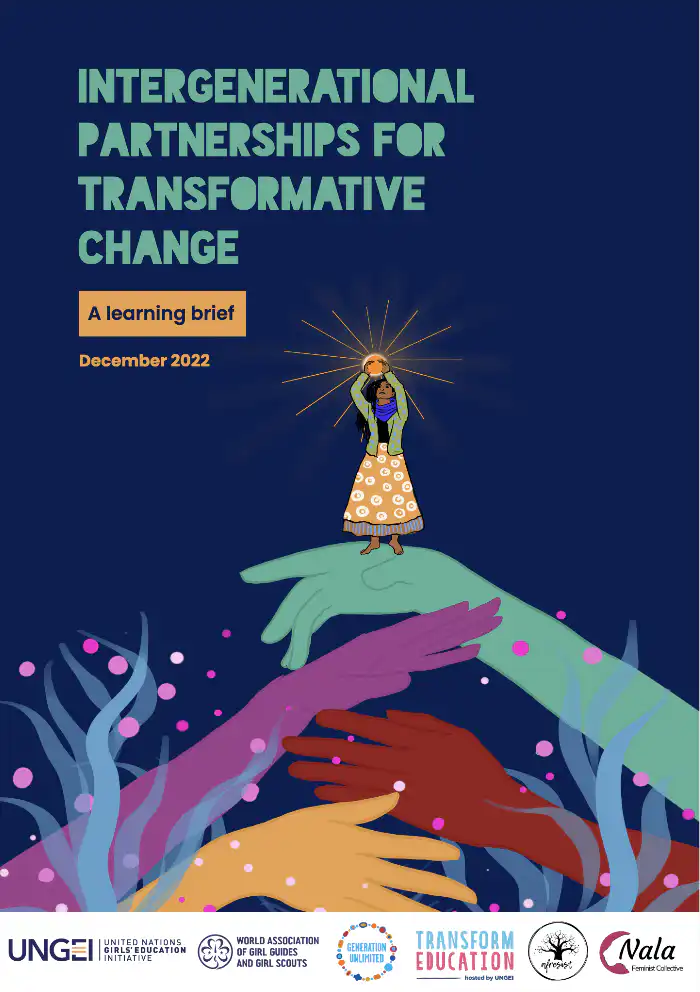
The Intergenerational Partnerships for Transformative Change brief has been launched. The Intergenerational Partnerships for Transformative Change was co-created by Generation Unlimited, the UN Girls’ Education Initiative, WAGGGS, Nala Feminist Collective, Transform Education and Afresist.
What do we mean by intergenerational partnerships?
Intergenerational partnerships are widely referenced but are often left undefined. Generally, they can refer to older and younger generations working together in pursuit of change or a set of common goals. Feminist principles of power-sharing, mutual respect and knowledge sharing are some of the words often described as underpinning meaningful intergenerational partnerships.
At their core, intergenerational partnerships are borne out of the recognition of the interdependency of older and younger generations, and the distinct and valuable
knowledge, perspectives and resources that each generation brings to their joint endeavour.
It aims at exploring and documenting meaningful youth engagement in practice through intergenerational partnership to achieve transformative change for girls’ education and gender equality
WANT TO PASS 2027 BECE? REGISTER FOR BECE HOME MOCK
Register your ward for Ghana's premier Home Mock service, active since 2022.
The success of the intergenerational partnerships for transformative change hinges on five key areas..
1. Formal and Institutionaized representation

Young people need more than a seat at the table; they need formal, institutionalized representation. This means that youth are full and equal members of organizations, institutions
and decision-making or governing bodies and fully and actively participate. This includes ensuring they have opportunities to take up space and speak, and that underrepresented youth groups, such as those within Northern native communities, North Asia and the Global South, are prioritized.
The adoption of quotas and other formal youth engagement mechanisms can be both a symbolic and meaningful shift, but only when it is backed by institutional commitment and
resources.
2. Safe, intergenerational stereotypes and promote spaces to overcome healing
Confronting inherent biases held by all generations can be a meaningful first step in the collaborative space. When set up intentionally, safe, intergenerational spaces,
such as Solidarity Circles, can serve as vital building blocks in establishing mutual understanding and empathy and identifying areas for joint action. These spaces must
also acknowledge the intersectional nature of power structures in order to dismantle them, including with regards to age, postcolonialism, race, disability and gender.
3. Meaningful dialogue generations
Creating a conducive and safe environment for mutual learning and exchange underpins meaningful, intergenerational dialogue.
To be inclusive of diverse backgrounds, dialogues can be shaped around the group’s needs and preferences for self-expression and can include storytelling, art and circle based conversation, as examples.
4. Genuine co-ownership and co-leadership
For genuine co-ownership or coleadership to take root, it’s important to identify, along with youth partners, the institutional or cultural barriers that prohibit genuine co-leadership.
Co-creating new decision-making processes to replace those that are inherently hierarchical or adultcetric can help to fully embed and Institutionaize principles of equality
and shared power, transparency and accountability.
5. Resources must underpin fully fledged co-leadership
If solidarity is to turn into action, young people, and especially young feminist activists, must be adequately supported with financial and non-financial resources. Organizations or institutions partnering with youth-led groups must be willing to commit themselves financially to their success. Ensuring that future generations are resourced to take forward the collective efforts of generations is in itself an intergenerational, transformative and power-shifting act.