Teachers, There Are Opportunities Beyond the Classroom: 15 Areas to Explore
Teaching is often associated with the classroom, lesson preparation, marking and interaction with learners. But the skills developed through teaching can also be applied to other areas of education, including online tutoring, assessment development, educational publishing, consulting, EdTech and building education-related businesses. A recent post shared by Engr Fabian C. Onunwa highlights a number of opportunities teachers can explore beyond traditional classroom teaching. The central message is not necessarily that teachers should leave the classroom, but that the knowledge and skills acquired through teaching can be applied to solve other problems in education. In Ghana, examples of education professionals building services around these skills can already be found in areas such as BECE mock examinations, school assessment services, educational content, education news, online practice, school management technology and teacher recruitment. One practical example is Wisdom Kojo Eli Hammond, founder and lead consultant of Education-News Consult, whose work combines education assessment, digital platforms, education publishing and EdTech services. Education-News Consult publicly describes services including BECE Home Mock, school mock and assessment services, while its wider SkulManager.com ecosystem provides tools and services for schools, teachers, students and parents. The experience provides a useful illustration of how a teacher's knowledge can be developed into services that address specific education needs. Online tutoring Online tutoring is one of the most direct ways teachers can extend their teaching skills beyond the physical classroom. Instead of limiting instruction to students in one school, a teacher can provide academic support remotely in areas such as school subjects, examination preparation, language learning and digital skills. The important skill remains teaching. What changes is the delivery method. A teacher who already understands how learners struggle with a particular subject can package that knowledge into online lessons, revision sessions or targeted academic support. Create digital study materials Teachers spend considerable time preparing notes, exercises, questions, lesson resources and revision activities. These materials can also form the foundation of digital educational resources, provided the teacher respects copyright requirements and the rules governing examination materials. Possible resources include study guides, revision notes, worksheets, practice questions, lesson resources and teaching templates. The opportunity is particularly relevant to teachers who have developed strong subject knowledge and understand the specific areas in which learners commonly need additional practice. Education-News Consult, for example, publishes and distributes examination-related educational materials and mock questions for learners, teachers and schools. Its websites have also been used to provide sample BECE questions and other preparation resources. Online course creation A teacher does not necessarily have to create a large educational programme to start an online course. A course can focus on one clearly defined problem. Examples could include a course on basic mathematics for JHS students, examination preparation, English comprehension, research skills or another area in which the teacher has demonstrated knowledge. The principle is simple: identify a problem learners face and organise the teacher's knowledge into a structured learning experience. Educational consulting Teachers with experience in particular areas of education can also explore consulting. The original post identifies areas such as school improvement, curriculum planning, EdTech implementation, teacher development and assessment systems. In Ghana, assessment consultancy provides a practical example. Education-News Consult describes itself as providing assessment services, including BECE Home Mock and institutional school mock services. Its public service information also identifies exam consultancy as part of its education-related work. This demonstrates how experience with teaching, assessment and examination preparation can be developed into a service for schools, parents, organisations and other education stakeholders. Question and assessment development Teachers already develop tests, quizzes, assignments, practice exercises and marking criteria as part of their work. Those skills can be applied to assessment-development services. A teacher who understands how to construct questions, assess learning outcomes and identify misconceptions can potentially develop assessment materials for schools, educational organisations and digital learning platforms. Education-News Consult's mock examination work provides a practical example. Its services include BECE Home Mock, WASSCE Home Mock and institutional school mock services, with professional marking and grading listed among the services available through the SkulManager ecosystem. For a teacher, the important lesson is that assessment itself is a specialised skill. Editing and proofreading Teachers work with written language every day. Depending on their subject and experience, they may have developed skills in grammar, structure, clarity, reviewing written work and communicating ideas effectively. These skills can be useful in proofreading and editing educational materials and other forms of written content. A teacher with strong language skills can therefore explore editing work alongside teaching without necessarily abandoning the classroom. Educational resource design Teachers who learn tools such as Canva, PowerPoint and other design software can combine those technical skills with their classroom experience. The result can be educational presentations, workbooks, worksheets, classroom posters and infographics. The advantage teachers have is that they understand the audience. A designer who understands education can create resources based not only on how something looks but also on how learners are likely to understand and use it. Academic research support Teachers with research experience can explore legitimate research-support services. The original post identifies areas such as literature organisation, data organisation, research editing, reference management and research-skills training. There is an important ethical distinction, however. Providing research guidance or editing support is different from completing another person's academic work for them. Teachers exploring this area need to maintain that distinction. Research and academic writing skills can therefore become a service while still respecting academic integrity. Educational blogging and publishing Educational blogging is another area where teachers can use their knowledge. A teacher may write about subjects they understand well, explain difficult concepts, provide study guidance or discuss practical classroom issues. Over time, this can develop into a body of published work and a professional portfolio. There are already Ghanaian examples of education-focused publishing platforms operating around examination preparation, school information and education news. Education-News Consult manages education publishing platforms including GhanaEducation.org and GhanaEducationNews.org, which publish education news, examination resources and educational content. For teachers, educational publishing can therefore be viewed as another way of turning subject and classroom knowledge into useful information for a wider audience. Education technology Education technology, or EdTech, creates opportunities for teachers who are interested in combining education with technology. Possible areas include instructional design, learning management systems, digital learning, e-learning content and EdTech support. Teachers have an important advantage here because they understand the classroom from the learner's and teacher's perspective. That knowledge can help them identify whether a technology actually addresses an education problem. SkulManager provides a practical example of how technology can be used to address different education needs. Its current ecosystem includes school management tools, online practice tests, BECE and WASSCE mocks, teacher recruitment, GES resources, e-voting, result checkers and an SHS choice and selection system. The example also shows that an education technology platform does not have to solve only one problem. Build an education business The broader opportunity is to build a business around an education problem. This does not necessarily mean opening a school. A teacher can start by identifying a problem, applying existing knowledge to develop a solution and then turning that solution into a product or service. Education-News Consult offers a practical illustration. Its work has developed around several education needs, including assessment and examination preparation. Its public service information lists BECE Home Mock, institutional school mock services, examination consultancy and other education resources. The wider SkulManager platform extends the idea into technology, providing services for schools, teachers, students and parents. The underlying model is one that teachers can understand easily: Teaching knowledge → Identify an education problem → Develop a solution → Turn the solution into a service or product. Build services around examination preparation Examination preparation is another area in which teachers can apply their subject knowledge. Teachers already understand revision, question-setting, marking, examination techniques and the challenges students face when preparing for major examinations. These skills can support services such as mock examinations, revision programmes, practice questions and assessment support. Education-News Consult's BECE Home Mock and School Mock services provide a Ghanaian example of this model. The Home Mock allows candidates to take assessments from home, while the institutional service is designed for schools. Public information about the services describes question access, script submission, marking and performance information as part of the assessment process. This is an area where the teacher's assessment expertise becomes the core value of the service. Develop school technology services Teachers who understand school administration as well as classroom teaching can also identify problems that schools face outside instruction. Digital school management is one example. SkulManager currently describes a school management system that includes functions such as SBA sheets, terminal reports and fee tracking, alongside other education services. A teacher who understands how schools operate can therefore potentially identify administrative problems that technology can solve. The important skill is not necessarily programming. It is understanding the problem well enough to work with technology developers or use available tools to create a solution. Explore teacher recruitment and professional services The education ecosystem also contains opportunities connected directly to teachers themselves. SkulManager currently lists a teacher recruitment service through which schools can find teachers, as well as home tuition requests for parents. This illustrates another possible direction for educators: rather than providing teaching directly to learners, a teacher or education professional can develop services that connect teachers, parents and schools. The same principle applies to professional development. The platform also lists virtual CPD training for educators as an education service. Use teaching skills to enter digital education services The examples above point to a broader issue. Teachers develop more skills than they may initially recognise. They communicate ideas, research information, prepare content, assess learners, solve problems, manage time, present information and use technology. Those skills can be applied in different parts of the education ecosystem. The opportunity is not necessarily to stop teaching. It can be to identify what the teacher already knows and determine which education problem that knowledge can help solve. Teachers do not have to leave the classroom The original message shared by Engr Fabian C. Onunwa makes an important distinction: exploring opportunities beyond the classroom does not necessarily mean abandoning teaching. A teacher can remain in the classroom while developing an additional professional activity around an existing skill. For one teacher, that could mean online tutoring. For another, it could be assessment development, educational publishing, research support, resource design or EdTech. Another may eventually build a full education business. The practical question is therefore not simply, "How can I make money as a teacher?" A more useful starting point is: What problem can my teaching skills help me solve? That question shifts the focus from looking for a random side job to identifying a genuine education need and considering whether the teacher has the knowledge and skills to address it. What teachers can learn from Education-News Consult and SkulManager The experience of Education-News Consult and SkulManager shows that education services can be built around several connected problems rather than one traditional classroom role. Education-News Consult's public platforms currently connect assessment services, examination preparation, education news and digital education resources. SkulManager describes a wider education ecosystem covering school management, mocks, result checkers, online practice, teacher recruitment, GES resources, e-voting, SHS selection and other services for schools, teachers, students and parents. For teachers considering a similar path, the significance is not that they must copy these businesses. Rather, the examples show how specialised education knowledge can become the foundation for products and services when it is connected to a clearly identified problem. The bigger opportunity is the expertise teachers already possess Teaching experience can produce valuable professional skills that extend beyond lesson delivery. Communication, research, presentation, assessment, content development, leadership, problem-solving, public speaking, time management and technology are among the capabilities identified in the original post. The next step is to recognise where those skills can create value. A teacher who understands a problem deeply may be better placed to develop a practical solution than someone who understands the business side but has little experience with learners. That is why opportunities beyond the classroom can begin with the classroom itself. The question is not whether a teacher should abandon teaching. It is whether the expertise developed through teaching can also be used to solve other problems for learners, parents, schools and the wider education sector. Create a simple but effective featire image for this

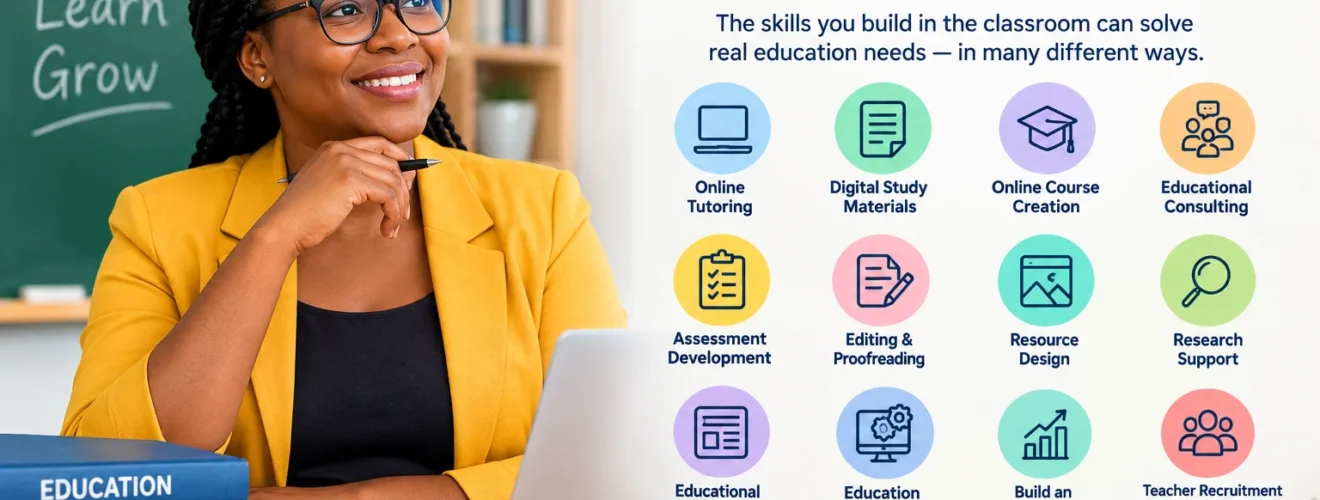
Teaching is often associated with the classroom, lesson preparation, marking and interaction with learners. But the skills developed through teaching can also be applied to other areas of education, including online tutoring, assessment development, educational publishing, consulting, EdTech and building education-related businesses.

A recent post shared by Engr Fabian C. Onunwa highlights a number of opportunities teachers can explore beyond traditional classroom teaching. The central message is not necessarily that teachers should leave the classroom, but that the knowledge and skills acquired through teaching can be applied to solve other problems in education.

In Ghana, examples of education professionals building services around these skills can already be found in areas such as BECE mock examinations, school assessment services, educational content, education news, online practice, school management technology and teacher recruitment.

One practical example is Wisdom Kojo Eli Hammond, founder and lead consultant of Education-News Consult, whose work combines education assessment, digital platforms, education publishing and EdTech services.

Education-News Consult publicly describes services including BECE Home Mock, school mock and assessment services, while its wider SkulManager.com ecosystem provides tools and services for schools, teachers, students and parents.

The experience provides a useful illustration of how a teacher’s knowledge can be developed into services that address specific education needs.

WANT TO PASS 2027 BECE? REGISTER FOR BECE HOME MOCK

Register your ward for Ghana's premier Home Mock service, active since 2022.

REGISTER YOUR WARD NOW

Online tutoring

Online tutoring is one of the most direct ways teachers can extend their teaching skills beyond the physical classroom.

Instead of limiting instruction to students in one school, a teacher can provide academic support remotely in areas such as school subjects, examination preparation, language learning and digital skills.

The important skill remains teaching. What changes is the delivery method.

A teacher who already understands how learners struggle with a particular subject can package that knowledge into online lessons, revision sessions or targeted academic support.

Create digital study materials

Teachers spend considerable time preparing notes, exercises, questions, lesson resources and revision activities.

These materials can also form the foundation of digital educational resources, provided the teacher respects copyright requirements and the rules governing examination materials.

Possible resources include study guides, revision notes, worksheets, practice questions, lesson resources and teaching templates.

The opportunity is particularly relevant to teachers who have developed strong subject knowledge and understand the specific areas in which learners commonly need additional practice.

Education-News Consult, for example, publishes and distributes examination-related educational materials and mock questions for learners, teachers and schools. Its websites have also been used to provide sample BECE questions and other preparation resources.

Online course creation

A teacher does not necessarily have to create a large educational programme to start an online course.

A course can focus on one clearly defined problem.

Examples could include a course on basic mathematics for JHS students, examination preparation, English comprehension, research skills or another area in which the teacher has demonstrated knowledge.

The principle is simple: identify a problem learners face and organise the teacher’s knowledge into a structured learning experience.

Educational consulting

Teachers with experience in particular areas of education can also explore consulting.

The original post identifies areas such as school improvement, curriculum planning, EdTech implementation, teacher development and assessment systems.

In Ghana, assessment consultancy provides a practical example.

Education-News Consult describes itself as providing assessment services, including BECE Home Mock and institutional school mock services. Its public service information also identifies exam consultancy as part of its education-related work.

This demonstrates how experience with teaching, assessment and examination preparation can be developed into a service for schools, parents, organisations and other education stakeholders.

Question and assessment development

Teachers already develop tests, quizzes, assignments, practice exercises and marking criteria as part of their work.

Those skills can be applied to assessment-development services.

A teacher who understands how to construct questions, assess learning outcomes and identify misconceptions can potentially develop assessment materials for schools, educational organisations and digital learning platforms.

Education-News Consult’s mock examination work provides a practical example. Its services include BECE Home Mock, WASSCE Home Mock and institutional school mock services, with professional marking and grading listed among the services available through the SkulManager ecosystem.

For a teacher, the important lesson is that assessment itself is a specialised skill.

Editing and proofreading

Teachers work with written language every day.

Depending on their subject and experience, they may have developed skills in grammar, structure, clarity, reviewing written work and communicating ideas effectively.

These skills can be useful in proofreading and editing educational materials and other forms of written content.

A teacher with strong language skills can therefore explore editing work alongside teaching without necessarily abandoning the classroom.

Educational resource design

Teachers who learn tools such as Canva, PowerPoint and other design software can combine those technical skills with their classroom experience.

The result can be educational presentations, workbooks, worksheets, classroom posters and infographics.

The advantage teachers have is that they understand the audience.

A designer who understands education can create resources based not only on how something looks but also on how learners are likely to understand and use it.

Academic research support

Teachers with research experience can explore legitimate research-support services.

The original post identifies areas such as literature organisation, data organisation, research editing, reference management and research-skills training.

There is an important ethical distinction, however.

Providing research guidance or editing support is different from completing another person’s academic work for them. Teachers exploring this area need to maintain that distinction.

Research and academic writing skills can therefore become a service while still respecting academic integrity.

Educational blogging and publishing

Educational blogging is another area where teachers can use their knowledge.

A teacher may write about subjects they understand well, explain difficult concepts, provide study guidance or discuss practical classroom issues.

Over time, this can develop into a body of published work and a professional portfolio.

There are already Ghanaian examples of education-focused publishing platforms operating around examination preparation, school information and education news.

Education-News Consult manages education publishing platforms including GhanaEducation.org and GhanaEducationNews.org, which publish education news, examination resources and educational content.

For teachers, educational publishing can therefore be viewed as another way of turning subject and classroom knowledge into useful information for a wider audience.

Education technology

Education technology, or EdTech, creates opportunities for teachers who are interested in combining education with technology.

Possible areas include instructional design, learning management systems, digital learning, e-learning content and EdTech support.

Teachers have an important advantage here because they understand the classroom from the learner’s and teacher’s perspective.

That knowledge can help them identify whether a technology actually addresses an education problem.

SkulManager provides a practical example of how technology can be used to address different education needs. Its current ecosystem includes school management tools, online practice tests, BECE and WASSCE mocks, teacher recruitment, GES resources, e-voting, result checkers and an SHS choice and selection system.

The example also shows that an education technology platform does not have to solve only one problem.

Build an education business

The broader opportunity is to build a business around an education problem.

This does not necessarily mean opening a school.

A teacher can start by identifying a problem, applying existing knowledge to develop a solution and then turning that solution into a product or service.

Education-News Consult offers a practical illustration.

Its work has developed around several education needs, including assessment and examination preparation. Its public service information lists BECE Home Mock, institutional school mock services, examination consultancy and other education resources.

The wider SkulManager platform extends the idea into technology, providing services for schools, teachers, students and parents.

The underlying model is one that teachers can understand easily:

Teaching knowledge → Identify an education problem → Develop a solution → Turn the solution into a service or product.

Build services around examination preparation

Examination preparation is another area in which teachers can apply their subject knowledge.

Teachers already understand revision, question-setting, marking, examination techniques and the challenges students face when preparing for major examinations.

These skills can support services such as mock examinations, revision programmes, practice questions and assessment support.

Education-News Consult’s BECE Home Mock and School Mock services provide a Ghanaian example of this model. The Home Mock allows candidates to take assessments from home, while the institutional service is designed for schools. Public information about the services describes question access, script submission, marking and performance information as part of the assessment process.

This is an area where the teacher’s assessment expertise becomes the core value of the service.

Develop school technology services

Teachers who understand school administration as well as classroom teaching can also identify problems that schools face outside instruction.

Digital school management is one example.

SkulManager currently describes a school management system that includes functions such as SBA sheets, terminal reports and fee tracking, alongside other education services.

A teacher who understands how schools operate can therefore potentially identify administrative problems that technology can solve.

The important skill is not necessarily programming. It is understanding the problem well enough to work with technology developers or use available tools to create a solution.

Explore teacher recruitment and professional services

The education ecosystem also contains opportunities connected directly to teachers themselves.

SkulManager currently lists a teacher recruitment service through which schools can find teachers, as well as home tuition requests for parents.

This illustrates another possible direction for educators: rather than providing teaching directly to learners, a teacher or education professional can develop services that connect teachers, parents and schools.

The same principle applies to professional development.

The platform also lists virtual CPD training for educators as an education service.

Use teaching skills to enter digital education services

The examples above point to a broader issue.

Teachers develop more skills than they may initially recognise.

They communicate ideas, research information, prepare content, assess learners, solve problems, manage time, present information and use technology.

Those skills can be applied in different parts of the education ecosystem.

The opportunity is not necessarily to stop teaching. It can be to identify what the teacher already knows and determine which education problem that knowledge can help solve.

Teachers do not have to leave the classroom

The original message shared by Engr Fabian C. Onunwa makes an important distinction: exploring opportunities beyond the classroom does not necessarily mean abandoning teaching.

A teacher can remain in the classroom while developing an additional professional activity around an existing skill.

For one teacher, that could mean online tutoring. For another, it could be assessment development, educational publishing, research support, resource design or EdTech.

Another may eventually build a full education business.

The practical question is therefore not simply, “How can I make money as a teacher?”

A more useful starting point is:

What problem can my teaching skills help me solve?

That question shifts the focus from looking for a random side job to identifying a genuine education need and considering whether the teacher has the knowledge and skills to address it.

What teachers can learn from Education-News Consult and SkulManager

The experience of Education-News Consult and SkulManager shows that education services can be built around several connected problems rather than one traditional classroom role.

Education-News Consult’s public platforms currently connect assessment services, examination preparation, education news and digital education resources.

SkulManager describes a wider education ecosystem covering school management, mocks, result checkers, online practice, teacher recruitment, GES resources, e-voting, SHS selection and other services for schools, teachers, students and parents.

READ: Enrol Your Ward for 2026 October BECE Home Mock Now

For teachers considering a similar path, the significance is not that they must copy these businesses.

Rather, the examples show how specialised education knowledge can become the foundation for products and services when it is connected to a clearly identified problem.

The bigger opportunity is the expertise teachers already possess

Teaching experience can produce valuable professional skills that extend beyond lesson delivery.

Communication, research, presentation, assessment, content development, leadership, problem-solving, public speaking, time management and technology are among the capabilities identified in the original post.

The next step is to recognise where those skills can create value.

A teacher who understands a problem deeply may be better placed to develop a practical solution than someone who understands the business side but has little experience with learners.

READ: Teachers With Unpaid September Salaries Given October 1 Deadline to Restore Payments

That is why opportunities beyond the classroom can begin with the classroom itself.

The question is not whether a teacher should abandon teaching. It is whether the expertise developed through teaching can also be used to solve other problems for learners, parents, schools and the wider education sector.


Georg D.

Senior Education Journalist & Technical LeadGeorge Darko is a prolific education news writer, SEO specialist, and core web developer for Ghanaeducation.org. Combining a deep passion for educational advocacy with advanced technical expertise, George acts as the bridge between impactful storytelling and modern web engineering.As a master of HTML, CSS, and custom WordPress architecture, he doesn't just write the news—he builds, optimizes, and designs the very platforms that deliver it to millions of parents, teachers, and candidates across Ghana. When he isn't breaking critical updates on GES and WAEC developments, George is fine-tuning site performance, writing responsive code, and engineering SEO strategies to ensure that vital educational resources remain accessible, lightning-fast, and highly visible online.

You may also like...

Leave a Reply

Your email address will not be published. Required fields are marked *