STOP the Mother Tongue Madness: Why the Minister’s Order Proves They Don’t Understand Ghana’s Classrooms
The recent directive by the Minister of Education to mandate the use of the mother tongue as the medium of instruction in basic schools across Ghana is underpinned by a laudable, research-backed goal: improving foundational literacy and learning outcomes. However, a deeper look at the contemporary reality of Ghanaian basic schools—especially in our rapidly evolving, cosmopolitan cities and communities—reveals that this well-intentioned policy is navigating a linguistic minefield.
As an education journalist, I contend that the rigid, geographically based implementation of this policy, without innovative national planning, risks creating more educational hurdles than solutions, especially when it clashes with the complex tapestry of Ghana’s modern demographics and the practical limitations of its teaching workforce. How can teachers teach Mathematics and Science for instance in the mother tongue when the text books are in English. This is a very weak suggestion from the Minister.
The Unspoken Truth: Ghana’s Shifting Linguistic Landscape
The core flaw of the current directive lies in its assumption of a homogeneous linguistic environment within geographically defined areas. This is a severe underestimation of Ghana’s urbanization and internal migration patterns.
The Cosmopolitan Classroom Conundrum
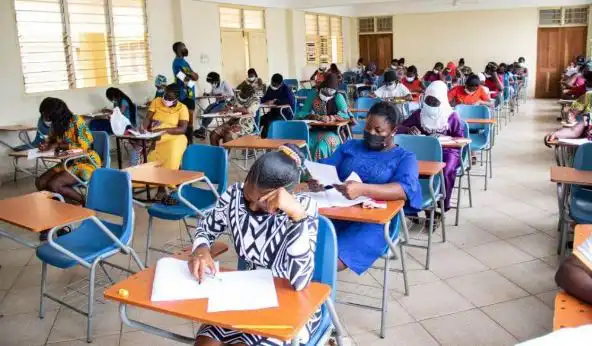
Consider Accra, the Greater Accra Region: the capital is a vibrant melting pot where Ewe, Ga, Twi/Akan, Fante, Dagomba, Hausa, and dozens of other languages coexist in a single community, sometimes even on a single street. To insist that every learner in a state school in Kaneshie or Adabraka must be taught solely in Ga, the indigenous language of the region, fundamentally ignores the linguistic reality of the majority of the student body. The same challenge is replicated in Kumasi (Ashanti Region), where a significant portion of the population might speak Fante or other northern languages, yet the default mother tongue is set as Twi/Akan. In Tamale (Northern Region), the situation is even more complex, with multiple local languages like Dagbani, Gonja, and Mampruli.
How does this policy work in a class where children have 5-10 different mother tongues?
If the teacher selects the majority language (e.g., Twi in a Kumasi school), all non-Twi speakers are immediately disadvantaged.
If the teacher selects the local/regional language (e.g., Ga in an Accra school), the non-Ga speakers—who might be the majority in some communities—suffer.
The class becomes an arena of linguistic exclusion, inadvertently slowing down the learning for a significant portion of the student population who may have greater proficiency in Ghanaian Pidgin English or even Standard English than the designated local mother tongue.
The Teacher Supply Deficit
Another crippling practical challenge is the teacher’s linguistic competence. The Ghana Education Service (GES) operates a national posting policy. It is an undeniable fact that a highly competent Ewe teacher from the Volta Region could be posted to a school in the Northern Region, or a Dagomba teacher from the North to a school in the Greater Accra Region.

The Policy’s Blind Spot: This teacher, despite being a dedicated professional, does not speak or write the local mother tongue. Are they expected to:
Suddenly learn and become proficient enough in the local language to use it as the medium of instruction? This is unrealistic and unprofessional.
Be excluded from teaching basic schools in that region, thereby exacerbating the teacher shortage crisis?
Teach in their own mother tongue, which only a handful of learners understand, further complicating the cosmopolitan classroom?
The policy essentially demands a localized hiring approach in a nationally managed education system, leading to an inevitable institutional bottleneck and compromising the quality of instruction.
A Nationalistic and Innovative Way Forward: Language as a Choice, Not a Constraint
The objective—improving learning outcomes through a familiar language—is noble. The approach, however, needs a radical, nationalistic overhaul that prioritizes the learner’s best interest and the nation’s unifying principles.
1. The “Mother Tongue PLUS” – A Nationalistic Approach
Instead of imposing a single, geographically-defined mother tongue, Ghana should adopt a “Mother Tongue PLUS” model, coupled with a renewed focus on a unifying national identity.
Elevate Ghanaian Pidgin English (GPE) or English as the Pragmatic Medium: In cosmopolitan areas like Accra, Kumasi, Takoradi, and Tamale, where linguistic diversity is extreme and GPE or Standard English is often the de facto common language among children, the medium of instruction for subjects like Maths, Science, and Social Studies should be a combination of English and Language of the Classroom Communication (LCC)—which often defaults to GPE or a simplified English. This ensures immediate understanding for the maximum number of learners.
READ: Buy Likely WASSCE Mocks with Answers for Sch and Private candidates
Mandatory Ghanaian Language as a Subject (L1 and L2): Make the study of two Ghanaian languages mandatory from basic school:
L1 (Primary Mother Tongue): The student’s actual mother tongue (or the language most spoken at home), taught as a subject where literacy and cultural heritage are developed.
L2 (National/Regional Language): Akan (Twi/Fante), Ewe, Ga-Adangme, Dagbani, or Hausa (a recognized lingua franca). Students should choose or be assigned one of these major Ghanaian languages to study as a second Ghanaian language subject. This ensures that every Ghanaian is multilingual and can communicate across major cultural divides, fostering national cohesion and a shared cultural understanding—a true nationalistic goal.
2. Practical and Innovative Lessons for the Minister and GES
| For the Minister/GES | Practical Lesson/Suggestion |
| Teacher Training & Placement | Linguistic Specialization Posting: Post teachers to basic schools based on their Ghanaian language specialization (e.g., teachers proficient in Ewe are posted to schools with significant Ewe-speaking populations nationwide, not just the Volta Region). This requires a national census of student and teacher language skills. |
| Curriculum Development | Develop High-Quality Learning Materials in Major Languages: Invest heavily in producing textbooks and readers in the six most spoken Ghanaian languages (Akan, Ewe, Ga-Adangme, Dagbani, Gonja, and Hausa) for use as L1 and L2 subjects. Make these resources accessible digitally. |
| Assessment | Decouple Language from Content Assessment: Do not grade students on their proficiency in the local mother tongue (e.g., Ga) in a Maths test if they speak another language (e.g., Fante) at home. Assess Maths in the language of instruction (English/LCC), and assess the Ghanaian language separately as a subject. |
A Call to Teachers and the Ghanaian Public
To Teachers: You are the front-line soldiers in this linguistic battle. Be flexible. Use the local language as a tool for explanation and illustration—a teaching strategy—rather than a rigid medium of instruction. Embrace code-switching to clarify complex concepts, especially when you can gauge that a significant number of your students understand a different Ghanaian language or a common simplified English. Your professional discretion in a diverse classroom is the real magic.
To Ghanaians: We must recognise that language is dynamic. The purpose of education is to equip our children with the skills to navigate the future. A policy that isolates learners into small linguistic enclaves based on a 20th-century demographic map is a recipe for a fragmented society. Let us champion a vision where Ghanaian languages are valued as cultural anchors and tools for national unity through mandated study, while a pragmatic language (English/GPE) serves as the universal bridge for content learning, especially in our proudly cosmopolitan centers.
The Mother Tongue directive is a conversation starter, but its current rigid structure is unsustainable. We need a flexible, nationalistic, and innovative policy that harnesses our linguistic diversity for educational success, rather than allowing it to be a source of confusion and inequality. Language should be an asset, not an obstacle.
By Wisdom Hammond / An Educator, Content Creator and Provoking Debate Starter