Letter to the Editor vs. Article for Publication: Key Differences and Similarities
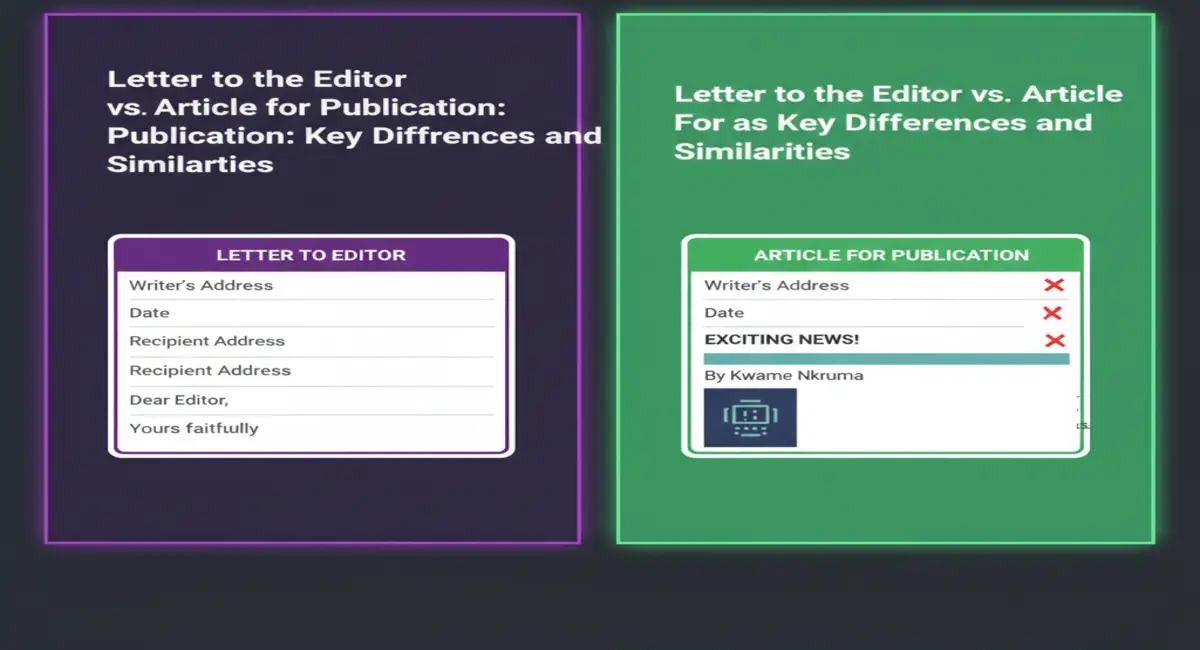
WAEC and other examination bodies that assess students in the English language may test students on Letter to the Editor and Article for Publication questions. Students preparing for the BECE and WASSCE must master these forms of English composition just for the examination.
Knowing how these differ and the similarities helps avoid errors. Teachers of English Language are encouraged to use the structure of this article to help their students revise these two forms of writing ahead of the next BECE and WASSCE or any other English Language examination. While both could be written for a media house, they have different features and a few similarities.
In English language assessments, students often confuse the structure of a Letter to the Editor with an Article for Publication.
Writing letters to editors and articles for publication are essential skills for BECE and WASSCE students because they allow you to share your opinions on issues that affect your community and the world. A Letter to the Editor is a formal letter written directly to the person in charge of a newspaper or magazine to complain about a problem, suggest a solution, or react to a recent news story.
For example, you might write to an editor to express your anger about poor road conditions in your neighborhood or to praise a successful local cleanup exercise. On the other hand, an Article for Publication is a more detailed piece written for a general audience—like your schoolmates or the entire country—to educate, inform, or even entertain them on a specific topic. A student might write an article for a school magazine about the “Problems of Indiscipline in Schools” or for a national newspaper discussing the “Effects of Social Media on Students”.
Both formats are powerful tools for advocacy and public education, but they have different structures you must follow for exam success. A Letter to the Editor requires a formal layout with two addresses, a formal salutation like “Dear Editor,” and a signature at the end. An Article for Publication, however, usually starts with a bold, catchy title and ends with your name and class or position—called a “byline”—rather than a formal letter closing. To do well in your exams, remember that a letter is like a formal conversation with a specific person, while an article is like a speech written down for many people to read.
While both are intended for a public audience, they serve different purposes. A letter is a direct correspondence to an individual (the editor), whereas an article is a general piece written for the public.
Key Similarities and Differences between Letter to the Editor and an Article for Publication
From the table, it is clear that the first four features of a formal letter are absent when it comes to an article. Let us carefully look at the table below, which gives a snapshot of details to help you do a good job in and out of the exam hall.
Both formats require a clear title and a structured introduction, body, and conclusion.

However, the most significant difference lies in the contact information and formal greetings.
A letter to the editor is a formal letter and therefore requires the recipient’s address and a salutation like “Dear Editor,” while an article for publication does not.
The table below provides a side-by-side comparison of the mandatory elements for each format:
| Details | Letter to Editor | Article for Publication |
| 1. Writer’s Address | Yes | No |
| 2. Date | Yes | No |
| 3. Recipient’s Address | Yes | No |
| 4. Salutation (e.g., Dear Editor) | Yes | No |
| 5. Title | Yes | Yes |
| 6. Introduction | Yes | Yes |
| 7. Body | Yes | Yes |
| 8. Conclusion | Yes | Yes |
| 9. Subscription | Yes (Yours faithfully) | Yes (with byline) |
These Letter to the Editor vs. Article for Publication differences should guide students and teachers preparing for English Language examinations.
By Wisdom Hammond
Team Lead at Education-News Consult