Mathematics for BECE and WASSCE: What is a complement in sets and Venn diagram questions?
In Mathematics for BECE and WASSCE, What is a complement in sets and Venn diagram questions?
Get it right with this post as we break down all you need to know regarding mathematics for BECE and WASSCE when it comes to understanding what is a complement in sets and Venn diagram questions.
In sets and Venn diagrams, a complement refers to everything that is not part of a given set. It’s the collection of all elements that belong to the universal set (which contains all possible elements) but do not belong to the specific set in question.
Key points about complements:
- Notation: The complement of a set A is usually denoted by A’ (read as “A prime” or “A complement”).
- Universal set: The complement is always defined relative to a universal set, which is the context for all the sets involved.
- Venn diagrams: In Venn diagrams, the complement of a set is typically shaded differently to visually distinguish it from the set itself.
Basic facts to master to solve any question that is related to complement prime-related set questions.

Mathematics for BECE and WASSCE – What is a subset?
A subset is a collection of elements that is contained within another larger collection, called the superset. In simpler terms, a subset is a smaller group of elements that belongs entirely to a bigger group.
Here are some key points to remember about subsets:
WANT TO PASS 2027 BECE? REGISTER FOR BECE HOME MOCK
Register your ward for Ghana's premier Home Mock service, active since 2022.
- Notation: We often use the symbol ≤ to denote the subset relationship. So, if A is a subset of B, we can write A ≤ B, which means “every element of A is also an element of B.”
- Inclusion: Think of a layer cake. Each individual layer is a subset of the entire cake. Similarly, every element in a subset is included in the superset.
- Examples:
- In the set {1, 2, 3}, {1, 2} is a subset.
- The even numbers are a subset of the whole numbers.
- All red vehicles are a subset of all vehicles.
- Types of subsets:
- Proper subset: When a subset has at least one element that is not in the superset, it’s called a proper subset. For example, {1, 2} is a proper subset of {1, 2, 3} because 3 is not in the smaller set.
- Equal sets: If a set has all the same elements as another set, they are considered equal sets, even though one might be written differently. For example, {2, 4, 6} and {6, 4, 2} are equal sets.
- Empty set: The empty set (Ø) is considered a subset of any set, including itself. This is because it has no elements, and therefore, all its elements are also elements of any other set.
A’ = All members of the Universal set less All Members of Set A. Where set A is a subset of the Universal Set
A’ = U -A

In the same way B’ = U – B where B is a subset of the universal set.
Mathematics for BECE and WASSCE – More explanations
What is A’ U B’ = A union of all elements in the universal set that are not in subset A and all elements in the universal set that are not in B.
What is A’ n B’ = This simply means all the elements that are common to A’ and B’; thus, the elements must be found in both A’ and B’ before they can be included in A’ n B’.
To sol: ve this we can say A’ n B’ = (U-A ) n (U – B) n
Example:
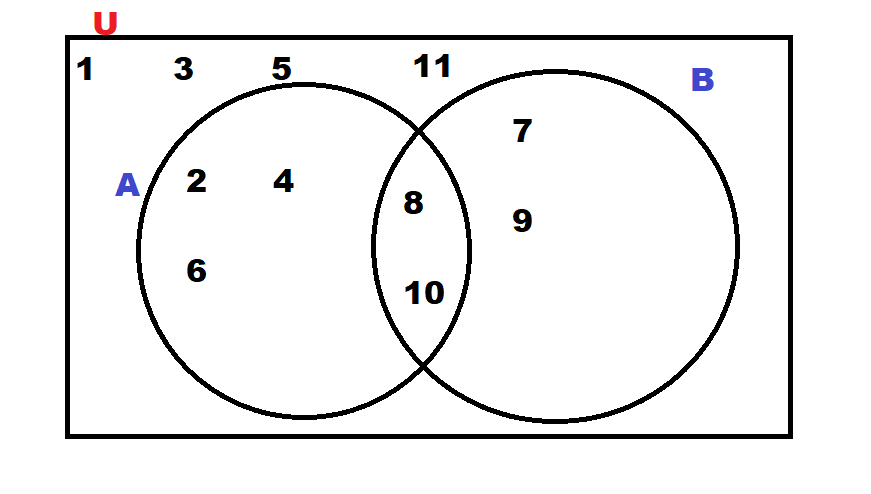
- Universal set: U = {1, 2, 3, 4, 5, 6, 7, 8. 9. 10, 11}
- Set A: A = {2, 4, 6, 8, 10}
- Set B: B = {7 ,8 ,9 , 10 }
- A n B = Elements in A which can also be found in B = {8,10}
- Complement of A: A’ = {1, 3, 5, 7,9, 11} (all elements in U that are not in A)
- Complement of B: B’ = { 1 ,2, 3, 4, 5, 6, 11} (all elements in U that are not in B)
- A’ U B’ = Complement of A and Complement of B together = { 1,2,3,4,5,6,7,9,11}
- A’ n B’ = elements that are common to Complement of A and Complement of B. From our earlier answers
We have:
Complement of A: A’ = {1, 3, 5, 7,9, 11} (all elements in U that are not in A)
Complement of B: B’ = { 1 ,2, 3, 4, 5, 6, 11} (all elements in U that are not in B)
A careful look at the two sets should find the elements that are present in both A’ and B’ only. This is also called an intersection. In everyday English. (What is in A’ and is also in B’
A’ n B’ = { 1, 3, 5, 11 }
Visualizing complements in a Venn diagram:
- Draw a circle for set A within a larger rectangle representing the universal set U.
- Shade the area outside of circle A, within the rectangle U, to represent A’.
- Elements within circle A belong to set A. Elements within the shaded area outside the circle belong to A’.
- Below is the set that represents the above-solved question.
READ: Some BECE 2023 Graduates are Still Home
Understanding complements is crucial for solving various set operations and logical reasoning problems involving Venn diagrams. It helps you identify elements that meet certain criteria or fall within specific combinations of sets.