2026 BECE School Placement Release Date, Protocol Placement & How to Check CSSPS Placement
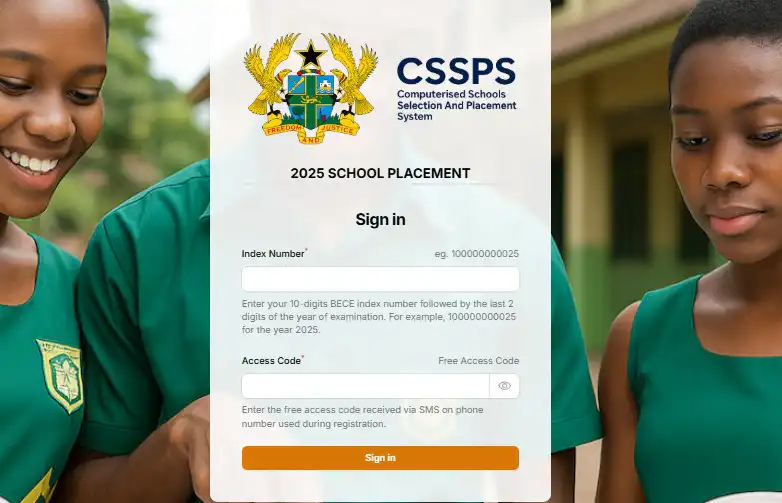
If you are a Ghanaian parent reading this at night on your phone while your child sleeps — after months of early mornings, extra classes, mock examinations, and prayers — this article is written for you.
And if you are a 2026 BECE candidate who worked hard, got your results, and is now sitting in uncertainty waiting to find out which school will define the next three years of your life — this one is for you too.
The period between BECE results and SHS1 reporting day is one of the most stressful stretches in any Ghanaian family’s year. Information is scattered. WhatsApp groups are full of rumours. People who do not actually know anything speak with enormous confidence. And the official channels — as important and legitimate as they are — do not always communicate in ways that reach the families who need the information most.
This article fixes that.
Everything you need to know about the 2026 BECE school placement — when it will be released, how to check it, what to do if something is wrong, how to understand what your result means, when SHS1 starts, what to bring on reporting day, and what to do right now if you have not yet selected schools — is in here. Read it fully. Bookmark it. Share it with every parent and student in your network.
What Is the CSSPS and How Does Placement Actually Work?
Before we get into dates and steps, it helps to understand what you are actually dealing with — because a lot of the anxiety families feel during placement season comes from not understanding how the system makes its decisions.
The Computerized School Selection and Placement System — CSSPS — is the digital platform that the Ghana Education Service uses to match every 2026 BECE candidate to a Senior High School based on their examination results and their stated school preferences. It is run jointly by GES and WAEC, and it operates through the portal at cssps.gov.gh.
Here is the honest truth about how placement works: the system does not care about anything except two things. Your aggregate score from the BECE — the total of your six best subject grades — and the list of schools you selected in order of preference. That is it. There is no human sitting somewhere deciding your fate. There is no committee reviewing individual cases. An algorithm processes your result against available spaces at your preferred schools and assigns you accordingly.
The algorithm tries your first choice first. If there is space at that school for a student with your aggregate in your chosen programme, you get placed there. If not, it moves to your second choice. Then your third. And so on through all eight positions. If none of your eight selected schools can accommodate your aggregate in the programme you selected, the system places you at the most appropriate available school.
This is why selecting all eight schools matters enormously. A family that selects only two or three schools is essentially asking the system to find them a placement with one hand tied behind its back. The more realistic options you give the system, the better your chances of ending up somewhere that works for you.
The system also balances several other factors simultaneously — regional distribution, boarding versus day availability, programme capacity, and gender in cases of single-sex schools. This is why two students with the exact same aggregate can end up at different schools. The spaces available when the system processes each record, and the competition from other students with similar aggregates selecting similar schools, all influence the outcome.
One more thing that every parent needs to understand: there are two placement cycles. The first placement processes students who completed their selections during the initial selection window. The second placement — processes students who are reselecting, who missed the first window, or whose results came in late such as private candidates. Both placements end up on the same portal. Both are checked the same way.
When Will the 2026 BECE School Placement Be Released?
This is the question that gets typed into Google more than any other during this period, and the honest answer is that GES does not announce the placement release date far in advance. It announces it a few days before — or sometimes on the same day — through official channels.
What we can tell you, based on the consistent pattern from previous years, is the following:
| Year | BECE Results Released | First Placement Released | Second Placement Released |
|---|---|---|---|
| 2021 | August | September | October |
| 2022 | August | September | October |
| 2023 | August | September | October |
| 2024 | August | September | October |
| 2025 | August | September | October |
| 2026 | August 2026 | Expected September 2026 | Expected October 2026 |
The pattern is consistent and it is unlikely to change dramatically in 2026. Between the time BECE results are released and the time placement results appear on the portal, GES and WAEC need time to feed every student’s aggregate into the CSSPS, process the selections, run the algorithm across the entire national candidate pool, verify the outputs, and load them onto the portal in a format that can handle the enormous traffic that hits the site the moment placement goes live.
That processing window typically takes three to five weeks after results are released. So if your child’s 2026 BECE results are released in August, you can reasonably expect first placement results to appear on the CSSPS portal in September 2026.
How will you know when placement is released?
The official announcement will come through these channels in this order:
First — the GES official website at ges.gov.gh will carry a formal press release or notice.
Second — the CSSPS portal at cssps.gov.gh itself will show a notice or the placement checking function will become active.
Third — GES will post on their official Facebook page and other verified social media accounts.
Fourth — credible education news platforms including Ghanaeducation.org will publish the announcement immediately when it goes live.
What you must ignore:
Every year, in the weeks before placement is released, social media fills up with posts claiming to know the exact date, claiming the portal is live when it is not, and in some cases directing families to fake websites that look like the CSSPS portal but are designed to steal personal information or collect money. None of these posts are legitimate. The only source you should trust for the placement release date is cssps.gov.gh, ges.gov.gh, and verified accounts you already follow such as this platform.
Save the date of this article in your phone. We will update it the moment official placement information is released.
How to Check Your 2026 BECE School Placement — Step by Step
When placement goes live, the CSSPS portal will be under enormous strain. In the first few hours after release, hundreds of thousands of Ghanaian families will be trying to access the site simultaneously. Pages will load slowly. The site may time out. This is normal and it is not a sign that anything is wrong with your child’s placement.
Here is how to check effectively:
Before you start — gather these details:
- Your child’s BECE index number — exactly as it appeared on their examination registration slip
- Your child’s date of birth
- Your child’s full name as registered with WAEC
- A stable internet connection — WiFi is better than mobile data for the portal
- A device that can open PDF files for downloading the placement slip
Step 1 — Go to the correct website
Open your browser and type: cssps.gov.gh
Do not search for it on Google and click a random link. Type the URL directly. There are websites with similar names that are not the official CSSPS portal. The official site is cssps.gov.gh and nothing else.
Step 2 — Find the placement checking section
When placement is live, the homepage will have a clear option to check placement results. It may be labelled “Check Placement” or “View Placement Result” — the exact wording changes slightly each year but it will be the most prominent feature on the page during placement season.
Step 3 — Enter your details
You will be asked for your child’s index number and either their date of birth, their PIN, or both depending on the system configuration for 2026. Enter these exactly as they appear on the BECE registration documents. A single character error will return a “not found” result that has nothing to do with the actual placement status.
Step 4 — Read your result carefully
When the placement loads, you will see:
- The full name of the school your child has been placed at
- The region and district where the school is located
- The programme your child has been placed in
- Whether the placement is boarding or day
- The reporting date
- Sometimes additional instructions specific to the school
Read every element. Do not just look at the school name and close the page.
Step 5 — Download and save your placement slip
There will be an option to download or print your placement slip. Do both. Save a digital copy in at least two places — your phone gallery and your email or WhatsApp saved messages. Print at least three copies. The placement slip is the single most important document your child will carry to school on reporting day. Losing it creates unnecessary problems.
Step 6 — Screenshot as backup
Take a screenshot of the placement result page as it appears on screen. This is your backup if the downloaded PDF has any issues.
If the portal is slow:
Try accessing it during off-peak hours. Early morning — between 5am and 7am — and late at night — after 10pm — tend to have significantly less traffic than midday. If the page times out, wait a few minutes and try again. Do not keep refreshing rapidly as this actually adds to the server load.
If you cannot access the internet at home:
Ghana has several accessible options. Most district GES offices provide internet access for placement checking during the placement period. Community information centres, libraries, and private internet cafes are available in most towns and districts. If you have a smartphone, mobile data — even 3G — is sufficient for the CSSPS portal. If you are in a rural area with limited connectivity, ask your child’s school teacher or the school head whether they can assist with portal access.
Understanding What Your 2026 BECE Placement Result Actually Means
When you see your child’s placement, the information on the screen tells you more than just the school name. Here is how to read every element correctly.
The school name and category
Ghana’s Senior High Schools are organised into categories that broadly reflect their competitiveness and resource level. Understanding which category your child’s assigned school falls in helps you understand their placement in context.
| Category | What It Means | Typical Aggregate Range | Well-known Examples |
|---|---|---|---|
| A | The most competitive and well-resourced national schools | Aggregate 6 to 12 | Achimota, Prempeh College, Wesley Girls, GISS, Mfantsipim, Holy Child |
| B | Strong regional schools with good facilities and academic track records | Aggregate 13 to 18 | Various strong regional schools across all 16 regions |
| C | District schools that serve their communities well | Aggregate 19 to 24 | District secondary schools |
| D | Community day schools providing local access to secondary education | Aggregate 25 to 30 | Local community day schools |
If your child has been placed at a Category B or C school and you were hoping for Category A, that is not an error. That is the algorithm reflecting the competition for Category A places relative to your child’s aggregate. It feels disappointing in the moment. But a child who thrives in the right programme at a Category B school will consistently outperform a child who struggles at a Category A school that was beyond their academic level at the time of placement.
The programme
The programme your child has been placed in is as important as — and in some ways more important than — the school itself. Here is what each programme means and where it leads:
| Programme | What You Study | Career Directions |
|---|---|---|
| General Science | Physics, Chemistry, Biology, Elective Mathematics | Medicine, Pharmacy, Engineering, Nursing, Sciences |
| General Arts | Literature, History, Government, Economics, French | Law, Education, Journalism, Social Work, Political Science |
| Business | Accounting, Economics, Business Management, Costing | Banking, Commerce, Entrepreneurship, Accounting |
| Home Economics | Food and Nutrition, Management in Living, Textiles | Nursing, Catering, Hospitality, Dietetics |
| Visual Arts | Textiles, Ceramics, Picture Making, Graphic Design | Architecture, Design, Fine Arts, Fashion |
| Technical | Technical Drawing, Workshop Technology, Building Construction | Engineering, Construction, Artisan trades |
| Agricultural Science | Crop Husbandry, Animal Husbandry, Agricultural Economics | Agribusiness, Veterinary Science, Environmental Science |
If the programme your child has been placed in does not match their interests, that is worth addressing — through the resolution process, through speaking with the school directly in the first week of enrolment, or through the SHSpath portal at ghanaeducation.org/shspath/index.php which can help clarify which programme genuinely suits them best.
Boarding versus day
If your child selected boarding and has been placed as a boarding student, they will live at the school during term time. If placed as a day student, they commute daily. In some cases, the system places a student who selected boarding as a day student because the boarding spaces at their assigned school are full. If this creates a genuine logistical problem, contact the school directly to discuss whether boarding space may become available, or pursue a transfer to a school where boarding is accessible.
The reporting date
This is the date your child must physically present themselves at the school. It is not a suggestion. Schools that fill up their reporting quota on the official dates may refuse students who arrive significantly late without prior notice. Note this date immediately and work backwards to plan your preparation.
My 2026 BECE Placement Is Not Showing — What Is Actually Happening
If you check the CSSPS portal and your child’s placement does not appear, or you see an error message instead of a placement result, the first thing to do is breathe. In most cases this is not a sign that something catastrophic has happened. Here is a simple way to figure out what is going on:
Are you a private candidate?
If your child wrote the 2026 BECE as a private candidate — not as an enrolled pupil of a registered school — their results come out later than school-based candidates. And since placement can only be processed after results are available, private candidates are also placed later. The “index number not found” or “incorrect index number” message on the portal is the standard experience for private candidates during the gap between the main results release and the private results release. This is not an error. It is the normal timeline. Monitor waecgh.org and ghanaeducation.org and act immediately when private results are released.
Was there an incident at the examination centre?
If your child or anyone at their examination centre was involved in a reported malpractice incident, their results — and therefore their placement — may be withheld pending WAEC’s investigation. Contact the nearest WAEC Ghana Regional Office with your child’s index number and examination centre details for clarity on the status.
Is it a portal technical issue?
During the first 24 to 48 hours after placement goes live, server congestion can cause pages to load incorrectly or return errors that have nothing to do with the actual placement data. Try again later — preferably early morning or late at night — before concluding that placement is missing.
Have results been released but placement is still empty?
If your child’s BECE results are showing on the WAEC portal but the CSSPS portal shows no placement, contact your District Education Office immediately. Bring the BECE result slip and the CSSPS index number. This scenario — results confirmed but no placement record — requires direct intervention through GES channels and cannot be resolved by waiting.
My 2026 BECE Placement Is Wrong — Here Is How to Fix It
A wrong placement is different from an unwanted placement. If your child hoped for Achimota but was placed at a Category B school because their aggregate was not competitive enough for Achimota, that is not a wrong placement. That is how the merit system works and the resolution process is not designed for this situation.
A genuinely wrong placement is one where there is a verifiable error — your child has been placed at a school they never selected, in a programme they never chose, in a region they have no connection to, or with a boarding status that contradicts their selection.
Here is how to address each type:
| Type of Error | What It Looks Like | What to Do |
|---|---|---|
| Wrong school — not on selection list | School name is completely unfamiliar | CSSPS portal resolution channel — submit immediately |
| Wrong programme | Science student placed in Arts | CSSPS resolution + contact school administration |
| Wrong region | Accra-based student placed in Upper East | CSSPS resolution + GES Regional Office |
| Wrong boarding status | Selected boarding, placed as day | Contact school directly + CSSPS resolution |
| No placement at all | Results confirmed, zero placement record | District Education Office immediately |
The resolution process:
Step one — Log into the CSSPS portal at cssps.gov.gh. Look for the “Placement Resolution” or “Challenge Placement” option. This is available during a specific window after placement is released. Submit your challenge with a clear explanation of the specific error.
Step two — Document everything. Take screenshots of your selection list as submitted, the placement result as shown, and any error messages. Keep copies of all original documents.
Step three — If the portal resolution does not resolve the issue within a reasonable period, visit your District Education Office in person. Bring every document — BECE result slip, CSSPS placement slip, birth certificate, and a written explanation of the error.
Step four — If your District Education Office cannot resolve it, escalate to the GES Regional Office for your region. Regional Directors have the authority to escalate legitimate placement errors to the national CSSPS team.
One important thing to remember: do not attempt to resolve placement errors through people who claim to have “connections” at GES. The legitimate resolution process exists and it works. Paying an intermediary for something that the official process handles for free is both unnecessary and risky.
The Second Selection Phase and the August 7, 2026 Deadline
If your child has not yet selected schools, or if they want to change their selections from the first round, the second selection phase is currently open and closes on August 7, 2026.
This deadline is real. It is not the kind of deadline that gets extended casually. When the portal closes on August 7, students who have not submitted selections will be placed by the system into whatever spaces remain — with no input from the student or the family. The chances of a satisfactory placement in that scenario are significantly lower than for students who submitted thoughtful, strategic selections.
Who needs to use the second selection window right now:
Students whose 2026 BECE results came in late — particularly private candidates whose results were released after the first selection window. These students need to select schools immediately when their results are confirmed and before August 7.
Students who submitted first selections but are unhappy with their placement and want to reselect based on their actual results.
Students whose results were under malpractice investigation and have now been cleared.
Students who did not complete their first selection for any reason.
If you are in any of these categories, go to cssps.gov.gh right now. Do not wait until August 6. System traffic increases dramatically as the deadline approaches and technical delays on peak days could leave you without a submission.
How to Select the Right Schools — A Strategy That Actually Works
Most families approach school selection the same way — they write down the most famous schools they can think of, list them in order of prestige, and hope for the best. This approach produces some of the worst placement outcomes in the system.
Here is a better way.
Start with programme, not school
Before you look at a single school name, spend ten minutes on the SHSpath portal at ghanaeducation.org/shspath/index.php. Answer the 32 questions honestly on behalf of your child. The programme recommendation that comes out of SHSpath gives you a rational, evidence-based starting point that removes guesswork and family pressure from the most consequential part of the decision.
Once you know which programme suits your child, you are looking for schools that offer that programme at a category appropriate to your child’s aggregate. That narrows the field immediately and makes your list of eight schools much more purposeful.
Match aggregate to category honestly
| Aggregate | Realistic Category | What This Means in Practice |
|---|---|---|
| 6 to 9 | Category A — all programmes competitive | Any school, any programme. Focus on programme fit |
| 10 to 12 | Category A borderline, Category B strong | Mix of A and B. Do not fill list with only A schools |
| 13 to 18 | Category B primary | Mostly B schools. Category A selections waste slots |
| 19 to 24 | Category C primary | Focus on good C schools in your region |
| 25 to 30 | Category D and community day schools | Be realistic. Good C and D schools exist everywhere |
Build your list of eight strategically
| Position | Strategy | Why |
|---|---|---|
| 1 and 2 | Best realistic aspirations | Your aggregate is competitive but not guaranteed here |
| 3 and 4 | Solid realistic choices | Comfortably within your aggregate range |
| 5 and 6 | Comfortable safe choices | Your aggregate is well above their typical intake |
| 7 and 8 | Safety net schools | Places where your aggregate ensures placement |
A list built this way gives you genuine chances at every level and ensures that even if your top choices are full, you land somewhere appropriate and not at the bottom of whatever is left.
Research before you select
Do not select schools you know nothing about. For each school on your provisional list, find out what programme they offer, whether they are boarding or day, how far they are from your home, and roughly what aggregate range they typically accept. Ghanaeducation.org’s school profiles and the SHSpath portal are useful starting points for this research.
When Does SHS1 Start in 2026? The Reporting Date Explained
The SHS1 start date and the SHS1 reporting date are two different things — and confusing them causes unnecessary panic for families every year.
The reporting date is when your child must physically arrive at the school, present their documents, complete initial formalities, and in the case of boarding students, settle into the dormitory. For 2026, based on the consistent annual pattern, this is expected to fall in mid-September 2026 — likely around the third week of September. GES will publish the official date when it is confirmed.
The academic start date — when actual classroom teaching begins — typically follows a week or two after reporting. The gap is used for orientation activities, house meetings, administrative processes, and settling-in time especially for boarding students who have never lived away from home before.
Here is the historical pattern:
| Year | SHS1 Reporting Date | Academic Term Start |
|---|---|---|
| 2022 | Mid-September | Late September |
| 2023 | Mid-September | Late September |
| 2024 | Mid-September | Late September |
| 2025 | September 18 to 20 | Late September |
| 2026 | Expected mid-September 2026 | Expected late September 2026 |
What should I do if my child cannot report on the official date?
Life in Ghana does not always cooperate with official schedules. If a genuine emergency prevents your child from reporting on the official date, contact the school directly and in advance. Call the school’s administration office, explain the situation, and ask specifically whether late reporting is permitted and under what conditions. Schools deal with late reporters every year and most have a process for it — but you must communicate proactively rather than simply not showing up.
What to Bring on SHS1 Reporting Day 2026
This section deserves more attention than it usually gets. Every year, families arrive on reporting day missing critical documents, carrying items that schools cannot legally demand, or unprepared for processes they did not know existed. Here is how to be the family that arrives prepared.
Documents — Non-negotiable
Every item on this list must be in your bag before you leave home on reporting day:
- CSSPS Placement Form — printed, minimum three copies. This is your single most important document
- 2026 BECE Result Slip — original plus at least two photocopies
- Birth Certificate — original plus photocopies
- Parent or Guardian Ghana Card — original plus photocopies
- Student passport photographs — minimum six, more is better
- Any medical documentation, such as the National Health Insurance Card if your child has a condition the school needs to know about
- Any school-specific forms you collected during a pre-visit or downloaded from the school’s website
The GES 2026/2027 Harmonised SHS1 Prospectus
The Ghana Education Service publishes a Harmonised SHS1 Prospectus every year that lists the items every newly placed Form One student is expected to bring to school. This is the official, binding list. No school can add to it. No teacher or headmaster can demand items that are not on it.
The prospectus comes in three tiers:
The Red Prospectus covers essential minimum items — the non-negotiable basics that every student must have regardless of family income.
The Orange Prospectus covers additional recommended items that improve comfort and learning but are not strictly compulsory.
The Green Prospectus covers optional supplementary items for families with greater financial capacity.
Download the official 2026/2027 version from the GES website at ges.gov.gh or from ghanaeducation.org. Do not use WhatsApp-forwarded versions — these frequently contain unauthorised additions designed to extract money from parents who do not know any better.
If your child’s school demands items not on the official list:
Do not buy them under pressure. Document the demand — take a photograph of the school’s list or screenshot any digital communication. Report the school to your District Education Office with the documentation. No teacher, housemaster, or head teacher has the authority to override a GES directive on the official prospectus.
Financial preparation
Some schools collect levies, SRC dues, or other official fees on reporting day. Call the school in advance to find out exactly what payments are expected and in what form — cash, mobile money, or bank draft. Arriving with the wrong payment method creates avoidable delays on what is already a busy and stressful day.
What Ghana’s Free SHS Actually Covers in 2026
There is a lot of confusion about Free SHS — what it covers, what it does not cover, and what families are still responsible for. Here is the honest picture:
| Item | Free SHS Status | Family Responsibility |
|---|---|---|
| Tuition fees | Fully covered by government | None |
| Boarding accommodation | Covered | None |
| Feeding for boarding students | Covered | None |
| Textbooks | GES provides | None |
| School uniform | Guidelines provided — initial cost to family | Yes — initial purchase |
| Personal toiletries | Not covered | Yes |
| Stationery and supplies | Not covered | Yes |
| Transport to school | Not covered | Yes |
| SRC dues | Small mandatory levy | Yes — small amount |
| FOSSAG levy | Legitimate small levy | Yes — small amount |
| Extra classes or tutoring | Not covered | Optional |
| Medical specialist care | Not covered by school | Yes |
The major financial barrier that prevented previous generations of Ghanaian families from accessing secondary education has been substantially removed by Free SHS. If a family is telling themselves or their child that they cannot manage SHS fees — that is no longer the primary obstacle. The remaining costs are manageable for most families and there are support systems available through District Education Offices for those who genuinely cannot manage even these.
If your family is in genuine financial difficulty even after understanding what Free SHS covers, contact your District Education Office immediately. Ghana’s educational support systems include bursaries, scholarships, and grants from both government and NGO sources that many qualifying families never access simply because they do not know they exist.
Protocol Placement in 2026 — What Every Parent Needs to Know Honestly
Every placement season, the conversations about protocol placement intensify. Parents who are unhappy with their child’s placement — or who were hoping for a specific school and did not get it — start asking who they can call, what it will cost, and whether someone can “arrange something.”
Here is the honest version of this conversation.
Protocol placement is real. It exists. It operates through official channels involving GES officials, the Ministry of Education, Regional Directors of Education, Members of Parliament, and school headmasters who have a small discretionary quota of places they can fill independently of CSSPS. When done correctly through legitimate official channels, it is legal.
But most of what circulates as “protocol placement” during the BECE season in Ghana is not the legitimate version. It is fraud. Every year, people position themselves near GES offices, on Facebook groups, and in community WhatsApp groups as intermediaries who can “arrange” placement at specific schools. They collect money — sometimes significant amounts — and deliver nothing. Or they deliver a placement through a forged letter that GES can revoke at any time, even after the student has been enrolled for a year.
Before you pursue any protocol route, ask yourself honestly: is my child’s aggregate genuinely close to the school I want, and is there a legitimate pathway through a verified official? Or am I paying someone I do not know to do something that sounds like it might work?
For the full, detailed guide on protocol placement including how to pursue it legitimately, who can actually authorise it, and the step-by-step process, read our complete protocol placement article on Ghanaeducation.org.
SHSpath — Find the Right Programme Before You Select Schools
Everything about secondary school in Ghana — your child’s performance, their motivation, their WASSCE result, and ultimately their university options — connects back to one foundational decision: which programme they study.
Get this right and almost everything else falls into place. Get it wrong and the next three years become a grind that could have been avoided.
The SHSpath portal at ghanaeducation.org/shspath/index.php was built specifically for this. It asks your child 32 questions about their interests, strengths, preferred ways of learning, and future aspirations. Based on their answers, it identifies which SHS programme in Ghana’s curriculum aligns best with who they actually are — not who their parents hope they will be, and not which programme sounds most impressive at a family gathering.
It is free. It takes about ten minutes. And it is the most useful ten minutes a 2026 BECE family can spend before opening the CSSPS portal.
Here is a simplified version of what SHSpath typically finds:
| Student Profile | Likely Programme Match | Why It Works |
|---|---|---|
| Loves science subjects, wants to work in health | General Science | Core pathway to medical and health careers |
| Good at drawing, loves creative work | Visual Arts | Practical creative education with career options |
| Interested in money, business, and trading | Business | Direct pathway to commerce and entrepreneurship |
| Enjoys farm work, interested in food and nature | Agricultural Science | Ghana’s growing agribusiness sector needs this |
| Strong at languages, loves debate and discussion | General Arts | Humanities pathway to law, education, media |
| Good with hands, interested in how things work | Technical | Engineering and construction career pathways |
| Interested in cooking, health, and home management | Home Economics | Nutrition, catering, nursing adjacent pathways |
Use SHSpath before you finalise any school selection. The programme recommendation it gives you should be the anchor around which your list of eight schools is built.
What Grade 7 and 8 Students Across Ghana Must Understand Right Now
If you are in Grade 7 or Grade 8 at a Junior High School anywhere in Ghana and someone has put this article in front of you — read this section carefully. It is written directly for you.
The BECE feels far away when you are in Grade 7. It feels a little closer in Grade 8 but still not urgent. By Grade 9, it suddenly feels like it is happening tomorrow and the panic sets in.
The students who perform best in the BECE are not always the most intelligent students in the classroom. They are the students who started preparing earliest and built consistent habits while their peers were still treating JHS as something to get through rather than something to use.
Your BECE aggregate is not decided on the day you sit the examination. It is decided across three years of daily choices — whether you attend class, whether you pay attention, whether you ask questions when you do not understand, whether you do the practice questions, whether you take your end-of-term examinations seriously even when they feel like they do not count.
In Ghana’s NaCCA Common Core Programme curriculum, the subjects that matter most for your BECE aggregate are Mathematics, English Language, Integrated Science, and Social Studies. These are the subjects that appear on every student’s result regardless of what programmes they eventually choose in SHS. Strong performance in these four subjects is the foundation of a competitive BECE aggregate.
READ: Dangers of Buying WASSCE Result Checkers Anywhere Online: How to Buy Safely
Use the SHSpath portal now — even before your BECE — at ghanaeducation.org/shspath/index.php. Knowing which SHS programme interests you gives you a reason to study that goes beyond simply being told to. A student who knows they want to study General Science at a good school and who understands that they need aggregate 12 or better to compete for those schools has a concrete target to work toward every single day. That target changes how they approach every class, every test, and every homework assignment.
You are not too young for this conversation. You are exactly the right age for it. The choices you make this term, and next term, and the term after that — are the choices that will determine what your BECE result says. And your BECE result will determine which doors are open to you in September 2026 and beyond.
Ghana has given you free secondary school education. It is waiting for you. The only question is whether you will show up prepared enough to choose where you go — or whether you will show up and go wherever what is left sends you.
All Important Contacts and Resources in One Place
Save this section to your phone. You will need it.
| Resource | Details |
|---|---|
| CSSPS Placement Portal | cssps.gov.gh |
| WAEC Ghana | waecgh.org |
| GES Official Website | ges.gov.gh |
| GES Official Facebook | Facebook — Ghana Education Service |
| SHSpath Programme Portal | ghanaeducation.org/shspath/index.php |
| Ghanaeducation.org | ghanaeducation.org |
| Education-News Consult | +233 (0) 55 036 0658 — Dodowa, Accra |
| Skulmanager.com | skulmanager.com |
If you need help in your region, contact your Regional Education Office:
All sixteen regions of Ghana have a Regional Education Office with the authority to assist with placement issues, school disputes, prospectus violations, and escalated resolution requests. Your District Education Office — present in every district — is your first point of contact for any issue that cannot be resolved through the CSSPS portal alone.
Conclusion — What You Must Do Today
You have read the full picture. Now here is what matters most between today and the first day of SHS1.
If your child has 2026 BECE results and has not yet selected schools — go to cssps.gov.gh right now. The August 7 deadline is not waiting for anyone and the system does not grant extensions based on good intentions.
If your child’s placement is not showing yet and they are a private candidate — monitor waecgh.org and ghanaeducation.org daily. Act the moment results are confirmed.
If your child’s placement is confirmed and you are happy with it — download the placement slip, save it in multiple places, note the reporting date, download the GES Harmonised Prospectus, and begin preparing.
If your child’s placement has a genuine error — use the CSSPS resolution channel immediately and follow up through your District Education Office if needed.
If you have not yet used SHSpath — go to ghanaeducation.org/shspath/index.php before you touch the school selection portal. Ten minutes there will make everything that follows more purposeful.
And if you are a parent of a Grade 7 or Grade 8 student who stumbled on this article — share it with your child’s class teacher, share it in your school’s parent group, and have the conversation about BECE preparation that you have been postponing.
Ghana’s secondary school system — with all its imperfections — is one of the most powerful tools available to Ghanaian families for building a better future. The placement system, the Free SHS policy, the TVET pathways, and the SHSpath guidance tool exist to help every BECE graduate find their right place in it.
READ: August 2026 BECE Home Mock Starts—Register your ward
Use every tool available. Share every useful piece of information. And make sure that no Ghanaian child who passed the 2026 BECE ends up without a secondary school place simply because their family did not have access to the right information at the right time.
That is what Ghanaeducation.org is here for.
We will update this article as official placement dates, SHS1 reporting dates, and CSSPS announcements are confirmed. Bookmark this page and check back regularly.
Published by Education-News Consult | Powered by Skulmanager.com Editorial Team, Ghanaeducation.org — Ghana’s Most Trusted Education News and Resource Platform Contact: +233 (0) 55 036 0658 | Dodowa, Accra, Ghana