Inside the Dreaded Headmaster’s Bungalow: Arrest, GES Shake-Up and Fresh Questions in Obuasi SHTS Scandal
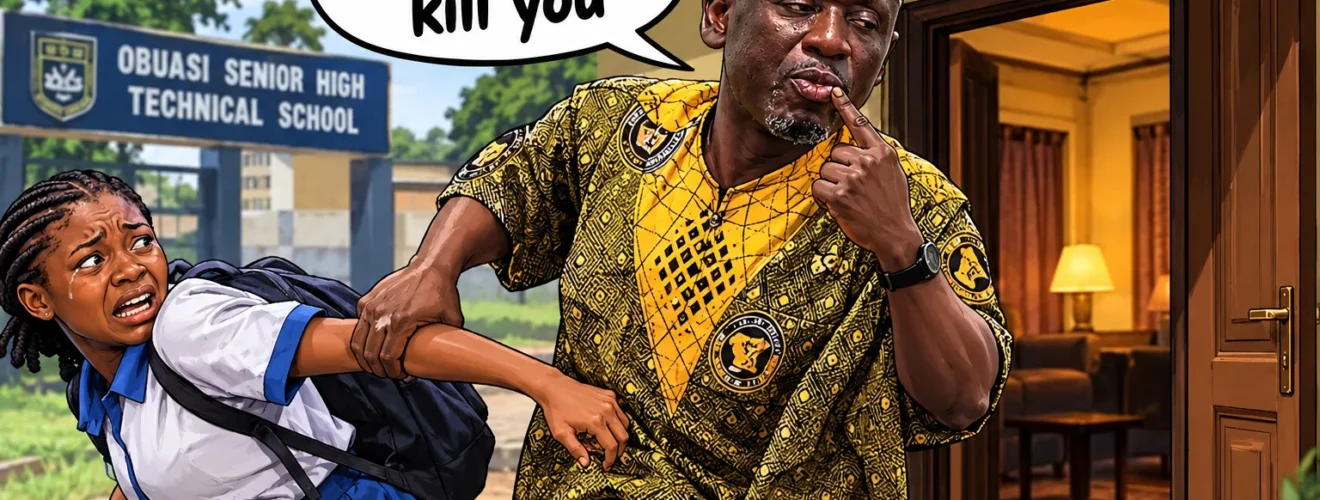
Ghana’s investigation into allegations of sexual abuse involving female students at Obuasi Senior High Technical School has entered a new phase, with the headmaster reportedly arrested, two education directors directed to step aside and police investigations continuing.
The case surrounding Inside the Dreaded Headmaster’s Bungalow, the JoyNews investigative documentary by Manasseh Azure Awuni, has taken several major turns since its release on October 19, 2026.
Interior Minister Mohammed Mubarak Muntaka disclosed on October 20 that the interdicted headmaster, Zakaria Abdulai, had been arrested and had given a statement to the police. The minister also said the case had been transferred from the Ashanti Region to Police Headquarters in Accra for further investigation, with investigators pursuing the legal process required to obtain a DNA sample.
In a separate development, the Ghana Education Service (GES) directed the Ashanti Regional Director of Education, Dr William Amankrah Appiah, and the Obuasi Municipal Director of Education, Kwamena Owusu-Nketiah, to step aside while investigations continue. The Service said the move was intended to prevent interference, or the perception of interference, in the investigation.
The developments come amid reports that 19 female students have come forward with allegations of sexual abuse involving the headmaster, growing demands for accountability from civil society organisations and fresh questions about how earlier complaints were handled.
The allegations have not been established by a court. The arrest and administrative measures should not be interpreted as proof of guilt.
Headmaster arrested as police pursue further investigation
The most significant new development is the disclosure by the Interior Minister that Zakaria Abdulai has been arrested in connection with the allegations.
Speaking before Parliament’s Public Accounts Committee on Tuesday, October 20, Mr Muntaka said the headmaster had been arrested and had given a statement to investigators.
According to reporting by 3News and JoyNews, the minister said the case had been moved from the Ashanti Regional Police Command to Police Headquarters in Accra for further investigation.
Mr Muntaka disclosed that the matter first came to his attention on September 7, when a report was submitted to the Criminal Investigation Department (CID). He said he insisted that the case be transferred to the national headquarters.
The minister also said investigators were pursuing legal authorisation to obtain a DNA sample from the headmaster for comparison with biological material reportedly recovered from the clothing of one of the alleged victims.
He explained that the police required a court order before collecting the sample and that the process was underway.
The disclosure introduces an important evidential development into the investigation. However, the proposed DNA procedure should not be confused with a completed test or a confirmed forensic result. No result was established in the reports reviewed as of October 20.
Mr Muntaka assured the public that the investigation would proceed in accordance with the law and that the headmaster would have the opportunity to respond to the allegations through the appropriate legal process.
Police explain why one complaint has been investigated
Another important development concerns the number of complaints formally investigated by the police.
On October 20, Bekwai Police Public Relations Officer ASP Lloyd Baidoo said the police had completed their investigation into a rape complaint filed by a student and forwarded the case docket to the Attorney-General for study and advice.
The police disclosure raises a distinction between the complaint that has already gone through the regional investigation process and the wider allegations reported by JoyNews.
According to MyJoyOnline, the docket sent to the Attorney-General concerns the single complaint investigated by the Ashanti South Police Command. The police said they were awaiting instructions from the Attorney-General on the next steps.
ASP Baidoo also said the police investigate matters brought formally to their attention and would welcome additional complaints or relevant information from other alleged victims.
He indicated that the police could act on further information, including a report from the GES committee that investigated the school disturbances.
This means the submission of one complaint docket to the Attorney-General should not be presented as proof that all 19 reported allegations have been investigated or resolved.
The wider investigation at Police Headquarters, the status of other complaints and the outcome of the Attorney-General’s review remain important issues to watch.
GES orders two education directors to step aside
The GES has also taken administrative action against two senior education officials while the case is being investigated.
In a statement issued on Tuesday, October 20, and signed by its Head of Public Relations, Daniel Fenyi, the Service directed Dr William Amankrah Appiah, the Ashanti Regional Director of Education, and Kwamena Owusu-Nketiah, the Obuasi Municipal Director of Education, to step aside with immediate effect.
The two officials were instructed to hand over their offices and all state property in their possession to Thomas Kwame Boateng, the Deputy Ashanti Regional Director of Education.
The Service said the decision was intended to allow the investigation to proceed without interference or the perception of interference.
The directive followed reports that complaints about alleged misconduct had reached education officials before the JoyNews documentary brought the case to wider public attention.
However, the GES directive does not, by itself, establish that either director committed misconduct or deliberately failed to act. Their responsibilities, the information available to them and the actions they took must be assessed through the relevant processes.
The Service also reaffirmed that Abdulai remained interdicted, dismissing reports circulating that he had been cleared.
The new directive broadens the administrative dimension of the case. Investigators must now establish not only what happened in the underlying allegations but also whether the systems responsible for receiving and escalating complaints operated as required.
What the earlier GES inquiry found about the allegations
A report published by MyJoyOnline on October 20 introduced an important qualification to the discussion about the history of complaints at Obuasi SHTS.
A nine-member committee that investigated the August 2026 school disturbances reportedly concluded that the sexual harassment allegations presented to it against the headmaster were not substantiated by the evidence it received.
According to the report, the committee was informed by the school’s Safe Space Focal Person that 16 girls were allegedly involved in sexual harassment cases concerning the headmaster.
All 16 students were invited to appear before the committee, but only four attended.
The finding must be understood within the scope of that inquiry. It concerned the evidence presented to the committee investigating the August disturbances. It is not a final court determination of the allegations, and it is separate from the fresh investigation prompted by the JoyNews documentary.
The distinction is essential because the earlier inquiry and the subsequent investigation have different contexts and processes.
The latest documentary brought additional accounts and questions about complaints reportedly made before the August disturbances. The GES and police must establish how those reports relate to the earlier inquiry and whether further evidence warrants additional action.
Neither the earlier committee’s conclusion nor the later allegations should be used to prejudge the outcome of the ongoing investigation.
How the allegations became a national story
JoyNews investigative correspondent Manasseh Azure Awuni’s documentary, Inside the Dreaded Headmaster’s Bungalow, examines allegations of sexual harassment and assault involving female students at Obuasi Senior High Technical School in the Ashanti Region.
The investigation focuses on accounts from students, complaints reportedly submitted to school and education authorities, and questions about whether those responsible for protecting learners responded appropriately.
The number of students reportedly alleging abuse increased as the investigation progressed.
In an October 15 report, JoyNews said the initial information available to Manasseh concerned five students. The number increased to 14 when he arrived at the school, before two additional students reportedly came forward, bringing the total to 16.
Subsequent reporting said three more students came forward, taking the reported number to 19 by October 18.
These figures refer to reported allegations, not findings that 19 offences have been proven. Each account requires appropriate investigation, and the available reports do not establish that every allegation concerns an identical incident.
The documentary has also drawn attention to the reported history of complaints involving school personnel, parents and education officials.
JoyNews previously reported that the school’s Girl Child Coordinator and safeguarding teacher had petitioned management in February 2026, while five girls reportedly made complaints to the Obuasi West Municipal Education Directorate in March.
Those accounts have prompted questions about how the complaints were handled and whether sufficient measures were taken to protect students.
The allegations and reported complaints remain subject to investigation. Any conclusions about individual responsibility must be supported by evidence.
Education Minister refers the criminal allegations to the CID
The Ministry of Education intervened before the documentary was released in full.
On October 13, Education Minister Haruna Iddrisu directed the immediate suspension of Abdulai pending investigations. The GES announced the headmaster’s interdiction on October 14.
The minister also requested that the CID investigate the criminal aspects of the allegations while education authorities pursued the administrative process.
In comments reported by MyJoyOnline on October 19, Mr Iddrisu said the criminal and administrative dimensions of the matter would be handled through their respective processes.
He also indicated support for stronger rules governing the conduct of teachers and students, including making the GES code of conduct and standards legally binding under Article 11 of the 1992 Constitution.
The proposed changes were presented as broader measures under consideration, not as legislation already enacted.
The distinction between administrative and criminal investigations matters. The GES can investigate professional conduct and take disciplinary action where justified, while the police investigate suspected offences under the law.
Any criminal charge, prosecution and determination of guilt must follow the applicable legal procedures.
Headmaster resigns from NDC constituency position and withdraws from race
The case has also affected Abdulai’s political activities.
On October 20, he formally resigned as Juaben Constituency Secretary of the National Democratic Congress (NDC) and withdrew his candidature for the constituency chairmanship.
In a letter to the party’s General Secretary, Abdulai said his decisions took immediate effect. He expressed gratitude to friends, relatives and supporters who had maintained their belief in his innocence.
He also said he intended to pursue lawful avenues to clear his name and vindicate his position.
The withdrawal followed controversy over the party’s handling of his proposed candidacy. The NDC had initially allowed him to proceed with the contest while the allegations were being investigated, before reversing course and directing him to step aside.
The party’s Deputy General Secretary, Mustapha Gbande, said the leadership wanted the investigation to proceed while respecting due process. The party also indicated that the outcome of the investigation could influence any further action.
Abdulai’s resignation and withdrawal are political decisions. They do not determine the outcome of the police investigation, and the allegations remain unproven unless established through the appropriate legal process.
Gender Ministry engages Manasseh Azure over student support
The Ministry of Gender, Children and Social Protection has also begun engaging with the journalist behind the investigation.
Adomonline reported on October 20 that the sector minister, Dr Agnes Naa Momo Lartey, had met Manasseh Azure Awuni to obtain first-hand information about the investigation and determine how the ministry could support the affected students.
According to the report, the ministry was reaching out to the students to provide psychological and other forms of support while the investigations continued.
Dr Lartey also said she had contacted the GES Director-General to arrange a meeting on the matter.
The ministry’s reported engagement adds a child-protection and welfare dimension to the response. Beyond determining whether criminal offences occurred, the authorities must consider the safety, privacy and wellbeing of students who have come forward.
Support for alleged victims should not depend on the eventual outcome of a criminal case. Appropriate assistance can be provided while ensuring that investigations remain fair and evidence-based.
Civil society organisations demand accountability and safeguarding reforms
The developments have prompted calls for a broader review of how allegations of sexual misconduct are handled in Ghanaian schools.
The Gender Centre for Empowering Development (GenCED) called for a thorough investigation, institutional accountability and stronger safeguards for students.
In a statement on October 20, the organisation said administrative action alone would not be sufficient without a credible investigation and effective protection for students. It also cautioned that the decision for education directors to step aside should not be treated as proof of wrongdoing.
Child Rights International separately criticised what it described as a tendency for the GES to prioritise school reputation over student safety. Its Executive Director, Bright Appiah, called for a review of safeguarding policies and argued that abuse allegations should be referred to appropriate law enforcement and child-protection authorities rather than handled solely as internal disciplinary matters.
RISE-Ghana also urged the NDC to reconsider its initial decision to allow Abdulai to contest the constituency chairmanship. The organisation argued that political parties and state institutions should demonstrate a clear commitment to child protection and accountability while respecting due process.
Amnesty International Ghana called for a prompt, independent and survivor-centred investigation. It urged the relevant authorities to protect students and witnesses from intimidation, preserve evidence and examine whether safeguarding failures contributed to the alleged incidents.
These are the positions of the respective organisations, rather than findings of a court or an official inquiry. Their statements nevertheless underline the broader public concern about complaint handling, student safety and institutional responsibility.
What the case means for student protection in Ghana
The Obuasi SHTS case raises questions about the safeguards available to students who report alleged abuse, particularly when allegations involve a senior school administrator.
Students depend on school authorities for supervision, discipline and protection. Reporting channels must therefore be accessible and sufficiently independent to allow complaints against senior officials to be escalated beyond the immediate school management structure.
The case also highlights the importance of keeping proper records of complaints, referring suspected criminal conduct to the appropriate authorities and protecting complainants from pressure or retaliation.
A school safeguarding system must do more than exist on paper. Students need to know where they can report concerns, how those concerns will be handled and what protection is available while a complaint is being investigated.
At the same time, a credible response must protect the rights of all parties. Allegations must be investigated thoroughly, evidence preserved and decisions based on established facts rather than political affiliation, public pressure or speculation.
If the investigations establish professional misconduct or failures by officials responsible for student protection, the relevant authorities must determine the appropriate action under the law and applicable disciplinary procedures.
What happens next in the Obuasi SHTS case?
As of October 20, 2026, several processes remain important.
The police investigation has entered a new phase following the reported arrest and transfer of the case to Police Headquarters in Accra. Investigators are pursuing court authorisation for DNA testing, while the Attorney-General is expected to provide advice on a docket concerning one complaint already investigated by the Ashanti South Police Command.
Separately, the GES has directed two education directors to step aside and has maintained the headmaster’s interdiction. The Service must also address questions about the earlier inquiry, the handling of reported complaints and any further evidence that emerges.
The Gender Ministry’s engagement with the journalist may lead to additional support for the students, while civil society organisations continue to press for accountability and stronger safeguarding arrangements.
No final police finding or court judgment establishing the allegations was identified in the sources reviewed for this update.
READ: National Service 2026/27 First Batch Posting Out for 70,072 Personnel
The next significant developments to watch are the outcome of the police investigation, any directions from the Attorney-General, the findings of the fresh GES inquiry and any further official measures to protect the students concerned.
The central test is whether the authorities can establish the facts, ensure a fair legal process, provide appropriate support to students and address any institutional failures that the evidence confirms.
For now, Inside the Dreaded Headmaster’s Bungalow remains an unfolding investigation. Its lasting significance will depend not only on the allegations it has brought to public attention but also on how effectively the institutions responsible for justice and student protection respond.