
Pupils to Study Radiation and Nuclear Science
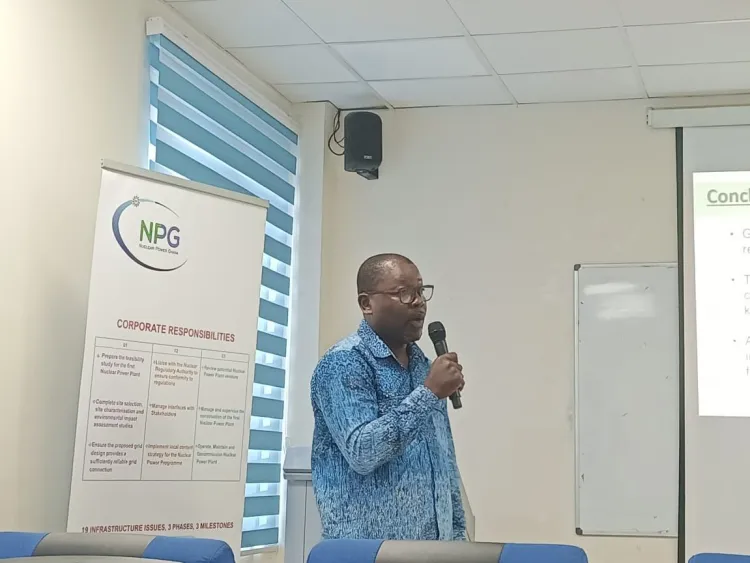
Plans are currently in progress to incorporate radiation and nuclear science into the fundamental education curriculum of elementary schools as a component of broader initiatives aimed at enhancing comprehension of the subject and shaping public perception.
The Institute of Statistical Social and Economic Research conducted a perception survey, which revealed that there is little understanding of radiation science or nuclear science and technology.
READ ALSO :Give NPP a third term to operate Mahama E-block schools – Adutwum.
Ghana is working towards building and operating its first nuclear power plant to support the country’s industrialisation agenda, and public perception about nuclear is critical to the successful implementation of the project.

Dr Archibold Buah-Kwofie, Deputy Director, Nuclear Power Institute, told the Ghana News Agency at a workshop for editors and senior media professionals in Accra.

He said it was important to bridge the knowledge gap on nuclear science as the country took steps to add nuclear to its energy portfolio.
WANT TO PASS 2027 BECE? REGISTER FOR BECE HOME MOCK
Register your ward for Ghana's premier Home Mock service, active since 2022.
He said a draft curriculum had been developed and engagements with the Education Ministry were ongoing to include the subject in the curriculum.
“It is useful to include nuclear at the level of basic education so that people coming out of basic education will have some level of knowledge about what radiation signs are.
“A lot of people don’t know that the X-Ray we take at the hospital is radiation. There are a lot of important uses of radiation that we need to know and understand,” Dr Buah-Kwofie said.
He added: “If we are going to be a nuclear country, we need to ensure that we have a sustainable supply of human resource and the earlier they understand the uses of radiation and what we can get out of them, the better.”
Dr Buah-Kwofie said the Nuclear Power Ghana (NPG) had also signed partnerships with some tertiary institutions, including the University of Media, Arts and Communication, Ho Technical University, and Takoradi Technical University, to roll out general basic nuclear radiation signs in their programmes.
Dr Stephen Yamoah, the Executive Director, NPG, urged journalists to be accurate, factual, and use verified information in their reportage on nuclear to prevent misinformation on the subject.
“The discussions on nuclear power should emphasise its immense transformational socio-economic benefits, while also addressing concerns related to safety, waste management, security, and safeguards,” he said.
Ghana’s nuclear programme has been justified on the need for alternate baseload power for industrialisation, limited hydro sources, postulated decline of gas, tariff reduction for industries, desalination, employment creation and climate change commitments.
MORE STORIES FOR YOU:Buy Term 1 Exam Questions And Answers (KG1 to JHS3) – Up To
As of 2021, hydro accounted for 38 per cent of the country’s energy generation portfolio, whiles thermal accounted for 60 per cent (making it the baseload).
Solar and biomas contributed one per cent each to the energy mix.
Experts have raised concerns about the cost of power from thermal sources, and there are fears that electricity prices may continue to go up if the country did not adopt cheaper energy sources.
It is estimated that 40 per cent of the production cost of industries goes into electricity tariffs
 Placement Pending on CSSPS 2026: What It Means and What Students Should Do
  How to Study Smarter, Not Harder: 5 Science-Backed Strategies for Students
  NSMQ 2026: Edinaman SHS Stages Comeback to Secure One-eighth Spot!
  NSMQ 2026: Accra Girls’ SHS Storms into the One-eighth Stage!
  GES Opens 2026 CSSPS School Choice Upload – Heads of Basic Schools Have 3 Days
  Free 2026/2027 Term 1 Schemes of Learning: Download for all classes and subjects