The Dangers of Not Attending Secondary School After BECE
Your child passed the 2026 BECE. You celebrated the way Ghanaian families celebrate — with food, with prayers, with phone calls to relatives in Kumasi and Accra and abroad. You relaxed. You assumed the hardest part was behind you.
But right now, across all sixteen regions of Ghana — from the dusty streets of Bolgatanga to the busy neighbourhoods of Tema, from the fishing communities of the Central Region to the farming villages of the Brong-Ahafo — thousands of 2026 BECE graduates are making a quiet decision that will define the entire arc of their adult lives. And most of them do not even know they are making it.
The school selection stage looks like a game filled with excitement — choosing schools, comparing notes with friends, debating boarding versus day. But the destinies of thousands of young Ghanaians will be tied permanently to the choices made in these next few days. And the most dangerous choice of all is not choosing wrong — it is choosing nothing. It is not going at all.
This article is not written to judge any Ghanaian family facing genuine hardship. It is written because the dangers of a BECE graduate not attending Senior High School or TVET in Ghana are so severe, so permanent, and so systematically underestimated that every parent of a JHS student — from Grade 7 right through to 2026 BECE graduates awaiting placement — needs to read it, understand it, and share it with their community before it is too late for someone they love.

What the BECE Certificate Actually Means in Ghana Without SHS
Think of the BECE like getting selected for the Black Stars. Asamoah Gyan did not stop after scoring his first goal for Ghana. He kept going, kept showing up, kept performing — because getting selected was not the achievement. Performing consistently after selection was. Your child’s BECE result is their first Black Stars call-up. SHS is where they prove they deserve to stay.
The Basic Education Certificate Examination result slip is exactly that — a certificate of basic education completion. The word basic is not an insult in the Ghanaian educational context. It is a legal and academic descriptor that certifies your child has completed the foundational minimum of Ghana’s pre-tertiary educational requirement. Nothing more. Nothing less.
WANT TO PASS 2027 BECE? REGISTER FOR BECE HOME MOCK
Register your ward for Ghana's premier Home Mock service, active since 2022.
Here is what a BECE certificate alone cannot do for your child in Ghana in 2026:
| Opportunity in Ghana | BECE Only | SHS Certificate (WASSCE) |
|---|---|---|
| Ghana Public Services Commission application | Not eligible | Eligible |
| Ghana Health Service — Nursing and Midwifery | Not eligible | Eligible |
| Ghana Education Service — Teacher Training | Not eligible | Eligible |
| University of Ghana, KNUST, UCC, UDS entrance | Not eligible | Eligible with grades |
| Ghana Police Service recruitment | Not eligible | Eligible |
| Ghana Armed Forces enlistment | Not eligible | Eligible |
| Judicial Service of Ghana application | Not eligible | Eligible |
| Formal bank business loan in Ghana | Extremely limited | Accessible |
| Most formal private sector employment Ghana | Not eligible | Entry level eligible |
| Professional certification programmes Ghana | Not eligible | Eligible |
| TVET higher programmes and certifications | Limited access | Full access |
Every single row in that table represents a door in Ghana that closes permanently — or at minimum closes for years — the moment a BECE graduate chooses not to continue their education.

Danger 1 — The Income Trap That Compounds Every Year in Ghana’s Economy
In Ghana’s current economy, the income gap between a worker with only a basic education certificate and one with a WASSCE is not a minor difference. It is structural, systemic, and compounding — growing wider every year the person remains without the higher qualification.
A BECE graduate who enters the Ghanaian workforce immediately will typically access the informal economy — Kejetia market trading, Agbogbloshie labour, domestic work in Cantonments and East Legon, apprenticeships in the artisan sectors of Suame Magazine in Kumasi or Tema Community One. These are not shameful occupations. Many Ghanaians build dignified lives within them. But without a secondary school certificate, the ceiling in every one of these sectors is dramatically lower than it would otherwise be.
The BECE graduate who skips SHS and learns a trade at Suame Magazine will spend years mastering their craft with no paper qualification to show for it. The same person who completes SHS at a technical school and then enters the same trade brings formal literacy, numeracy, record-keeping skills, and the WASSCE qualification that allows them to eventually register a business with the Registrar General’s Department, open a GCB or Absa business account, access a loan from a microfinance institution, and employ other young Ghanaians. The starting point on the workshop floor looks identical. The destination twenty years later is completely different.
Danger 2 — Formal Employment in Ghana Is Legally Closed Without WASSCE
This is not an opinion or a discouraging generalisation. It is a documented policy reality that Ghanaian families consistently underestimate until the application portal rejects their child and sends them home.
The Ghana Public Services Commission, the Ghana Health Service, the Ghana Education Service, the Ghana Police Service, the Ghana Armed Forces, the Judicial Service of Ghana, the Electoral Commission, the Ghana Revenue Authority, the Driver and Vehicle Licensing Authority, and virtually every formal government institution in Ghana requires a minimum WASSCE result for entry-level recruitment.
Without it, your child is not just unlikely to get a government job in Ghana. They are legally ineligible to submit an application. The online form will not accept their details. The physical form will be returned at the counter. No amount of connection, protocol, MP’s letter, or community standing changes a minimum qualification requirement at the application stage.
This matters more urgently than ever in 2026 because Ghana’s formal economy is expanding. The digitalisation of government services under the Ghana.gov platform means that qualification verification happens automatically at the point of application. There is no longer a human officer who can look the other way. The system itself enforces the minimum requirement. And the window of opportunity for someone without WASSCE is shrinking, not expanding, as Ghana continues to develop.
Danger 3 — The Skills Gap That Cannot Be Fixed Later in a Ghanaian Career
Junior High School in Ghana teaches foundational literacy and numeracy under the NaCCA Common Core Programme. Senior High School builds the applied skills — analytical thinking, scientific reasoning, business mathematics, literary analysis, Ghanaian history and civic education, agricultural science, technical drawing, and economic reasoning — that a person uses to navigate adult life in Ghana with genuine competence and confidence.
A 2026 BECE graduate who skips SHS does not just miss WASSCE passes. They miss three years of structured cognitive development that shapes how they think, how they argue, how they solve problems, and how they understand the Ghanaian society they live in and contribute to.
This gap cannot be fully patched by market experience alone. It cannot be closed by watching YouTube tutorials or attending weekend business seminars in Accra. Formal secondary education in Ghana builds intellectual infrastructure that informal experience cannot replicate — and the absence of it shows, in subtle but consequential ways, throughout the rest of a person’s professional life in this country.
Danger 4 — The Social Mobility Wall That Divides Ghana’s Citizens
Ghana’s growing middle class is built almost entirely on secondary and tertiary education. The pathways from poverty to stability, from stability to prosperity, and from prosperity to generational wealth run almost exclusively through Ghana’s educational institutions.
A BECE graduate who does not attend SHS does not just close occupational doors. They wall themselves off from the social networks, mentorship relationships, alumni connections, and institutional affiliations that SHS and university provide in the Ghanaian context specifically.
Your child’s SHS classmates at Achimota, Opoku Ware, Holy Child, Tamale SHS, Bolga Girls, or any of Ghana’s hundreds of other secondary schools will become their professional network for the rest of their lives. Their SHS teachers will write references for their first formal job applications. Their school’s Old Students Association will open doors in Accra, Kumasi, London, and New York. The friendships formed in the dormitories and classrooms of a Ghanaian SHS will sustain your child through the difficult early years of adult life in ways that no market friendship or neighbourhood connection can replicate.
None of this — not a single element of it — is available to the BECE graduate who stays home.
Danger 5 — The “I’ll Go Later” Myth That Is Destroying Ghanaian Futures
This is the most dangerous belief circulating in Ghanaian families right now and it destroys futures with heartbreaking regularity across every region of this country.
“He will work with his uncle in the shop for one year and then go back to school.”
“She will help at home while her younger siblings finish JHS and then it will be her turn.”
“We cannot manage the incidentals right now but by January we will sort it out.”
Free SHS exists. The government of Ghana provides free secondary school education to every qualified BECE graduate placed in a government Senior High School. The fees that prevented an entire generation of Ghanaian children from accessing secondary education are no longer the primary barrier. The CSSPS system is available. The schools are waiting. The prospectus is free to download.
But the myth of going later persists across Ghana because families do not understand three critical facts about how the SHS placement system operates in this country.
Fact one — The CSSPS placement system runs in specific annual cycles tied directly to BECE results. Missing the current cycle means waiting a full year for the next one. The second selection window for 2026 closes on August 7, 2026. After that date, no new selections are processed until the next cycle.
Fact two — Every year a student delays entry into SHS is a year they fall behind the cohort they should have joined. Returning to SHS a year or two later means being older than your classmates, which in the Ghanaian school context creates social pressures that make persistence significantly harder.
Fact three — Life intervenes in Ghana with particular force. The young woman who stays home for one term to help with a new baby sibling gets recruited into full-time domestic responsibility that becomes impossible to leave. The young man who starts working in his father’s shop in Kejetia gets drawn into financial obligations to the family business that make walking away feel selfish. The temporary break becomes permanent. The plan to go later quietly dies in the noise of daily Ghanaian life. And twenty years later that person is sitting with their own child explaining why education matters — from the painful vantage point of someone who did not finish theirs.
Danger 6 — The Mental Health Cost That Ghana Does Not Talk About
There is a psychological dimension to educational exclusion in Ghana that our society rarely discusses openly in homes, in churches, in mosques, or in community meetings — but that shows up with painful clarity in the lives of Ghanaian adults who did not complete their secondary education.
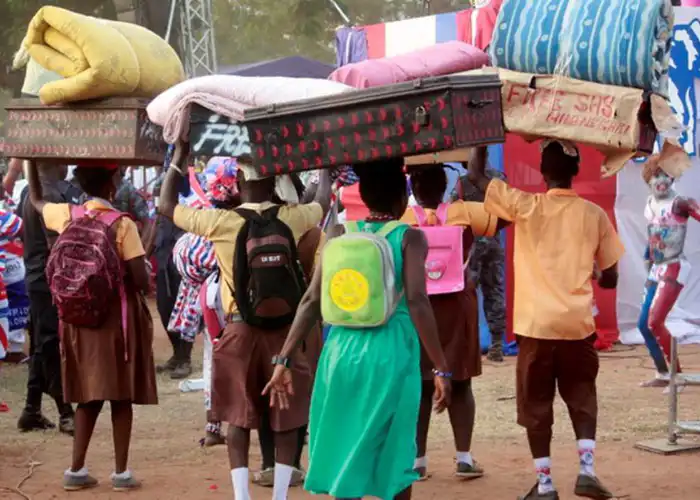
A 2026 BECE graduate who watches their peers board buses to Prempeh College, to Wesley Girls, to Mfantsipim, to T.I. Amass, to Krobo Girls, to Tamale SHS — who sees the uniforms being bought at Makola Market, the trunks being packed, the photographs being taken at the school gate — while they remain at home experiences a form of social exclusion that affects self-esteem, aspiration, and sense of personal worth in ways that persist for decades.
The adult Ghanaian who did not go to SHS often carries a quiet shame about their qualification status that shows up as reluctance to apply for opportunities they actually deserve, avoidance of formal environments and institutions, and a deeply internalised belief that certain rooms in Ghana — the boardroom, the government office, the professional association — are simply not for them. Not because they were told so explicitly. But because the absence of the qualification that opens those rooms has taught them, slowly and silently, to stop trying.
This is not inevitable. It is not the destiny of any Ghanaian child. And it is entirely preventable by making sure that every BECE graduate who can attend SHS in Ghana does attend SHS in Ghana.
What Free SHS and TVET Mean for Every Ghanaian BECE Graduate in 2026
Ghana’s Free SHS policy — fully operational in 2026 — covers tuition for every BECE graduate placed in a government Senior High School anywhere in Ghana. This policy exists precisely because the government of Ghana recognised that the country cannot develop if its young people are trapped in educational poverty through no fault of their own or their families.
For BECE graduates whose academic profiles or personal interests lean toward practical and vocational skills, Technical and Vocational Education and Training institutions across Ghana offer a legitimate, valuable, and increasingly recognised alternative pathway. Ghana’s TVET institutions — including the country’s technical schools, vocational training institutes, and community technical training centres — provide qualifications that are recognised by formal employers and that lead to NVTI certification and higher TVET programmes.
The message is clear. In Ghana in 2026, there is no longer a legitimate financial reason for a BECE graduate not to continue their education — whether through SHS or TVET. The infrastructure is in place. The policy is active. The schools are available. The only remaining barrier is the decision.
What Grade 7, 8, and 9 Students Across Ghana Must Understand Right Now
If you are currently in Grade 7, 8, or 9 at a Junior High School anywhere in Ghana — whether in Accra, Kumasi, Cape Coast, Sunyani, Wa, Navrongo, Ho, or any of the thousands of communities across this country — understand this clearly and take it seriously:
The decisions you are making about your attitude toward school right now — whether you attend class consistently, whether you submit your homework, whether you engage your teachers honestly, whether you study when it is easier to watch videos on your phone — are setting the trajectory for everything that comes after your BECE.
Students in Ghana who build strong academic habits in Grade 7 arrive at the BECE with aggregates that give them access to the schools and programmes they want. Students who coast through JHS treating it as an obligation to be endured arrive at the BECE with aggregates that limit their choices to whatever is left.
Your teachers at your JHS are not your enemies. The rules of your school are not obstacles designed to punish you. The NaCCA curriculum textbooks you find boring contain the exact material that will determine whether you get aggregate 8 or aggregate 24 — and that gap is the difference between the school of your dreams and a school you never wanted to attend.
You are not too young for this conversation. You are exactly the right age for it. In fact, if you are in Grade 7 reading this, you have more time to change your trajectory than any BECE graduate currently waiting for August 7. Use that time.
Use the SHSpath portal at ghanaeducation.org/shspath/index.php to understand right now which SHS programme matches your interests and strengths. Build your future intentionally, as a deliberate project. Do not let Ghana’s educational system build it for you by default.
What Ghanaian Parents Must Do Before August 7, 2026
If your child has received their 2026 BECE results and has not yet selected schools:
Do not allow another single day to pass without logging into the CSSPS portal at cssps.gov.gh and completing the school selection process. Select all 8 schools. The second selection window closes on August 7, 2026. Missing this deadline means waiting a full year for the next placement cycle. That year costs your child more than you can calculate right now.
If your child is currently in Grade 7 or 8:
Have the conversation this week. Not as a threat. Not as pressure from a frustrated parent. As an honest, loving, factual explanation of what adult life in Ghana looks like for someone with a WASSCE certificate versus someone without one and the need to work hard gradually towards the BECE and the need to excel in the exam. Use the table in this article. Show them the doors. Let the reality do the motivating rather than your frustration.
If you are concerned about the cost:
Ghana’s Free SHS covers tuition at government secondary schools and polit private schools. The GES Harmonised Prospectus covers personal items and has been standardised to reduce cost. Contact your District Education Office — every district in Ghana has one — for guidance on additional support systems including scholarships, bursaries, and educational grants available to qualifying Ghanaian families.
If your child is resistant to going to SHS:
Do not dismiss the resistance. Investigate it. Many Ghanaian students who resist SHS are not lazy — they are exhausted from three years of JHS examination pressure, anxious about leaving home, or responding to negative peer pressure from friends who are also not going. Identify the real reason and address that specifically rather than the surface behaviour.
The Complete Checklist for Every 2026 BECE Family in Ghana
Action required before August 7, 2026:
- Complete school selection — choose all 8 schools across realistic categories
- Use SHSpath at ghanaeducation.org/shspath/index.php — confirm programme fit before finalising selections
- Call the assigned school — confirm reporting date, requirements, and any additional forms
- Download the official 2026/2027 GES Harmonised SHS1 Prospectus — from GES website or Ghanaeducation.org
- Prepare all documents — CSSPS placement form, BECE result slip, birth certificate, passport photographs, parent Ghana Card
- Have the SHS conversation with your child — honest, specific, and grounded in the Ghanaian reality
For families of Grade 7 and 8 students:
- Read this article together as a family this week
- Identify the subjects your child finds most challenging in the NaCCA curriculum — address them now
- Use SHSpath to explore which SHS programmes match your child’s genuine interests
- Set specific academic targets for the next term — not vague goals but measurable ones
- Connect with your child’s class teacher — ask honestly how your child is performing and what needs to improve
Frequently Asked Questions
What happens if a BECE graduate does not attend secondary school in Ghana?
A BECE graduate in Ghana without a WASSCE certificate is legally ineligible for all government employment applications including Ghana Health Service, Ghana Education Service, Ghana Police Service, and Ghana Armed Forces. They are excluded from nursing, teacher training, and university entrance at KNUST, UG, UCC, and UDS. They are confined to informal sector work with dramatically lower lifetime earning potential and no pathway to formal professional development in Ghana.
Is secondary school compulsory after BECE in Ghana?
Ghana’s constitution mandates free basic education but SHS attendance is not legally enforced as compulsory. However the practical consequences in the Ghanaian context — total exclusion from formal employment, professional training institutions, and all universities — make secondary education functionally essential for any BECE graduate who wants a meaningful adult life in this country.
Can a BECE graduate get a good job in Ghana without completing SHS?
In Ghana’s current and developing formal economy, government and formal private sector employment almost universally requires a minimum WASSCE qualification. A BECE graduate is legally excluded from all government service applications regardless of their talent, intelligence, or family connections. The income gap between a BECE-only worker and a WASSCE holder compounds significantly and permanently over a Ghanaian working lifetime.
What does Ghana’s Free SHS policy cover for 2026 BECE graduates?
Ghana’s Free SHS programme covers tuition fees for all 2026 BECE graduates placed in government Senior High Schools across all sixteen regions. Supplementary personal items listed in the GES Harmonised Prospectus remain the family’s responsibility but the major historic financial barrier to secondary education in Ghana has been substantially removed by this policy.
What should a Grade 7 or 8 student in Ghana do right now to prepare for SHS?
Build strong academic habits under Ghana’s NaCCA CCP curriculum immediately. Focus specifically on Mathematics, English Language, Integrated Science, and Social Studies — the core BECE subjects. Use the SHSpath portal at ghanaeducation.org/shspath/index.php to identify which SHS programme matches your interests. Attend school consistently, engage your teachers honestly, and understand that your BECE aggregate is being determined by the work you do today.
What if a Ghanaian family genuinely cannot manage costs even with Free SHS?
Contact your nearest District Education Office immediately. Ghana’s educational support system includes the Ghana School Feeding Programme, the Capitation Grant, disability grants, and various NGO-supported bursary schemes available to qualifying families. Do not allow cost uncertainty to prevent SHS attendance without first contacting your District Education Office and exhausting every official Ghanaian support channel available to your family.
READ: Buy Your Master Compass Beacon of Light Questions and Answers for BECE Success
Conclusion
The 2026 BECE certificate is not the ending of your child’s educational journey in Ghana. It is the beginning — but only if they walk through the door that it opens.
Every 2026 BECE graduate in Ghana who does not attend Senior High School or TVET is not simply missing an education. They are missing the version of their life where the doors of the Ghana Public Services Commission are open to them. Where the Ghana Health Service considers their application. Where KNUST and the University of Ghana review their transcript. Where a formal bank in Ghana gives them a business loan. Where their children inherit a better starting point than the one they had.
Ghana made secondary school free. The CSSPS system is running. The schools across all sixteen regions are waiting. The August 7 deadline is real and it is close. The only thing standing between a 2026 BECE graduate and the rest of their Ghanaian future is the decision to go.
Make that decision today. Help your child make that decision. And share this article through every WhatsApp group, every Facebook page, every community notice board, and every conversation you have with Ghanaian parents, teachers, and JHS students — because the danger described in every section above is not a warning about a distant possibility. It is happening right now, quietly, to real Ghanaian children in real Ghanaian communities.
Do not let it happen to yours.
Published by Education-News Consult | Powered by Skulmanager.com
Editorial Team, Ghanaeducation.org — Ghana’s Most Trusted Education News and Resource Platform