
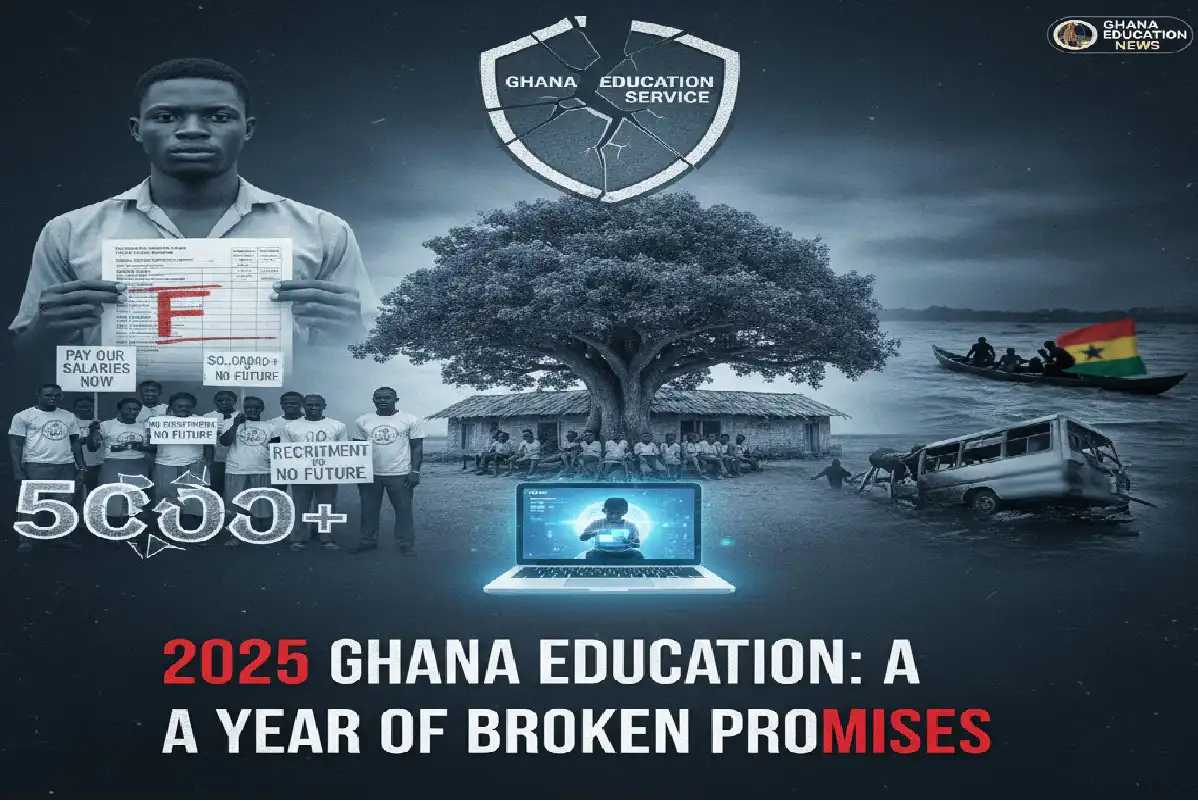
The year 2025 was never without sad education news and moments for students, teachers, and parents. While 2025 saw massive student failures, the real “crisis” lived in the staff rooms. From broken promises of recruitment to teachers picketing for salaries, the education sector in 2025 was defined by a growing distance between government policy and the reality of the Ghanaian educator.
Top 20 Most Disappointing Ghana Education News Headlines
1. The WASSCE Mathematics Meltdown (48.73% Pass Rate)
The most jarring headline was the catastrophic drop in Core Mathematics performance. The pass rate plummeted from 66.86% in 2024 to just 48.73%. For the first time in nearly a decade, more than half of the nation failed to secure a credit pass in the most vital subject for university admission.

2. The Recruitment Mirage: The “50,000 Teacher” No-Show
The biggest disappointment for graduate teachers was the government’s failure to fulfill its promise of recruiting 50,000 teachers and 10,000 non-teaching staff. While the Ministry of Education announced plans in Parliament, the GES repeatedly issued “fake news” alerts against viral recruitment letters, leaving thousands of trained graduates unemployed and in despair throughout 2025.
3. The “Unpaid” Sacrifice: Teachers Working 13 Months Without Pay
In September 2025, the Coalition of Unpaid Newly Posted Teachers hit the streets. It was revealed that over 6,000 teachers, mostly from the 2022 batch, had worked for up to 13 months without a single cedi in salary. The delay was blamed on expired financial clearances and administrative bottlenecks, forcing educators into a cycle of debt just to stay at their posts.
4. TEWU’s Indefinite Strike Paralyzes Administrative Services
In September, the Teachers and Educational Workers Union (TEWU) launched an indefinite strike. They cited “unjust and unfair” treatment regarding their conditions of service. This strike closed libraries, shut down school kitchens, and halted administrative work across all public and technical universities nationwide.
5. 6,296 Results Cancelled: A Crackdown on Future Prospects
While WAEC’s strictness was praised for integrity, the result was a “massacre” of academic futures. 6,296 candidates had subject results cancelled, and 653 students had their entire results voided for mobile phone possession, exposing how deeply malpractice had seeped into the system.
6. CETAG’s Stand-Off Over Arbitral Awards
The Colleges of Education Teachers Association of Ghana (CETAG) spent much of 2025 in a stalemate with the government. Despite a legally binding National Labour Commission (NLC) award, tutors saw their Book and Research allowances delayed, leading to threats that nearly shut down all 46 Colleges of Education.

7. The Continuous Professional Development (CPD) Allowance Betrayal
Teacher unions (GNAT and NAGRAT) expressed “strongest displeasure” in late 2025 when the government failed to pay the agreed CPD and CDISA allowances in November. A “technical challenge” at the Controller and Accountant-General’s Department was cited, but for teachers, it felt like yet another broken promise on the welfare front.
READ: Official GES 2025/2026 Second Term Calendar for Basic Schools
8. 5,000 Schools Still “Under Trees”
In a sobering December report, the Ministry admitted that 5,000 schools still operate under trees or in dilapidated sheds. This starkly contrasted with the high-tech “Smart School” laptops being distributed, highlighting a massive gap in basic infrastructure investment.
9. The Social Studies Slump (71.53% to 55.82%)
Social Studies, traditionally a high-scoring subject, saw a massive decline. Examiners attributed this to a shift toward higher-order thinking questions that caught students—used to “chew and pour” (rote learning)—completely off-guard.
10. Promotion Interview Gridlock
Thousands of teachers who passed their promotional interviews in 2024 and 2025 remained on their old salary scales. TEWU and GNAT reported that many staff had received no communication or salary upgrades months after completing the rigorous promotion process.
11. The 53% “Learning Poverty” Shock
A 2025 UNESCO report revealed that 53% of Ghanaian children aged 10 cannot read a simple story. This data point became the “smoking gun” for why JHS and SHS students are failing mass exams—they never mastered the basics of literacy.
12. High Court Battles Over University Postings
A group of university graduate teachers had to picket at the Ministry of Education in May 2025 after their postings were revoked. Out of 39,000 appointment letters issued, only about 12,000 could be absorbed due to a lack of financial clearance, leaving over 25,000 qualified teachers stranded.
13. Overcrowding Reaches a Breaking Point
With 3.2 million students now in the Free SHS system, 2025 saw classrooms in Category B and C schools swelling to 80 students per teacher. The “Double Track” system, meant as a temporary fix, remained a permanent and confusing reality for many.
14. Social Media Shorthand in Exam Scripts
WASSCE examiners reported a “disturbing” trend in 2025: students using WhatsApp shorthand (e.g., ‘u’ instead of ‘you’) in formal English and Social Studies essays. This highlighted a catastrophic decline in formal writing skills among the digital generation.
15. The Return to “International WASSCE” (An Admission of Defeat?)
Finally, the GES announced that Ghana would return to the International WASSCE in 2026. While many see this as a way to restore standard, critics view it as an admission that the “Ghana-Only” exams had become a sub-standard experiment that ultimately failed the 2025 batch.
The Ghana Education News editorial team dedicates the next session of our review to the educators and learners who did not make it to the end of 2025. Their names are not just statistics; they represent the heart and soul of the Ghanaian classroom.
16. The Bawku and Garu Tragedies: Schools as Battlegrounds
In 2025, the spillover of communal conflicts into “safe zones” reached a breaking point. In October, the nation mourned Mr. Bukhari Yahaya, the headteacher of Garu D/A Basic School, who was shot dead while heroically guiding his pupils to safety during a daylight attack. Earlier in July, final-year student Hakim Kundima was fatally shot on the campus of Bawku SHS. These incidents led to the temporary closure of several schools and highlighted the extreme risks faced by educators in conflict zones.
17. The “Silent Crisis”: A Rise in Student and Teacher Suicides
2025 exposed a dire need for mental health support in schools. The tragic death of Samiru Abass, a student leader at Islamic SHS who fell from a school building following an allegation of misconduct, sent shockwaves through the country. Additionally, reports of teachers taking their own lives due to emotional distress and financial pressure—including the widely reported case of Prince Nkrumah in Assin Fosu—highlighted that the “disappointment” of 2025 was often a matter of life and death.
18. Natural Disasters: The Anloga Lightning Tragedy
In a freak and terrifying incident in March 2025, the education community at Anloga SHS was thrown into mourning when a Physics teacher, Mr. William Amoako, was struck by lightning during a heavy downpour while heading home. This tragedy raised urgent questions about the lack of lightning arresters and safety protocols in many rural and peri-urban schools across the Volta Region.
19. The Lawra Drowning: Seven Lives Lost in the Black Volta
One of the darkest days of the year occurred in June 2025, when seven students of Lawra SHS tragically drowned. The students were attempting to cross the Black Volta River at Dikpe in a canoe when the vessel capsized. The “Black Saturday” incident devastated the Lawra community and underscored the dangerous commutes many students still endure just to access an education.
20. Road Carnage: The Road Safety Advocate’s Final Lesson
In a cruel irony, Mr. Collins Osei Boateng, a teacher known for his passionate online advocacy for road safety, died in a tragic car crash in August 2025—just one day after posting a plea for authorities to intensify road safety campaigns. His death, along with various school bus accidents throughout the year, remains a painful reminder of the treacherous nature of Ghanaian roads for the teaching fraternity.
| Rank | Headline Category | Primary Issue |
| 1-5 | Infrastructure & Funding | Unfinished school projects and budget cuts |
| 6-10 | Policy & Curriculum | Implementation delays and textbook shortages |
| 11-15 | Teacher Welfare | Salary disputes and industrial actions |
| 16-20 | Student Outcomes | Examination irregularities and placement challenges |
As we close the chapter on 2025, these 20 headlines serve as a sobering reminder of the hurdles still facing the Ghanaian education sector. While the year was marked by significant setbacks—from infrastructure deficits to policy inconsistencies—identifying these “disappointments” is the first step toward meaningful reform. Education remains the backbone of our national development, and the failures of the past year should not be viewed as final, but rather as a roadmap for what must be prioritized in 2026. It is our hope that stakeholders, policymakers, and educators take these lessons to heart to ensure that next year’s review is defined by progress rather than pitfalls.
The Ghana Education News Editorial Team is a specialized collective of education researchers, journalists, and policy analysts dedicated to providing high-fidelity reporting on the Ghanaian academic landscape. Serving as a primary bridge between governing bodies—including the Ghana Education Service (GES) and WAEC—and the public, the team leverages over a decade of combined experience to serve students, parents, and educators nationwide.
Lead Architect & Editor-in-Chief
The team is led by Wisdom Kojo Eli Hammond, a distinguished Ghanaian Edu-Tech Entrepreneur, AI Solutions Developer, and Product Architect with over 25 years of cross-disciplinary experience in education, finance, and digital media. Wisdom is the visionary force behind SkulManager, Ghana’s premier school management ecosystem, and the Lead Consultant at Education-News Consult.
A self-taught innovator, professional Web Designer, and regular columnist on GhanaWeb, Wisdom engineered SkulManager.com as the only platform strictly tailored to the GES Curriculum. His technical leadership has redefined educational assessment through a Hybrid Marking Ecosystem, pioneering the BECE and WASSCE Home Mock services—a unique fusion of WAEC-trained human examiners and advanced AI marking engines operational since 2022.
Wisdom’s 360-degree view of institutional challenges is grounded in his tenure as College President and Lecturer at Pinnacle College (Achimota), as well as his background as a school administrator and accountant. He is a dedicated lifelong learner currently advancing his studies at the Accra Institute of Technology (AIT), with academic ties to the University of Professional Studies, Accra (UPSA).
An accomplished author, his works include Returnees of the Dead Forest (UK Published), Simplified Beacon of Light (850+ Q&A), and The Leader in Me. A foundational pillar of the award-winning NGO Human Rights Reporters Ghana (HRRG), Wisdom is committed to building intelligent systems that solve societal problems and prepare the next generation of Ghanaian students for a digital future.
Contact: 0550360658 | Portals: GhanaEducation.org, GhanaEducationNews.org, SkulManager.com, BECEPrep.com. Educationnewsconsult.com etc