CEPME Dec 2025 BECE Science Mock Questions and Answers (PDF Download)
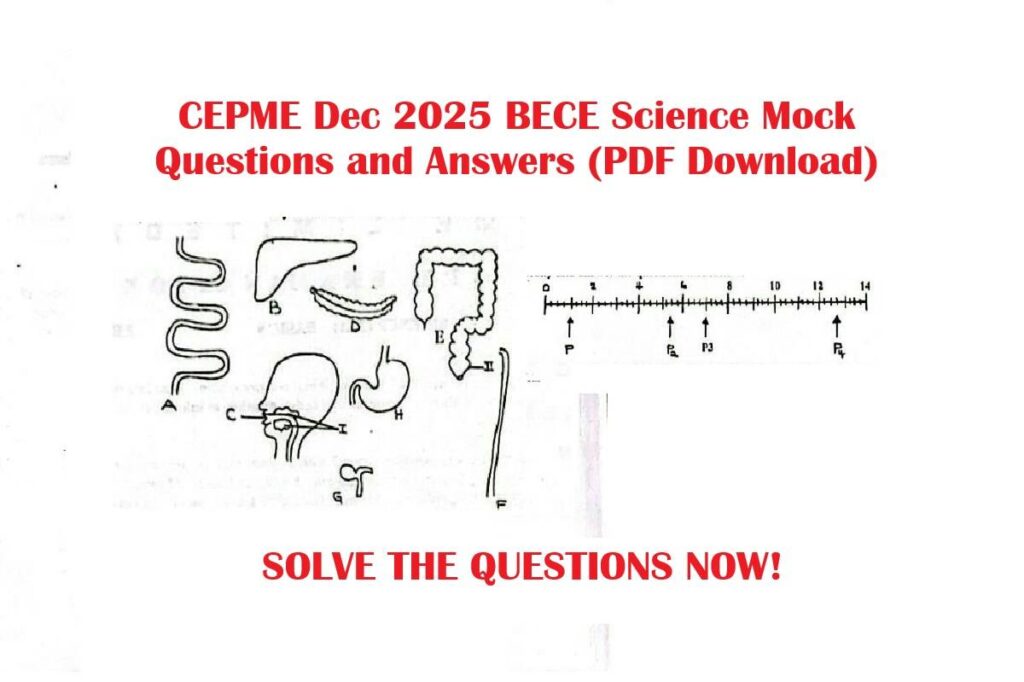

Revising for the BECE goes beyond teaching and learning. It needs resources such as this CEPME Dec 2025 BECE Science Mock Questions and Answers PDF Download.
The questions are well structured, challenging, and cover a wide range of topics, just like the WAEC BECE standard exam questions. This means learners and teachers can use this set of questions to revise for the BECE.

The 10 BECE Science Tips Guide For Solving The CEPME Dec 2025 BECE Science Mock Questions Below
- Experience: Use “First-Hand” Technical Language Don’t just describe a process; use the specific terminology a scientist would use. For example, in Question 3c, instead of saying “moving small plants,” use the authoritative term “transplanting.”
- Expertise: Define with Precision When defining terms like Atom or Compound (Question 3d), give the full, standard scientific definition. An “expert” answer doesn’t just say an atom is a small particle; it identifies it as the smallest unit of an element that retains its chemical properties.
- Authoritativeness: Label Diagrams Professionally In the circuit diagram (Image 2, Question c), do not just draw lines. Use standard symbols for the ammeter (A) and voltmeter (V). High-quality content in science is always backed by standardized symbols and units.
- Trustworthiness: Cite Units of Measurement A scientist’s work is only trusted if it is measurable. If a question asks for a value, always include the unit (e.g., Ohms for resistance, Volts for potential difference). An answer without a unit is scientifically “untrustworthy.”
- Experience: Relate Theory to Real-Life Observation In Question 4b, when explaining Ama’s symptoms, don’t just list facts. Explain the mechanism—how high salt intake leads to high blood pressure (osmosis in the blood), which then causes the dizziness she experienced.
- Expertise: Show the “Why,” Not Just the “What” For Question 5c, explain why cattle are ruminants (the four-chambered stomach for cellulose digestion), rather than just stating they eat grass. This shows a deeper level of expertise.
- Authoritativeness: Follow the Command Words Pay attention to “Distinguish,” “List,” and “State.”
- Distinguish: Requires a comparison (usually a table).
- State: Requires a brief, direct fact.
- Explain: Requires a reason or cause-and-effect sequence.
- Trustworthiness: Avoid “Clumsy” Presentations WAEC examiners, like Google Quality Raters, value clarity. Avoid canceling work repeatedly. If you make a mistake, draw a single neat line through it. Cluttered papers suggest a lack of “Expertise.”
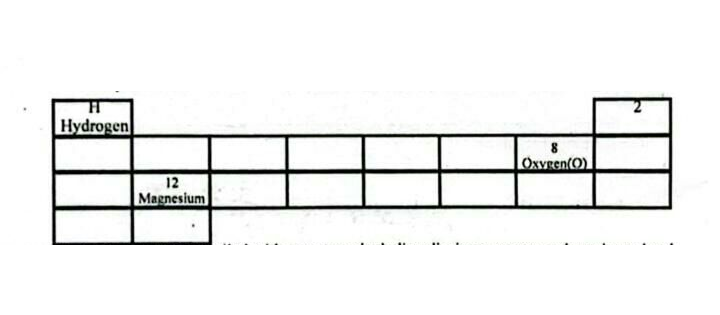
- Experience: Master the Periodic Table Logic For Question 4a, don’t just memorize the list. Understand the “Experience” of the table—elements are arranged by atomic number. Knowing that Magnesium is 12 helps you “authoritatively” place it in the correct Period and Group.
- Expertise: Use the “Rule of Two” for Differences When asked to distinguish between two things (like Mixed Farming and Mixed Cropping in Part II, 2d), always provide at least two distinct points of difference to show a comprehensive “Expertise” in the subject.
The Challenge to Science Teachers
“Teachers: We challenge you to stop teaching Science as a list of facts to be “poured” onto paper. Instead, mentor your students to think like Research Scientists. Teach them the expertise of precise definitions. Give them the experience of seeing these concepts in the local environment (the farm, the clinic, the workshop). When a student understands why they are writing an answer, they move from a “Pass” to an “Excellent” grade.” : From Ghana Education News Editorial Team
PART II: Answer three questions from this part

2. a. i. What are binary compounds?

ii. Give three examples of binary compounds.
iii. Write down the chemical formula for the binary compound named in (ii) above.
b. i. What is nitrogen cycle?
ii. State the processes of nitrogen cycle.
c. i. What is a dielectric?
ii. Give three examples of dielectric material.
d. State two differences between mixed farming and mixed cropping.
3. a. i. Draw the life cycle of a grasshopper.
ii. Outline three activities of grasshopper that are harmful to humans.
b. State two differences between:
Comets and asteroids
Asteroid and meteor
Section B: Question 4
a. Copy and complete the periodic table with the names and chemical symbols of the first twenty elements.
b. Ama went to the hospital with symptoms including dizziness, severe and persistent headaches, and general body weakness. She mentioned to the doctor that she consumes a lot of salt, alcohol, and foods high in fat. The doctor advised her to stop these habits, exercise regularly, avoid smoking, and reduce stress.
i. How might Ama’s consumption of salt, alcohol, and fatty foods contribute to the symptoms she experienced? ii. Why do you think the doctor advised Ama to avoid smoking and reduce stress as part of her treatment? iii. Explain briefly how regular exercise could help improve Ama’s overall condition based on the symptoms she reported.
c. Distinguish between shifting cultivation and land rotation. d. List two properties of light.
Section B: Question 5
a. State the energy change(s) that are involved in the following activities: i. Moving a car ii. Switching on a torch light iii. A mango falling from a tree
b. i. What is waste management? ii. State three ways in which waste generated affects the environment.
c. i. What is a monogastric animal? ii. Explain why cattle are classified as ruminants. iii. Give an example each of ruminants and monogastric animals.
d. Define the following and give one example of each: i. Herbivores ii. Carnivores iii. Omnivores
 How to Install the WAEC DigiCert App: Step-by-Step Guide and Public Reaction
  How to Recover Your Lost WAEC Index Number Using DigiCert App
  WAEC Launches Digital Certificate (DigiCert) Services in Ghana and West Africa
  GES to Host Meet the Subject Teacher’ Conference for 2026 BECE Prep