
Protocol Placement Into SHS in Ghana 2026: How It Works, Who Qualifies, and What Parents Must Know
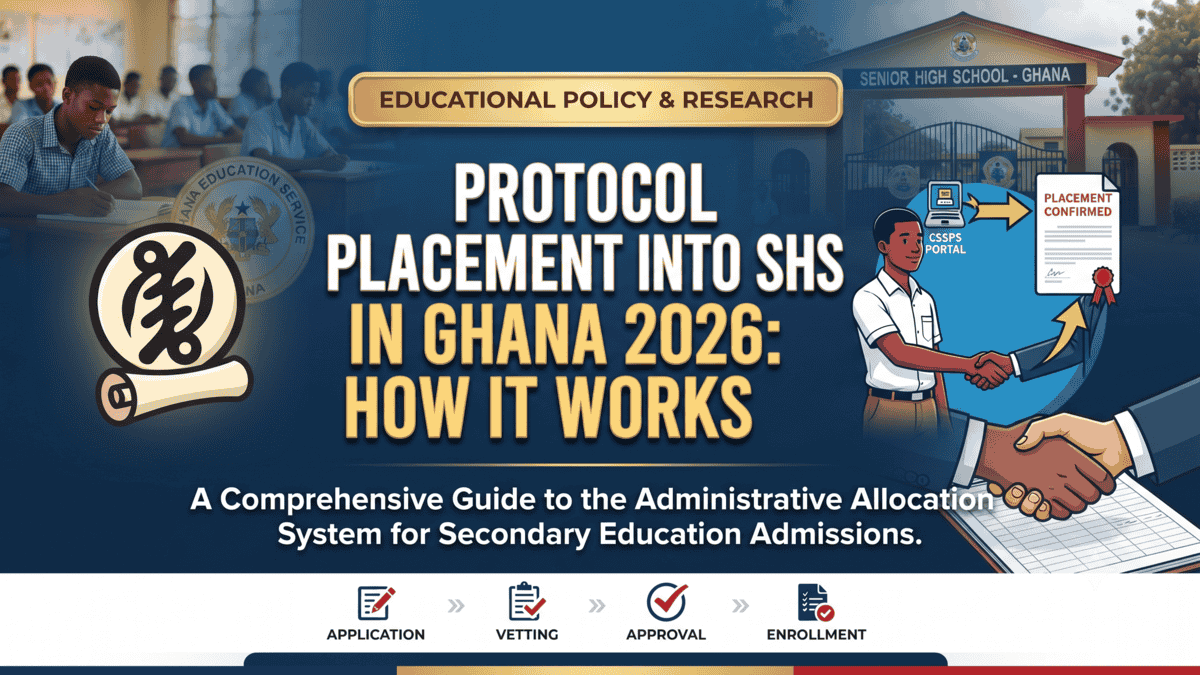
Protocol Placement Into SHS in Ghana is real and will not stop anyime soon.Every year, thousands of parents and guardians across Ghana seek ways to secure admission for their wards into specific Senior High Schools outside of the normal computerised placement system. The process they turn to is called protocol placement, and while it is widely practised, it remains one of the least understood and most misrepresented aspects of secondary school admissions in Ghana.
This guide explains exactly what protocol placement is, how it works, who can authorise it, what the requirements are, the step-by-step process for accessing it, and the genuine advantages and serious disadvantages every parent must weigh before pursuing it. Whether you are a parent whose child did not get their preferred school through the Computer School Selection and Placement System (CSSPS), or someone who wants to understand your options before BECE results are released, this article gives you accurate, complete information.
What Is Protocol Placement in Ghana?
Protocol placement is an administrative process that allows a student to gain admission into a specific Senior High School outside of the normal CSSPS computerised merit-based allocation. It operates through official channels involving the Ghana Education Service (GES), the Ministry of Education, and school authorities, but it bypasses the standard algorithm that places students based purely on their BECE aggregate scores and school preferences.
The term “protocol” in this context refers to the use of official administrative authority — typically a letter, directive, or request from a high-ranking official — to instruct a school to admit a particular student. It is distinct from purchasing or bribing your way into a school, though the line between legitimate protocol and corruption in practice is frequently blurred, which is one of its most serious disadvantages.

Protocol placement is legal when done through proper official channels and has been acknowledged by GES as an existing practice. It becomes illegal and subject to sanction when it involves financial inducement, forgery of letters, or misrepresentation of authority.
Who Can Authorise Protocol Placement?
This is the most important thing parents need to understand. Not every official can authorise a protocol placement. The recognised levels of authority in Ghana’s education system that can legitimately facilitate protocol placements include:
WANT TO PASS 2027 BECE? REGISTER FOR BECE HOME MOCK
Register your ward for Ghana's premier Home Mock service, active since 2022.
1. The Director-General of the Ghana Education Service
The highest authority within GES. A directive from the Director-General’s office carries the most weight and is rarely refused by any school.
2. The Minister of Education
The political head of education in Ghana. Ministerial protocol letters are among the most commonly cited in protocol placements and are processed through the Minister’s secretariat.

3. Regional Directors of Education
Each of Ghana’s sixteen regions has a Regional Director of Education. Regional Directors can authorise placements within their regions and their letters are processed through Regional Education Offices.
4. District Directors of Education
District Directors can facilitate placements at a more localised level, typically for day schools or schools within their district jurisdiction.
5. Heads of State Institutions
In some cases, heads of security services, the military, judiciary, or other state institutions can write on behalf of their staff members’ children to GES or directly to school heads.
6. Members of Parliament
MPs frequently write letters to GES or directly to school heads on behalf of constituents. These letters carry varying levels of effectiveness depending on the individual MP’s relationship with education authorities.
READ: 2026 SHS Prospectus: Illegal Items You Cannot Take To School
7. Heads of Schools (Limited)
Some school heads have a limited number of discretionary admissions slots, often referred to as the Headmaster’s List or Headmistress’s Quota, within which they can admit students independently of CSSPS. This is the most accessible form of protocol placement for ordinary families.
The Headmaster’s Quota — The Most Accessible Protocol Route
Every Senior High School in Ghana is allocated a small percentage of its total admission slots — typically between 10% and 15% of intake — that the headmaster or headmistress can fill at their own discretion. This quota exists officially within GES policy to allow schools to admit:
- Children of staff members
- Students with exceptional talents in sports, music, or arts
- Students from disadvantaged backgrounds identified by the school
- Students whose BECE results arrived late due to administrative issues
- Children of the school’s founding community or significant donors
In practice, many headmasters use these slots to accommodate protocol requests from parents who approach them directly or through intermediaries.
How to access the Headmaster’s Quota:
Contact the school directly after BECE results are released and CSSPS placement is confirmed. Request an appointment with the headmaster or headmistress. Come with your child’s BECE result slip, birth certificate, and a formal written request letter. Schools with available quota slots will assess the request. Some schools charge a legitimate administrative fee for discretionary admissions — this should be receipted and official.
Step-by-Step Process for Protocol Placement
Step 1 — Check CSSPS Placement First
Before pursuing any protocol route, check your child’s placement on the CSSPS portal at cssps.gov.gh. If your child was placed at an acceptable school, carefully consider whether the disruption and cost of seeking protocol is genuinely worth it. If your child was not placed at all or placed at a school far from home with safety concerns, protocol becomes a more justifiable option.
Step 2 — Identify the School You Want
Be specific and realistic. Research the school’s current admission capacity, how many students they took in the previous year, and whether they have a history of accepting protocol admissions. Highly competitive schools like Achimota, Prempeh College, Wesley Girls, GISS, and Mfantsipim receive hundreds of protocol requests and can only honour a fraction of them.
Step 3 — Identify Your Point of Access
Assess your personal network and connections honestly:
- Do you know anyone in GES at the district, regional, or national level?
- Do you have access to your MP or a government official?
- Can you approach the school headmaster directly?
- Does your employer have any institutional relationship with GES?
Your answer determines which route you pursue.
Step 4 — Prepare Your Documents
Regardless of which route you use, you will need:
- Child’s BECE result slip (original and copies)
- Child’s birth certificate
- Parent or guardian’s national ID (Ghana Card)
- Formal application letter addressed to the school or GES official
- Passport photographs of the student (usually 4)
- Any supporting documents relevant to your case (e.g. medical certificate if seeking placement based on health needs, distance from home, etc.)
Step 5 — Write and Submit a Formal Letter
Your letter should be addressed to the specific official you are approaching and should clearly state:
- Your child’s full name
- Your child’s BECE aggregate and grades
- The school they were placed at through CSSPS
- The school you are requesting placement at
- The specific reason for the request
- Your contact details
Keep the letter factual, respectful, and concise. Avoid emotional appeals or exaggerated claims.
Step 6 — Follow Up Through Official Channels
After submitting your request, follow up within five to seven working days. Persistence is important but must be respectful. GES offices receive large volumes of protocol requests especially in the weeks after BECE results and CSSPS placement. Keep records of every interaction including dates, names of officials you spoke with, and what was communicated.
Step 7 — Obtain a Protocol Letter or Admission Letter
If your request is approved, you will receive either:
- A protocol letter addressed to the school head, which you present to the school
- A direct admission letter from the school itself
Take this letter to the school during the reporting period. The school will process your child’s admission and issue further documentation for school fees and supplies.
Step 8 — Report to School on Time
Missing the reporting deadline can void even a valid protocol placement. Confirm the school’s reporting dates before CSSPS reporting week and ensure your child reports on time with all required items.
Advantages of Protocol Placement
1. Parental Choice and Proximity
Protocol placement gives parents the ability to place their child in a school closer to home, reducing transport costs and safety concerns especially for girls. This is particularly significant for families in urban areas where CSSPS may assign a child to a school in a different region.
2. Access to Better Resources
Parents who believe a particular school offers better facilities, more qualified teachers, or a stronger academic track record can use protocol to access those schools for their child even if the child’s aggregate was not competitive enough for direct merit placement.
3. Sibling and Family Continuity
Families where older siblings, parents, or relatives attended a specific school often use protocol to maintain that family connection, which can have genuine social and networking benefits for the child.
4. Flexibility for Special Circumstances
Students with medical conditions, physical disabilities, or other special needs that require proximity to healthcare facilities or specialised support can use protocol to access schools that are geographically or logistically appropriate for their situation.
5. Correcting CSSPS Errors
The CSSPS system, while generally reliable, occasionally produces placements that are clearly inappropriate — wrong programme, wrong region, or schools that do not offer the child’s preferred course. Protocol provides a correction mechanism for these administrative errors.
6. Access to Specific Programmes
Some students have clear vocational or academic interests that are only offered at specific schools. A student passionate about agriculture may specifically need a school with an active farm programme. Protocol allows programme-specific placement that the algorithm may not prioritise.
Disadvantages of Protocol Placement
1. It Is Fundamentally Inequitable
The most serious criticism of protocol placement is that it advantages children of the connected and wealthy over children of equal or greater academic ability who lack connections. A student with a better aggregate who did not access the right official loses their rightful place to a student with a lower aggregate whose parent knew the right person. This undermines the merit principle that the CSSPS was designed to uphold.
2. It Reduces Places for Deserving Students
Every protocol placement fills a slot that would otherwise go to a student through the merit system. In schools where demand far exceeds supply, protocol placements directly displace meritorious students, creating resentment and reducing the school’s overall academic quality.
3. Exposure to Fraud and Financial Exploitation
The opacity of the protocol process makes it a fertile ground for fraud. Parents desperate to secure specific placements are frequently targeted by individuals who claim to have connections to GES officials, collect substantial sums of money, and deliver nothing. These fraudsters are active every year immediately after BECE results are released, particularly on social media and around GES offices.
4. Financial Cost
Even legitimate protocol placements often come with unofficial costs — gifts, transportation to officials’ offices, facilitation fees, and in some cases direct payments to intermediaries. For lower income families this financial burden can be significant and there is no guarantee of success despite the expenditure.
5. Social and Academic Mismatch
A student placed by protocol into a school significantly above their academic level may struggle academically. If a child’s BECE aggregate honestly reflects their preparedness and they are placed into a highly competitive school through protocol, they may find themselves in the bottom percentile of their class, affecting their confidence and ultimately their WASSCE performance.
6. Institutional Pressure on School Heads
Headmasters and headmistresses frequently report that protocol requests create enormous pressure, including from powerful officials who expect compliance regardless of capacity. This pressure compromises the autonomy of school leadership and forces admission of students beyond the school’s genuine capacity, affecting quality of education for all students.
7. Legal and Ethical Risk
Protocol placements facilitated through forged letters, misrepresentation of authority, or financial inducement are prosecutable under Ghana’s criminal code. Parents who engage fraudulent intermediaries, and intermediaries themselves, have faced legal consequences. The risk increases as GES and the Ministry of Education periodically conduct verification exercises to identify and reverse illegitimate placements.
8. No Guarantee of Programme Availability
A protocol letter securing admission to a school does not automatically guarantee the specific programme a student wants. A student placed at a science school through protocol may still find that the science programme is full and be assigned to a general arts or business programme — defeating the purpose of the protocol request.
Frequently Asked Questions
Can protocol placement reverse a CSSPS placement completely?
Yes. A successful protocol placement typically involves the student being withdrawn from their CSSPS-assigned school and formally enrolled at the new school. Both schools must be notified and GES records updated.
Is there a fee for legitimate protocol placement?
GES does not charge any official fee for processing protocol requests. Any payment demanded by someone claiming to be a GES official as a condition for a protocol letter should be treated as suspicious. Schools may charge legitimate administrative fees for discretionary admissions that should be officially receipted.
What aggregate is needed for protocol placement?
There is no officially stated minimum aggregate for protocol placement. However, a student whose aggregate is significantly lower than a school’s merit cut-off is less likely to be admitted even through protocol, as school heads and GES officials consider academic appropriateness when processing requests.
When is the best time to pursue protocol placement?
Immediately after CSSPS placement results are released and before the schools’ reporting deadline. Acting within the first two weeks of placement results gives you the maximum window to process requests before schools reach capacity.
What happens if a protocol student is discovered to have been fraudulently placed?
GES policy allows for the reversal of fraudulent placements at any time, including after a student has enrolled and even after completing a year. The student may be withdrawn and the intermediary referred for prosecution.
Does every SHS honour protocol letters from MPs or officials?
No. School heads have the right to decline protocol requests if their school is at full capacity or if the student’s academic profile is genuinely unsuitable. In practice, letters from very senior officials like the Minister of Education or Director-General of GES are rarely declined, while letters from lower-level officials carry less guarantee.
Protocol placement in Ghana’s SHS system is a real, widely used, and officially acknowledged pathway that exists alongside the merit-based CSSPS. It provides genuine value in correcting administrative errors, accommodating special circumstances, and giving families limited choice in a system where algorithmic placement does not always produce ideal outcomes.
However its disadvantages are serious and systemic. It perpetuates inequality, exposes families to fraud, and undermines the integrity of a merit system that Ghana’s education structure depends on. Parents considering this route should pursue it only through verifiable official channels, maintain realistic expectations about success rates, protect themselves from fraudsters, and honestly assess whether the school they are seeking is genuinely appropriate for their child academically.
The most sustainable solution for any family remains adequate academic preparation — a child with a strong BECE aggregate has the widest range of placement options and needs no protocol at all.
This article has attempted to provide useful informatio and solutions to
- how to get protocol placement Ghana SHS
- protocol admission into Ghana’s senior high school
- SHS protocol placement requirements in Ghana
- protocol placement advantages and disadvantages in Ghana
- CSSPS protocol placement for 2026
- Ghana Education Service protocol admission procedures
- how protocol placement works in Ghana
- protocol placement vs merit placement Ghana
- protocol admission letter Ghana
About This Article
This article was researched and written by the editorial team at Ghanaeducation.org, Ghana’s leading education news and resource platform. Information is based on GES policy documents, CSSPS operational guidelines, and reporting on Ghana’s secondary school admission processes.
Published by Education-News Consult | Powered by Skulmanager.com





is it suitable for a agg 12 person