CSSPS 2026: A Guide to Checking Placement and Doing Self Placement
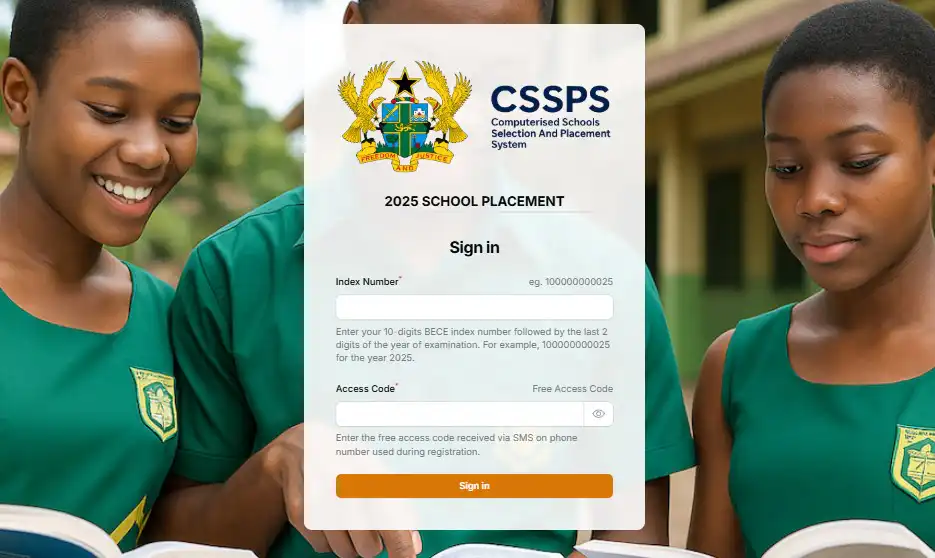
Quick answer: To check your child’s 2026 SHS placement, go to cssps.gov.gh, click “Check Placement,” and enter the BECE index number plus date of birth. Checking is free — you do not need to buy a voucher or checker card.
If your child wasn’t automatically placed, use the “Self-Placement” option on the same site to pick from schools that still have space. Automatic placement, once given, is final; self-placement can be revised until enrolment.
That one paragraph will solve most people’s problem. Everything after it is for the part nobody explains properly: why the portal has six different buttons, why some parents pay for a “voucher” that other parents never needed, what actually happens when your child’s index number “isn’t found,” and why the Ministry of Education keeps warning people, almost every August, about something called “protocol.”
What CSSPS Actually Is
CSSPS stands for the Computerised School Selection and Placement System. It’s the platform the Ghana Education Service and the Ministry of Education use to match BECE graduates to Senior High Schools, Senior High Technical Schools, and TVET institutions.
Before CSSPS existed, placement was largely a manual, paper-based process, and it was exactly as chaotic as that sounds.
The system now does the matching by computer, based on a candidate’s aggregate score, their chosen programme, whether they want boarding or day, and how many spaces are actually left in each school.
That’s the theory. In practice, most of the confusion parents run into isn’t about the matching logic at all — it’s about the portal itself, which has six separate services that aren’t well explained anywhere official.
The Six Things You Can Actually Do on cssps.gov.gh
If you land on the CSSPS homepage for the first time, you’ll see six service tiles, and most of them will be greyed out or marked “Closed” depending on where you are in the placement calendar. Here’s what each one is actually for:
Check Placement — this is the one almost everyone needs first. It shows your child’s assigned school, programme, and the placement documents to print for admission.

Self-Placement — only relevant if your child wasn’t automatically matched to any of their chosen schools. It shows a live list of schools and programmes that still have vacancies.
Choices Confirmation — a step where candidates confirm the schools they selected before results were released, to make sure every detail (spelling of name, programme, boarding status) is correct before final processing.
Edit Choices — lets you correct or replace a school choice, but only before it has been confirmed. Once confirmed, this door closes.
Re-Entry — for candidates from a previous year who are eligible to register and go through placement again.
Foreign Student — for candidates applying with a qualification obtained outside Ghana.
The site itself tells you to start with Check Placement and only touch the others if they apply to your specific situation, and that’s genuinely good advice. Most of the parent panic every August comes from people clicking into Self-Placement or Edit Choices before they’ve even confirmed whether their child needs to.
How to Check Your Placement, Step by Step
- Go to cssps.gov.gh directly — not a random blog, not a Facebook page, not a link someone sent you on WhatsApp.
- Click Check Placement.
- Enter your child’s 10-digit BECE index number, followed by the exam year eg. 26 for the year 2026
- Enter the candidate’s date of birth.
- Sign in to view the assigned school, the programme, and the documents you’ll need for admission.
Here’s the part that surprises a lot of parents: for the 2026 cycle, checking your placement costs nothing. You do not need a scratch card, a voucher, or a “checker card” from a vendor.
If you’ve been asked to pay someone before you can even see the result, you’re either dealing with an outdated process from an older cycle or, more likely, someone trying to make money off your anxiety. Save your receipt-checking energy for admission day, not for this step.
How to do self-placement on the school placement portal
Students can only use the Self-Placement Module of the school placement system if they can find their details of the portal but they were not placed in any of the 8 schools they chose. Again, students with grade 9 in Mathematics or English language will not be placed, and they also cannot use the self-placement module.
To do the self-placement, you need your BECE index number and date of birth.
Once you are not placed and you choose to use the self placement module, you need to select your preferred region, choose a school, programme, and residence type and confirm your chosie with the self placement button to be placed.
Follow these steps
- Select Self-placement from Placement Services portal https://www.cssps.gov.gh/ and sign in.
- Confirm that your candidate details are correct.
- Choose a region, then select a school with an available vacancy.
- Choose an available programme and residence type.
- Review the selection carefully and submit it.
- Return to Check placement to view and print your placement documents.
Choose an available school when you were not assigned one during automatic placement.
“My Child Wasn’t Placed Anywhere” — Now What?
Don’t panic, and don’t assume the worst. Not being automatically matched to any of the eight chosen schools happens to a real number of candidates every year, and it doesn’t mean your child is unqualified — it usually means the specific combination of programme, school, and boarding status they wanted was more competitive than the spaces available.
This is what Self-Placement exists for. Once you confirm through Check Placement that no automatic match was made, the Self-Placement portal opens up a live list of schools and programmes with genuine vacancies, filtered against your child’s aggregate.
You choose from what’s actually available — not from a wish list, but from real remaining seats. Unlike your original eight choices, self-placement selections can typically be revised more than once before your child actually enrols, so you’re not locked into the first option you see under pressure.
One thing worth saying clearly: automatic placement, once it happens, is final. If your child was matched to a school through the normal process, Self-Placement is not a tool for getting a “better” school instead — it’s specifically for candidates who weren’t matched to anything at all.
Your Index Number Says “Not Found” — Here’s What’s Actually Going Wrong
This is one of the most common support calls CSSPS gets, and it’s almost never a system failure. It’s nearly always one of three things:
- The wrong exam year is attached to the index number. If your child sat BECE in 2026, make sure you’re entering 2026, not the year the form was filled or a typo from a previous search.
- A digit is transposed. BECE index numbers are ten digits long, and it’s astonishingly easy to swap two numbers when you’re copying from a crumpled admission slip.
- The date of birth doesn’t match school records. If your child’s birth certificate and school records disagree by even a day, the system will reject the login until that’s resolved through the school.
Before calling anyone, double-check the index number against the original BECE registration slip, character by character, and confirm the date of birth exactly as it appears on the candidate’s school records — not the birth certificate, if the two ever differ. If it still won’t load after that, contact support rather than a random “agent.”
The Eight-School Rule, Explained Properly
Every candidate selects eight schools before results are released, and the rules around those eight choices genuinely matter more than most people realise going in.
Schools fall into categories — broadly, Category A (the most competitive, sought-after schools), Category B, and Category C. Under the current guidelines, a candidate can choose no more than two schools from Category A, up to three from Category B, with the remaining choices coming from Category C. You also cannot select the same school twice, even across categories.
The order you rank your eight schools in isn’t decorative — the system works down your list from your first choice, checking whether your aggregate and programme meet that school’s requirement and whether a space exists in the boarding or day option you selected. Only if that fails does it move to your next choice, and so on.
That’s why education writers keep repeating one piece of advice every selection season: don’t fill all eight slots with dream schools. A realistic mix gives the system something to actually match you to.
When two candidates end up competing for the same last available space with genuinely equal aggregates, CSSPS breaks the tie in a fixed order: first by the number of Grade 1s each candidate has, then by their raw scores across their best six subjects, and finally by performance in the four core subjects, checked in this specific order — English Language, Mathematics, Integrated Science, then Social Studies.
The “Protocol” Problem Nobody Likes Talking About
If you’ve spent any time around SHS placement season in Ghana, you’ve heard the word “protocol” — the practice of using personal connections or influence to get a candidate admitted to a school outside the official computerised process, sometimes with grades that wouldn’t normally qualify.
The Ministry of Education and GES have been explicit and repeated about this: paying anyone who promises a “protocol” placement, or an unofficial change to an assigned school, is illegal, and any change made outside the approved process may simply not be recognised when your child shows up to that school. It’s not a grey area they’re being quiet about — it’s a warning they issue publicly, almost every placement season, because the problem keeps recurring.
It’s also not just a rumour parents invented. A former GES leader has publicly described protocol influence as one of the system’s oldest, most persistent flaws — pressure applied directly to headmasters and officials to admit specific students outside the computerised list. Whatever your view on how deep that problem runs, the practical advice for a parent doesn’t change: the only placement that will actually hold when your child arrives at school is the one that comes through the official portal, confirmed by your child’s own index number and date of birth.
When to Actually Call Support
CSSPS support lines exist for genuine technical problems — an index number that won’t load after you’ve triple-checked it, a portal that won’t accept a valid self-placement choice, a document that won’t generate. The listed support numbers are 020 733 7515 and 054 154 8223, available during working hours. Save yourself the hold time by having your child’s index number, exam year, and a clear one-sentence description of the exact error ready before you call.
What support can’t do — and what no legitimate person can do for a fee — is move your child into a specific school outside the system’s own matching logic. If anyone offers that, whatever they’re selling isn’t help.
READ: 2026 BECE School Placement Release Date, Protocol Placement & How to Check CSSPS Placement
Frequently Asked Questions
Is checking my CSSPS placement free? Yes, for the current cycle, checking your placement through the official portal does not require a voucher or checker card. If you’re being asked to pay before you can even see the result, verify you’re on the official cssps.gov.gh site and not a lookalike page.
Can I change my child’s school after automatic placement? No — automatic placement is final once it’s been given. The Self-Placement option is only available to candidates who were not matched to any school at all, not as a way to swap out an assigned school for a different one.
What if my child’s index number isn’t recognised by the portal? Recheck the ten-digit index number and the exam year for typos, and confirm the date of birth matches what’s on the candidate’s official school records. If it still fails after that, this needs to go through your school or CSSPS support directly, not through an unofficial “agent.”
How many schools does a candidate need to select, and are there limits? Eight schools total, ranked in order of preference, with no more than two from Category A and up to three from Category B — the rest coming from Category C. No school can be selected more than once.
What happens if two candidates have the exact same aggregate and are competing for the same space? CSSPS resolves it in order: number of Grade 1s first, then raw scores across the best six subjects, then performance in the four core subjects — English Language, Mathematics, Integrated Science, and Social Studies, checked in that order.
Is paying someone for a “protocol” placement ever legitimate? No. The Ministry of Education and GES have publicly and repeatedly stated that paying for an unofficial placement is illegal, and that any change made outside the approved CSSPS process risks not being honoured by the receiving school.
Placement categories, selection limits, and portal features are updated by the Ministry of Education and GES most years — always cross-check specifics against the current official guidelines at cssps.gov.gh before making final decisions, and treat any information from unofficial “agents” or lookalike websites with caution.