
South Africa’s Lazy Mindset and Xenophobia Will Not Solve Its Problems
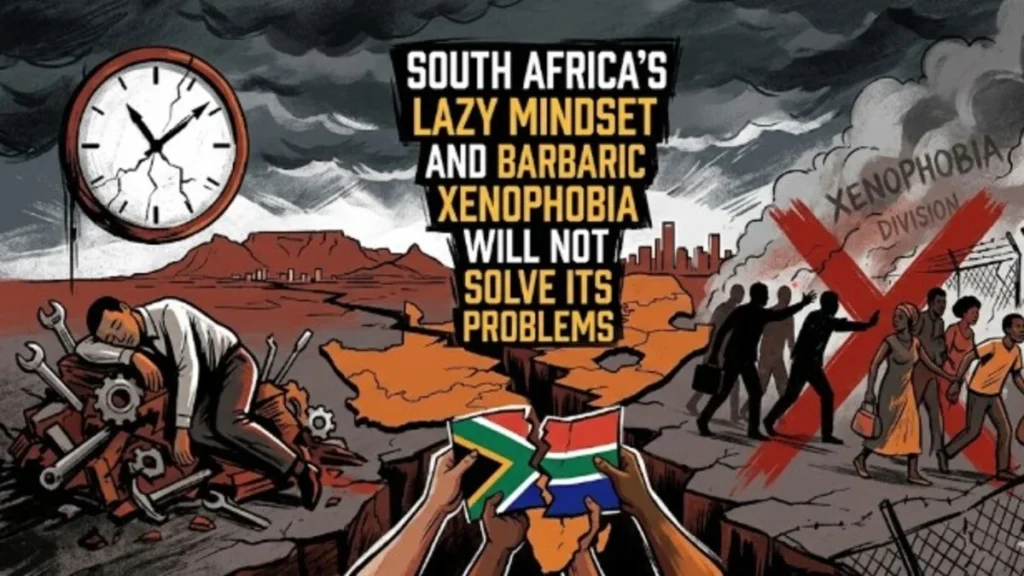
There is too much bad blood between the rest of Africa and South Africa following the latter’s lazy mindset and barbaric xenophobic attacks on other Africans in the name of “fixing their country.” Such acts only showcase the weak mindset of those leading the charge. It is one thing to have a good idea, but it is another to be more strategic, think deeply, and offer real solutions. The current approach will not solve their problems; in fact, it never has.
South Africa’s lazy mindset is too loud, and its xenophobic attacks are more than shameful
Xenophobic attacks by South Africans on fellow Africans living in South Africa have raised their ugly heads again, following unwarranted and barbaric assaults on Ghanaians, Nigerians, and other African nationals.
Since time immemorial, these acts have become a retrogressive cultural identity for some South Africans. They consistently blame foreign nationals for every woe they suffer, completely failing to engage in the inter- and intra-personal retrospection needed to realize how their own lifestyles, choices, and strategic national weaknesses contribute to their current state.
To them, every problem in South Africa is caused by foreign nationals of African descent. Tagging all African expatriates as criminals and targeting them with related vices is incredibly myopic. The world has watched in shock as South Africans treat other nationals living in their country like animals, completely devoid of respect, all under the guise of fixing their nation.

Fixing one’s country does not mean treating other nationals with disrespect, nor does it mean abusing their rights simply because they reside within your borders. One primary reason for these attacks is the misguided belief held by lawless citizens that other African nationals are the sole cause of their problems. From overstayed visas to illegal immigration, these lawless individuals have disrespected their own president and have been emboldened by the failure of the police service to arrest those breaking the law with impunity, further aggravating the issue.

It is now common to see irresponsible citizens, blinded by a “fixing the nation” mindset, beating, punching, and assaulting defenseless foreign nationals while looting their shops. All the while, police officers look on as though they are in bed with the criminals.
WANT TO PASS 2027 BECE? REGISTER FOR BECE HOME MOCK
Register your ward for Ghana's premier Home Mock service, active since 2022.
The fallacy of driving out foreigners to create jobs
One key reason for this disrespectful treatment is that the proponents of these atrocities believe foreign nationals are the reason many South Africans do not have jobs. However, the main challenge for the people of South Africa remains the harsh realities of their own lives that they refuse to recognize, accept, and correct. In life, until you realize that you are part of the problem, you cannot work toward a solution, and every measure you apply will amount to nothing.
It is a complete fallacy to believe that driving other Africans out of South Africa will automatically translate into jobs. This perception is not grounded in common sense, nor is it supported by the best recruitment practices of local or foreign businesses. To be employed, an individual must possess the academic qualifications, professional skills, training, and a strong work ethic that yields benefits for the employer’s business.
African nationals living in South Africa are often preferred for certain jobs over locals for very good reasons. A poor work culture over the years has made many locals unsuitable for these roles, yet they remain unwilling to change.
Laziness and the Monday absenteeism culture
One of the most glaring vices is laziness. Online research from various sources reveals a subculture of laziness among the locals who refuse to work. Kevin Taylor, one of Ghana’s most controversial broadcast journalists who operates from the US, shared real-life experiences and tacit knowledge gained from living in South Africa for at least two years. His revelations have been widely supported by other commentators across social media platforms.
In a video reviewed by the editorial team at Ghanaeducation.org, Jacinta—the woman behind countless anti-foreigner campaigns—has invested massive amounts of energy into instigating locals against foreign nationals. This has led to innocent people being beaten, abused, and looted. Yet, she has failed to use that same energy and “angry mindset” to think deeply and establish even a small-scale business to employ her own people. Instead, in the same video, she is seen demanding and begging a foreign employer, who appeared to be Lebanese, to hire South Africans.
Amusingly yet worryingly, the business owner firmly disclosed that South Africans have severe issues reporting to work on Mondays. Globally, Monday is the first working day of the week, and employees are expected to be present. Unfortunately, many South Africans spend most of that day busy with matters that have nothing to do with their employment. Consequently, these businesses lose revenue and sales when employing habitual absentees who routinely miss work on Mondays. How can foreign-owned businesses employ locals who harbor an unacceptable culture of laziness tied to Mondays?
The risk of diplomatic and economic retaliation
South Africans must not behave as though their own citizens do not live and work in other African countries. They should also not assume that every South African expat across the continent possesses all the legal documents required to reside and work there. It is short-sighted to assume that other countries cannot retaliate in equal measure—or with even harsher diplomatic strategies—which could severely cripple the South African economy.
READ: South Africa Takes Israel to ICJ: High-Stakes Hearing on Gaza Genocide Allegations
In Ghana alone, there are over 40 operating businesses owned by South Africans. Ghana could easily play its own cards by frustrating these entities into exiting or making their operations nearly impossible. Similarly, the parliament of Nigeria has previously called on its government to repay South Africa in its own coin for these inhumane xenophobic attacks on its nationals. The big question is, can South Africa truly survive alone without the presence of other African nationals and without its own citizens crossing borders to other countries on the continent? Ghana is on the verge of halting the renewal of the AngloGold Ashanti mining license, which has been loosely tied to the attacks on Ghanaians in South Africa.
📊 Comparative Indicator Table: South African Corporate Presence In Ghana and Nigeria, which may suffer if the Two countries decide to strike.
| Economic Sector | Dominant South African Brand(s) | Operational Footprint & Scale in Ghana | Operational Footprint & Scale in Nigeria |
| 📱 Telecommunications | MTN Group | Market Leader: Over 12 million subscribers. Dominates the mobile voice, data, and Mobile Money (MoMo) ecosystem. | Market Leader: Historically the largest corporate taxpayer outside the oil sector. Serves tens of millions of Nigerian lines. |
| 🛒 Retail & Fast-Moving Consumer Goods (FMCG) | Shoprite / Game / Woolworths / Mr Price | Mall Anchor Tenants: Heavily dominates modern shopping hubs like the Accra Mall, West Hills Mall, and Kumasi City Mall. | Major Shopping Anchors: Operates massive hypermarkets in major tier-1 cities like Lagos, Abuja, Kano, and Ibadan. |
| 📺 Mass Media & Entertainment | MultiChoice (DStv / GOtv) | Monopoly Profile: Controls the premium digital satellite television market and local broadcasting rights for international sports. | Monopoly Profile: Serves millions of household subscribers; heavily dictates local entertainment distribution structures. |
| 🏦 Banking & Financial Services | Stanbic Bank / Standard Bank Group | Tier-1 Elite Status: Heavily integrated into corporate financing, cocoa syndication, and private wealth sectors. | Stanbic IBTC Bank: Commands a massive share of institutional asset management, stockbroking, and pension funds. |
| ⛏️ Mining & Heavy Infrastructure | AngloGold Ashanti / Gold Fields / WBHO | Lifeblood Extractive Operations: Dominates large-scale gold mining real estate at Obuasi, Tarkwa, and Iduapriem. | Construction & Technical Services: Primarily targets mineral extraction supply chains, logistics channels, and commercial civil engineering contracts. |
| ⛽ Energy & Petroleum | Engen Petroleum | Ubiquitous Retail Network: Dozens of downstream oil service stations and retail fuel marts distributed nationwide across Ghana. | Industrial Supply: Heavily focused on specialized lubricants, chemical manufacturing components, and bulk oil refining sales. |
Ghana already has functional plans to evacuate about 900 of its citizens from South Africa and resettle them, offering returnees jobs and resources to help them reintegrate into the motherland. Ghana has successfully employed over 100 returnees and counting. Can the same leadership and employment drive be said about South Africa since the exit of these foreigners? The answer is obvious.
Ultimately, leadership is everything. Mastering strategic frameworks to deal with economic challenges is the key to resolving these issues—not chasing other Africans out of a country filled with citizens who lack a strategy to solve their own glaring problems.
 Why WAEC will not release the 2026 BECE result on 15th July as stated
  The Soft Life Lie: Real Costs for Ghanaian Youth in 2026
  How To Help Your Teenage Children Battling with Addictions
  The role of parents in building a child’s self-esteem
  The 10 “Demons” Bedeviling the GES and Their Impact on Teacher Morale
  4 Factual Reasons you are an Unemployed Graduate: Dilemma of Graduates